
New research identifies genetic patterns in Chornobyl dog populations—not proof of radiation resistance or a guide to risk.

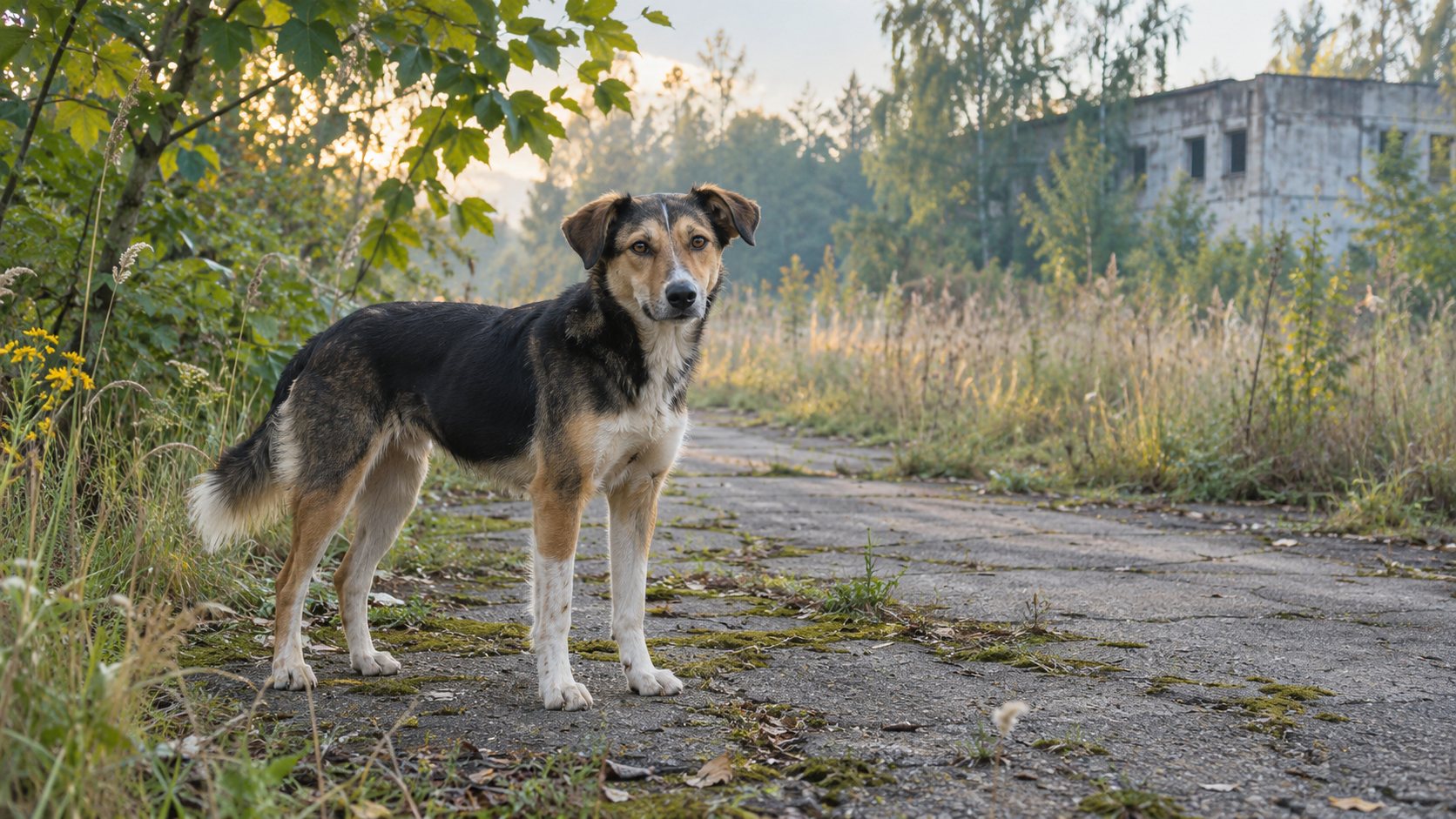
Dogs living near the Chornobyl nuclear plant have genetic patterns that suggest selection has shaped their population differently from dogs in the nearby city. That is the finding of a paper published September 27, 2026. The researchers have not shown that the dogs can withstand radiation or identified which environmental pressure produced those patterns.
The location makes the finding easy to overread. The 1986 accident released radioactive material, and that history draws attention to animals living in the exclusion zone. Yet their genomes alone cannot separate radiation from all the other conditions these populations have faced. Food, human contact, breeding patterns and the history of each group also matter when scientists try to explain the differences.
What the researchers compared
The paper, published in the journal Genes on September 27, used genomes previously obtained from 106 dogs sampled in 2018 and 2019. Fifty-eight were from near the plant and 48 from the city. After the researchers filtered close relatives and dogs that grouped genetically with the opposite population, the main comparison included 63 dogs: 33 from the plant area and 30 from the city. That narrower set is the basis for the principal analyses, so “106 dogs were studied” should not be read as “106 unrelated dogs entered every test.”
The researchers examined millions of positions in the dogs’ genomes and looked for patterns that stood out between the two groups. They identified candidate regions with signals consistent with selection. Some of the nearby genes have biological functions that make them interesting to investigate. None of that shows that those genes made a dog healthier, better able to repair DNA, or more likely to survive in the exclusion zone.
The signals offer clues about how particular genetic variants may have become more common in one group. They do not identify the historical event that changed those frequencies. Several analyses in the paper favored selection over genetic drift alone, the changes that can happen through chance. That supports further investigation of selection without establishing a single environmental cause.
How selection differs from mutation
Earlier work from the same research program asked whether increased mutation accumulation explained the differences between sampled dogs near the plant and those in the city. Its 2024 paper did not find evidence that an elevated mutation rate was the explanation. That is narrower than saying the dogs have no mutations or that radiation has had no biological effects.
A mutation introduces genetic variation. Selection can change how common existing variants become over generations. Researchers can examine both processes without treating them as mutually exclusive. In an NC State University account of the new paper, a researcher discussed the possibility that some variants were already present in dogs that initially survived. That is a hypothesis about a past the team cannot reconstruct from these samples, not a measured survival advantage.
The samples cannot show what happened to these populations year by year after 1986. They were collected decades after the accident, with no continuous genetic record of the intervening generations. The study can describe the patterns found in those samples and test explanations for them. Calling a candidate region a “radiation resistance gene” would require evidence about exposure and a corresponding trait that this work does not provide.
Why the groups may differ
The city and plant-area populations live in different places and have different population histories. Earlier research found that they are genetically distinct, which is part of why the newer comparison is possible. A distinct population, however, is not automatically a population adapted to a particular hazard. Its members could differ because of ancestry, migration, drift, selection, or some combination of those processes.
The new paper reports many candidate signals. It found 1,574 unusual positions among more than 4.8 million examined, spread across regions of the genome. The number of positions is not the number of proven helpful genes. The team identified 130 regions, with 111 supported by at least three additional measures in its analysis. Those results give other researchers places to look and questions to test; they are not a catalogue of traits the dogs have been shown to possess.
A gene near a candidate region may have a known role in a biological pathway, based on other research. That gives scientists a useful question to test. It does not show how the pathway works in these dogs or which environmental pressure, if any, favored the variant. To investigate that, researchers would need to connect the genetic candidates with measured traits and exposures.
To judge whether selection helps explain the differences, the researchers compared patterns across many parts of the genome. A variant common near the plant but uncommon in the city could reflect selection, but relatedness and the populations' underlying genetic structure can complicate that comparison. Removing close relatives and seeking agreement among several methods helps address those alternatives. It cannot remove every uncertainty about populations whose earlier generations were never sampled.
That also explains why a simple comparison with the 1986 accident is difficult. The dogs sampled in 2018 and 2019 are descendants of earlier animals, and the researchers do not have a matched set of genomes from before the accident. They cannot show that a particular variant began to rise at a known date. Nor can they assign its rise to radiation by pointing only to the location on a map. A useful follow-up would measure the dogs' environments and traits alongside their genomes, with careful attention to how the populations mix.
The institutional account draws a comparison between the city group and dogs from elsewhere to help describe the population structure. That comparison should not be mistaken for a claim of direct ancestry from a distant group or proof of a remarkable trait. Genetic similarity depends on the samples and measures used. In this work, the plant and city dogs are the central comparison.
The numbers describe different parts of the work. The 106 genomes were the starting material available to the paper; the 63 dogs remained after filtering for the principal comparison. The 130 candidate regions are parts of the genome, not a count of dogs or proven beneficial genes. None of these figures measures how many animals survived because of a particular variant.
What these findings mean for dogs
There is no advice here to expose a dog to radiation, and no evidence that the Chornobyl dogs are immune to its risks. The study is about a free-breeding population living under unusual conditions. Its value is in the questions it sharpens: how do nearby animal populations become genetically different, and which forces leave detectable patterns?
The questions are worth pursuing without giving the dogs abilities the study has not demonstrated. Their genetic differences offer a way to investigate how nearby populations develop distinct patterns over time. Establishing what drove those differences, and whether any candidate variant affects a dog's health or survival, will take more work. For now, the findings are clues to a complex population history.
Sources and further reading
- Dillon and colleagues, “Evidence of Selective Response in the Free-Breeding Dog Population in Chornobyl,” Genes, September 27, 2026
- NC State University, “Chornobyl Dog Population Shows Genetic Signatures of Directional Selection,” October 28, 2026
- Dillon and colleagues, “Is increased mutation driving genetic diversity in dogs within the Chornobyl exclusion zone?” PLOS ONE, December 27, 2024
- Spatola and colleagues, “The dogs of Chernobyl,” Science Advances, 2023