Dogs sleep at different amounts by age and routine. Learn what research and veterinary guidance can—and cannot—tell you about changes in your dog’s rest.
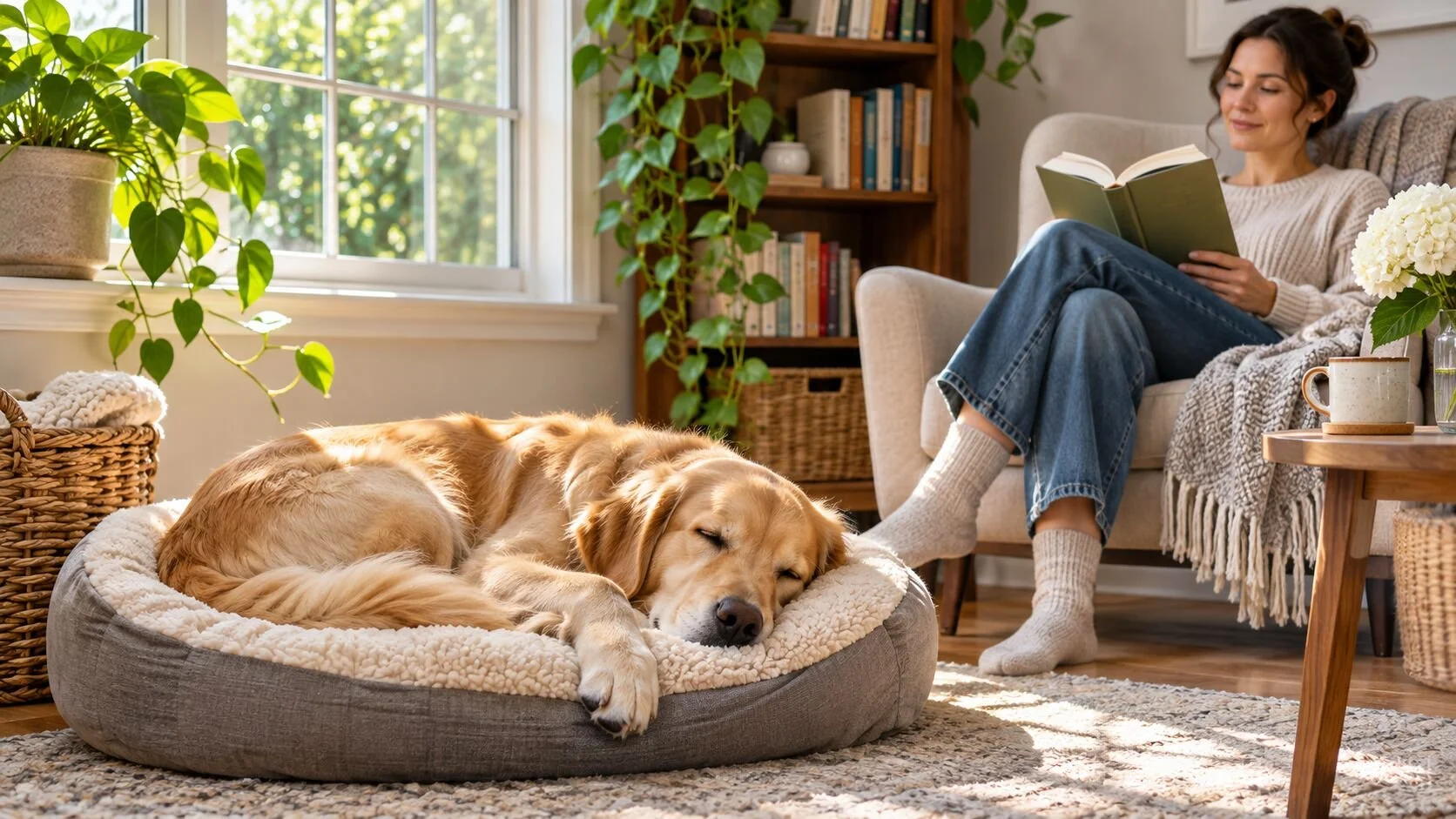
Your dog falls asleep after breakfast, lifts an ear at the door, then dozes off again. Later, they settle for the night. How much of that time would you count as sleep? It’s harder to say than it sounds. A dog can be asleep, resting quietly or simply someplace you can’t see. That’s worth remembering the next time you read how many hours a dog is supposed to sleep.
There isn’t one number that can tell you whether your dog is healthy. Age, activity, household routine and the way someone counts sleep all matter. What you know about your dog on an ordinary day gives you a better starting point: when they settle, what gets them up and how they act when awake. If that pattern changes, look at what else has changed before deciding what the hours mean.
Why the familiar numbers do not match
PetMD’s veterinarian-reviewed guide puts sleep at about 12 to 16 hours a day for most dogs. PDSA, a veterinary charity, gives a separate estimate of 14 to 16 hours or more for most dogs and recognizes that individual dogs vary. Those are two broad descriptions, not two measurements of the same dog. Averaging them won’t give you a more accurate target for your dog’s breed or age.
Some guides divide an adult dog's sleep into night hours and daytime naps. That can help an owner picture a day broken into bouts, but it is not a prescription for how long a particular dog must lie down at each time. Dogs may live with different household schedules and still have room for rest. The numbers are a starting point for a conversation, not a pass-or-fail test.
Even the word “sleep” can mean different things depending on who’s counting. From across the room, you might not know whether a dog curled up on a rug is asleep. If you’re at work, you might miss most of their afternoon naps. And a wearable can detect movement without showing whether the dog is in a particular sleep stage. Before borrowing a number from a study, check how the researchers got it and which dogs they studied.
What a puppy study actually measured
The Generation Pup research program asked owners about dogs at 16 weeks and at 12 months. In the 2020 analysis by Kinsman and colleagues, owner-reported 24-hour means were 11.2 hours at 16 weeks and 10.8 hours at 12 months. The younger puppies were reported to sleep more during the day and across the whole day, but less at night, than the 12-month-old group. Those are observations in a cohort, not a daily target.
What if you’ve seen a much higher number in a puppy guide? That doesn’t mean the puppies in the study were all short on sleep. The researchers asked owners to report what they saw at two specific ages. A guide may be giving a broad estimate for a much wider group. The numbers have different jobs. Neither can diagnose a problem in your puppy from one day’s total.
The study's participants and response counts vary between questions. The authors reported sleep-question responses for thousands at the younger age and fewer at 12 months. We do not turn a percentage from one table into a statement about every dog in the study. More importantly, the study did not randomly sample all puppies living in every kind of household. Its value is in a documented age comparison with stated methods and limits.
Puppies often take breaks between bursts of activity. Make room for those breaks and pay attention to what your puppy does after waking. A puppy who gets up to eat, explore and play as usual is a different situation from one who’s unusually hard to engage or shows other signs of illness. Don’t try to make the puppy hit the 11.2-hour study average or a higher number from a guide. If the puppy’s behavior changes, ask your veterinarian about what you’re seeing.
Sleep comes in episodes
A small 1993 observational study by Adams and Johnson followed 24 domestic dogs in urban settings during the night. It documented repeated sleep and wake periods rather than one solid stretch. Video records were available for 18 dogs. That work supports a simple point: night waking can be part of ordinary canine sleep organization. It does not tell us the total daily hours a modern household dog needs.
Those dogs were observed at night, in their own settings and for limited stretches. You can’t use the study to predict how often your dog will wake or to identify sleep stages from a pet camera. If your dog shifts position or lifts their head at a noise and then settles, that single moment doesn’t tell you there’s a sleep disorder.
Owners can also mistake quiet rest for sleep. A dog lying with its eyes partly closed may be relaxed but awake. That distinction is not something a household must measure precisely to provide good care. It is a reminder to avoid treating a home estimate as a clinical test. If your dog seems rested and acts normally, the calendar of naps can be flexible. If the pattern changes alongside other symptoms, those symptoms deserve attention.
Senior dogs require a different question
If an older dog who used to sleep through the night starts wandering after bedtime, it’s worth asking why. Age alone doesn’t explain a new pattern. Pain, breathing trouble, a change at home or another medical problem can affect rest. Cornell lists nighttime wandering and more daytime sleeping as possible signs of canine cognitive dysfunction. Other conditions can look similar, so take the change to your veterinarian rather than assuming it’s dementia.
A 2023 study by Mondino and colleagues examined a short daytime sleep opportunity in 28 senior dogs. In that setting, poorer cognitive performance and higher dementia scores were associated with less time in certain measured sleep stages. It was not a 24-hour home study and it did not establish that less sleep causes cognitive decline. It cannot give an owner a senior-dog daily hour target or diagnose a pet from the length of a nap.
The contrast between a brief measured nap and the full day matters. Sleep-stage findings need equipment and analysis that an owner does not have from casual observation. A pet camera may show that the dog moved around at night, but it does not reveal what the sleep-stage study measured. Tell the veterinarian what you saw rather than translating it into a laboratory conclusion.
When to call about a change
Look at how your dog acts when awake, not just how long they’ve been lying down. If your dog is sleeping more than usual and has lost interest in play or familiar activities, contact the veterinary team promptly. Merck lists the combination of increased sleep and unwillingness to play in its within-24-hours category. That’s guidance for those signs, not a reason to wait if something more serious is happening.
If your dog is struggling to breathe, collapses, loses consciousness or is extremely lethargic, get veterinary help immediately. Cornell directs owners to emergency care for breathing distress, and Merck distinguishes severe emergency signs from changes that can be assessed less urgently. Don’t spend time making a sleep diary or repeatedly trying to wake an unresponsive dog. Seek help now instead of trying to decide whether the number of hours is normal.
For a change that is not an emergency, call your veterinary team and describe the onset, the pattern you noticed and any other changes. Is the dog sleeping at a new time, waking often, avoiding usual activity, eating differently or appearing uncomfortable? Say what you know and what you could not see. The team can decide how soon to examine the dog and whether the sleep pattern is part of a broader problem.
A single restless night may follow an obvious change in routine. That does not prove the cause, and repeated nights or daytime changes deserve a closer look. Avoid deciding that a dog has anxiety, pain or cognitive dysfunction from sleep alone. Those are possible topics for a clinical conversation, not labels to apply from a clock or an app.
Making a useful observation
If the change is new or keeps happening, jot down the date and roughly when you saw your dog sleeping or awake. Add anything else worth mentioning: a skipped walk, a cough, panting, vomiting, a new medicine or a change at home. Write down what actually happened rather than trying to reconstruct every minute. The point is to make the veterinary conversation easier, not to run a sleep study in your living room.
If other people care for the dog, ask whether they have noticed the same change. A person at home during the day may see naps that a person at work misses. A short account from each observer can be more useful than a single total assembled from guesses. Share the timing and limits with the veterinarian; do not present the result as a validated measurement.
A video can sometimes show nighttime pacing or breathing that is hard to describe, provided making it does not delay care. It cannot establish a sleep-stage diagnosis. If breathing seems labored, seek help rather than trying for better footage. The question for the clinician is what the dog was doing and whether there were other signs, not whether you can prove an exact sleep duration.
A comfortable place to rest
Many dogs benefit from a quiet, comfortable place where they can lie down without constant interruption. PDSA advises making rest possible as part of a dog's welfare. The household can offer a space that suits the dog and allow it to settle, while still meeting its needs for exercise, social contact and care. That is an environment choice, not a guaranteed treatment for a medical sleep problem.
Think about whether anything at home changed around the same time. Maybe there’s more noise, company is staying over or the dog’s bed moved. It’s reasonable to make the resting spot quieter or more familiar, but don’t give the environment all the credit or blame. If the dog still can’t get comfortable, wakes repeatedly or loses interest in daytime activities, tell the veterinarian.
Avoid enforcing a universal crate schedule or fixed nap hours because of an online chart. The right arrangement depends on the dog and the household, and confinement should not be used to make a dog satisfy an estimated number. If the dog resists the sleeping space or appears distressed, discuss the behavior with a qualified professional rather than escalating pressure.
What numbers can and cannot do
The 12-to-16 and 14-to-16-or-more figures are broad guidance, not competing tests that one dog must pass. The Generation Pup means describe owner reports at two young ages. The small night observation describes bouts. The senior study links specific sleep-stage measures with cognition during a daytime session. Each source provides a different lens, and none authorizes a breed-specific hourly prescription or a diagnosis from one day of rest.
A dog below one quoted estimate may be functioning well, while a dog within an estimate may still be ill. The baseline, the direction of change and accompanying signs are more useful for deciding whether to call. A dog that suddenly sleeps much longer and declines normal activity deserves attention even if the new total fits a popular chart. Conversely, a routine full of short naps need not be treated as a problem simply because it does not resemble a human night.
When a number appears online, ask where it came from. Was it measured with a clinical tool, estimated by owners, observed during one part of the day or offered as general veterinary guidance? How old were the dogs? Was the study about healthy dogs, dogs with symptoms or a specific setting? Those questions help prevent a number from becoming an unsupported rule.
If your dog has a known condition or is taking medicine, ask your own veterinarian how that changes what to watch for. Do not change prescribed care to pursue a sleep target. The clinician can interpret a new pattern in the context of the dog's history. Your observations are valuable precisely because you know how the dog normally behaves.
Three examples of better questions
Say your young dog falls asleep after play, gets up for dinner and goes back to napping later. You might not know if the total was eleven hours or sixteen. It’s more useful to ask whether the dog is acting differently from usual and has a comfortable place to rest. The difference between those two estimates doesn’t give you a health answer by itself.
An older dog begins pacing at night and sleeping through familiar daytime activities. The owner can report when the change began, whether it is recurring and what else is different. Cornell's discussion of cognitive dysfunction may be one reason the veterinarian asks further questions, but the owner should not assume that diagnosis. Pain, illness and other causes still need assessment.
A dog appears to sleep much more after a day that also included poor appetite and refusal to play. The owner should call promptly rather than reassuring themselves with a chart. If the dog also struggles to breathe, collapses or becomes unresponsive, the question is no longer about a normal hour range: seek emergency veterinary help immediately.
One problem with sleep trackers is that they may turn an uncertain observation into a precise-looking score. If you use one, ask what the device actually records. Movement is not the same thing as a direct measurement of sleep stages, and a quiet dog may still be awake. Keep the app's number in its proper role: a possible clue about a pattern worth discussing, not a verdict about your dog's health. A veterinarian can consider a trend alongside the dog's history and examination.
Think about who is supplying the baseline. An owner may remember a dog as “always asleep” because the dog rests whenever the household is quiet. A dog walker may see a lively hour each afternoon, while a camera shows another pattern overnight. None of those views is necessarily false; each covers a different slice of the day. A few dated observations are clearer than a confident but unexamined estimate.
It is also possible for a dog to have a changed schedule without a changed total. A dog who sleeps more in the day because it is pacing at night may seem to meet a daily hour estimate while still having a concern worth discussing. This is particularly relevant when an older dog changes behavior in several ways. Tell the veterinarian about the timing, not just the sum. Similarly, a dog who appears restless during one unusual holiday visit may settle when the household routine returns. If the change persists or other signs appear, a call is still appropriate.
Before making a care decision, separate two questions. “How much did my dog sleep?” can be hard to answer from observation. “Is my dog behaving differently, and are there other concerning signs?” is usually more actionable. The distinction protects owners from false reassurance when a sick dog happens to fall within a popular range and from needless alarm when an otherwise well dog naps on a different timetable.
Give your dog room to rest. Use published sleep numbers to understand how researchers and veterinarians describe dogs, not to grade your own. If a familiar pattern changes, pay attention to what happens when your dog wakes and what else you notice. Tell the veterinary team what’s different, and let the urgency of the signs, especially any breathing trouble, guide how quickly you get help.
Sources
Kinsman et al. 2020 Generation Pup original study: https://pmc.ncbi.nlm.nih.gov/articles/PMC7401528/
Adams and Johnson 1993 publisher abstract: https://www.sciencedirect.com/science/article/pii/016815919390013F
Mondino et al. 2023 original study: https://www.frontiersin.org/journals/veterinary-science/articles/10.3389/fvets.2023.1151266/full
Merck Veterinary Manual triage table: https://www.merckvetmanual.com/multimedia/table/when-to-see-a-veterinarian
Merck Veterinary Manual emergency guide: https://www.merckvetmanual.com/special-pet-topics/emergencies/evaluation-and-initial-treatment-of-dog-and-cat-emergencies
Cornell cognitive dysfunction: https://www.vet.cornell.edu/departments-centers-and-institutes/riney-canine-health-center/canine-health-topics/cognitive-dysfunction-syndrome
Cornell respiratory distress: https://www.vet.cornell.edu/departments-centers-and-institutes/riney-canine-health-center/canine-health-topics/recognizing-and-responding-canine-respiratory-distress
PetMD consumer estimate: https://www.petmd.com/dog/general-health/how-many-hours-does-dog-sleep-day
PDSA consumer estimate: https://www.pdsa.org.uk/what-we-do/blog/dogs-and-sleep-our-top-tips-for-your-furry-friend
More stories
 Daily Doggy NewsPreparing Your Dog for a Holiday Boarding Stay
 Daily Doggy NewsThanksgiving Visitors and Dogs: A Practical Safety Plan
 Latest Daily Doggy NewsThanksgiving Dog-Proofing Check
 Canine JournalKennel Cough: What Dog Owners Should Know
 Tyson’s LifeThe Boss Has Four Legs
 It MattersShould Ear Cropping Still Be Legal?