A dog does not have to greet every Thanksgiving guest. Plan a quiet retreat, let the dog choose contact, and give adults clear supervision roles.
Key Takeaways
- A dog does not have to greet every Thanksgiving guest. A quiet separate space can be the safest and kindest plan.
- Ask the dog's person before approaching or touching. Watch the whole body, not a wagging tail alone.
- Give children and dogs active adult supervision and an undisturbed place to rest. Never leave a young child alone with a dog.
- If a dog turns away, freezes, stiffens, growls, or tries to leave, stop the interaction and give space. Do not punish the warning.
- Plan the greeting rules before the door opens. If a dog has a history of fear or aggression, work with a veterinarian or qualified behavior professional.
Picture the first five minutes of Thanksgiving: the bell rings, somebody puts down a casserole, and a guest bends over to hug the dog just as the dog backs away. The guest may mean well. The dog may still want nothing to do with that hello. The good news is that the host can settle the question before the bell rings. The dog doesn't have to greet anyone.
The ASPCA's bite-prevention guidance asks people to pay attention to canine body language and respect a dog's reluctance to be touched. Its holiday guidance also recommends a quiet retreat for pets that find visitors stressful. Neither step can guarantee a bite won't happen. They do give the dog a way out and give your guests a rule they can actually follow.
Make the plan before anyone knocks
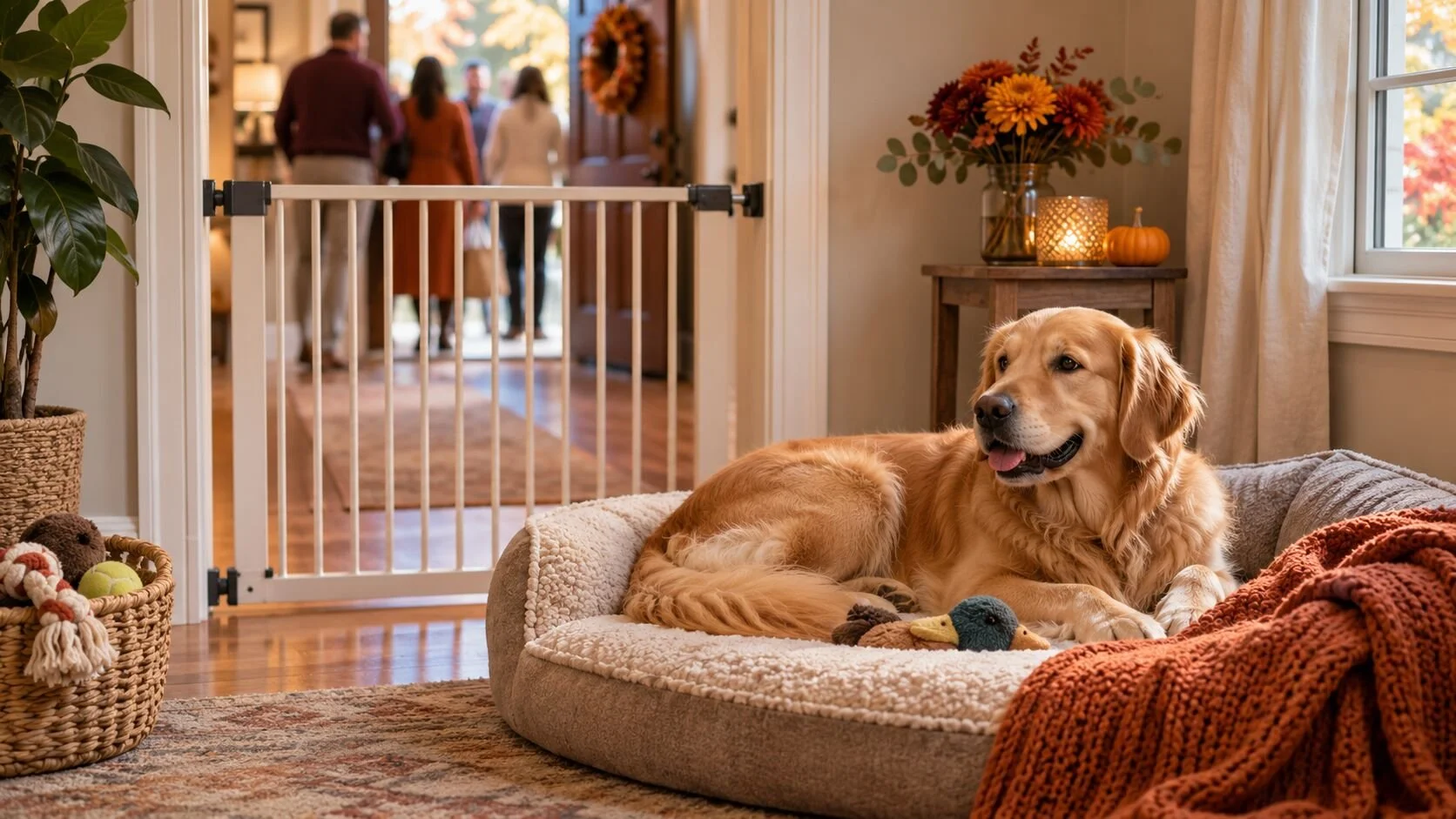
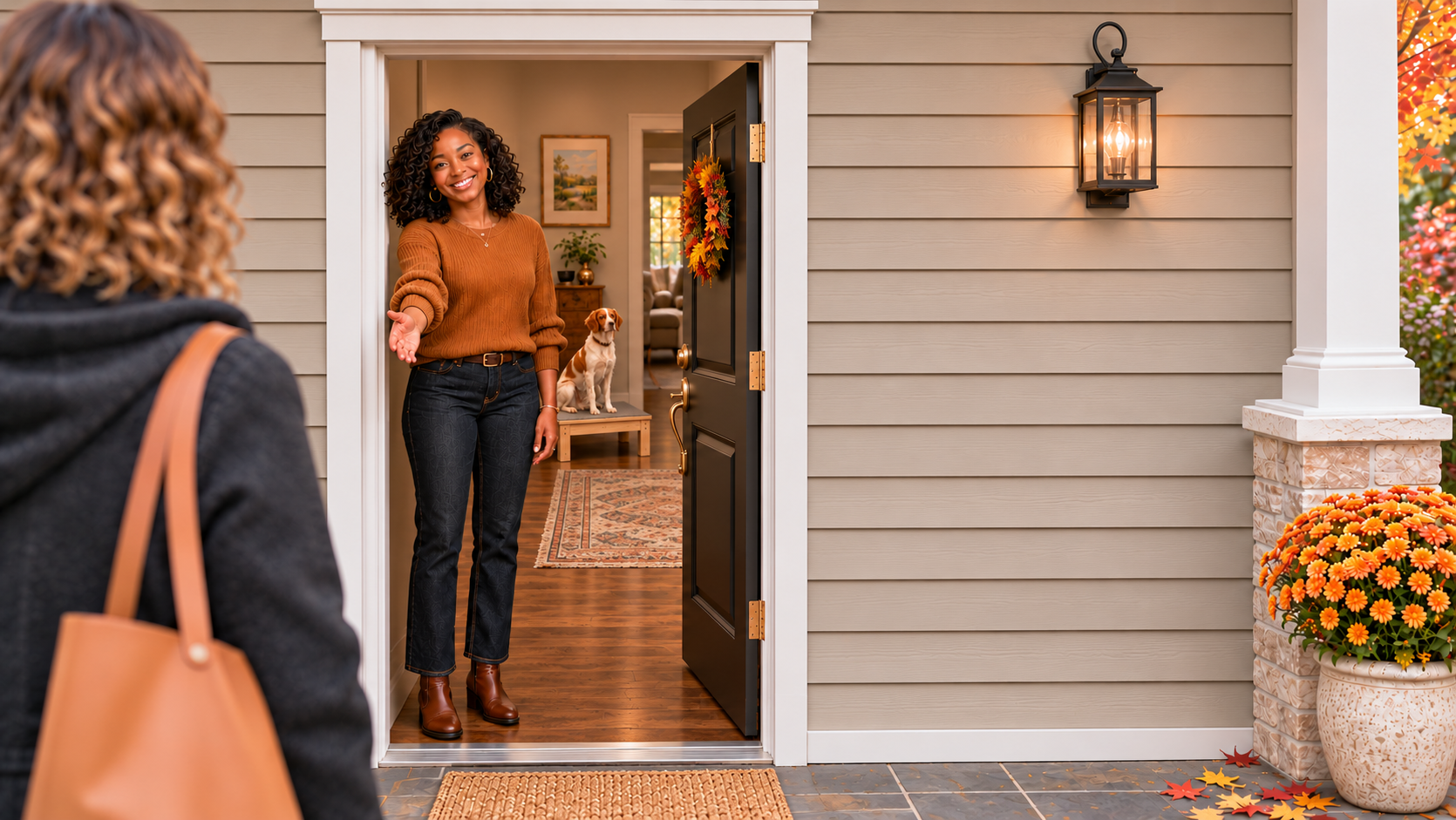
The doorway is where plans fall apart. Decide who's watching the dog, where the dog can rest, and whether introductions make sense at all. Even a dog who knows most of your guests may be uneasy when several of them arrive together. Starting in a quiet room and checking in later, privately, gives the dog a break from the rush.
Put water and a familiar bed where the dog can use them without an audience. Keep meals, walks, and toilet breaks as close to normal as you can. Pick a spot people won't have to walk past constantly or where they can stand and stare through a gate. The retreat isn't a time-out. If your dog is comfortable there and wants to stay, skipping the introductions altogether is fine.
Tell guests what they need to know: “The dog’s taking a break while everyone arrives.” There’s no need to tell the dog's whole history. Put one adult in charge of doors, gates, and where the dog is, so that neither the person cooking nor the person greeting visitors assumes somebody else is watching. A note on the door helps people remember; it can't do the adult's job.
A guest can ask. The dog can still walk away.
When somebody asks, “Can I say hello?”, look at your dog before you answer. The guest’s good intentions don't tell you whether the dog wants company. The ASPCA says to ask the dog's person before petting an unfamiliar dog. Permission from the person is the first step, not an order for the dog to accept contact. If the dog is avoiding the interaction, the answer can be no or not now.
Let a dog approach voluntarily if an introduction is appropriate. Do not drag the dog toward a visitor or hold them still for contact. A dog that sniffs and then walks away has made a choice. Respect it. A dog that remains near someone may still be deciding what to do. Avoid reaching over the head or leaning into the dog's face. The ASPCA advises that, when permission is given and the dog is comfortable, a person can allow the dog to investigate a closed hand and then pet the shoulder or chest rather than the top of the head. Any sign of discomfort means stop.
Some dogs enjoy a brief hello and then need a break. Other dogs never want a greeting during a noisy party. Neither situation is a failure of training or hospitality. The host can welcome guests without making the dog an attraction. A rule that allows the dog to leave at any point is easier to enforce than a rule that expects a long, polite interaction.
Look past the wagging tail
A wagging tail does not, by itself, say a dog wants to be touched. The ASPCA warns that a wagging tail can appear with other signs of fear, anxiety, or aggression. Look at the whole dog and the situation. A loose body and an easy ability to move away give different information from a stiff stance, hard stare, or dog cornered against furniture.
The ASPCA lists signs of anxiety or fear that can include shrinking down, lowering the head, lip licking, a tucked tail, ears flattened back, yawning, looking away, freezing, or trying to move away. It also describes signs that may indicate aggression, such as stiff posture, staring, baring teeth, growling, lunging, and barking. These signs are not a home diagnostic test, and a dog can show a mixture of signals. The practical response to discomfort is to give space and end the interaction.
Do not demand that a dog “prove” friendliness by tolerating another reach. If the dog freezes, pulls away, or growls, separate people and dog calmly. A growl is useful information that the dog is uncomfortable; suppressing the warning does not make the underlying situation safe. If you have ongoing concerns or a dog has shown aggression, seek professional help before putting the dog in another crowded situation. The ASPCA recommends a veterinary behaviorist, Certified Applied Animal Behaviorist, or qualified trainer for behavior concerns.
Give children a rule they can follow
Children may move quickly, hug tightly, or miss the signals that adults are trying to read. The ASPCA says to supervise children and dogs and never leave a baby or young child alone with a dog. A host should not translate “the dog is good with kids” into unsupervised access during a gathering. Even a familiar dog may be tired, guarding a rest spot, or unsettled by the day's changes.
Give children concrete instructions before they see the dog: ask an adult first, do not chase the dog, leave the dog alone when resting or eating, and let the dog walk away. An adult should actively watch and intervene, not supervise from another room while cooking. If many children are visiting or the host cannot give that attention, separation is a sound choice. It is easier to prevent an unwanted encounter than to manage it after a dog is cornered.
Adults can model the behavior they want children to copy. Do not coax a dog out of a quiet room for a photo or hold them for a child's hug. A child may be disappointed that the dog is unavailable. That is an ordinary boundary to explain, much like asking a child not to enter a closed room. The dog's rest is a responsibility of the adults, not a decision to leave to the child.
Make the quiet room off-limits to guests
A quiet room or other safe space matters only if guests respect it. Let the dog rest without repeated checks, taps on the door, or visitors entering to “see if they're ready.” The ASPCA advises providing a quiet place for pets around holiday visitors, and its bite prevention guidance stresses opportunities for dogs to rest. The location should fit the dog: some settle behind a closed door, while others do better with a familiar barrier and an adult nearby. Observe the dog's response and use the arrangement that keeps them comfortable.
The dog may need an ordinary walk or bathroom break during the gathering. Plan a route that avoids a crowd at the entrance. An adult can check the room and move the dog with care, instead of opening the door into a group of waiting guests. If the dog returns to the gathering after a break, the same greeting rules still apply. A second appearance is not an open invitation for everyone to touch them.
Rest also means leaving a sleeping dog alone. A visitor who reaches into a bed or startles a dog awake may create an avoidable problem. A separate area helps give the dog control over how much stimulation they receive. When the host is busy, this management plan may be more reliable than trying to interpret every interaction in a crowded room.
Don't wait for a growl
If the dog's body goes stiff or they start looking for a way out, pause the greeting. Ask people to back up. Moving the guests can be easier and safer than asking an uneasy dog to push through a crowd. If a child is involved, an adult should take over immediately. The dog does not owe another chance to “get used to” a touch. A calm interruption can end the encounter before everybody is more excited.
If a dog barks at arrivals, that does not necessarily mean the dog wants to meet them. It may be a response to the door, noise, or uncertainty. Avoid making the event louder by shouting at the dog or sending several people to approach. Use the plan you made before the doorbell: move guests inside, keep an exit clear for the dog, and settle the dog in the quiet area if needed.
A dog who has bitten or threatened to bite needs a more careful plan than a general article can provide. Do not use a holiday gathering as a training experiment. Speak with the dog's veterinarian and an appropriately qualified behavior professional about safe management. The ASPCA advises seeking professional help at the first sign of aggression, even without an injury. Qualified guidance should be tailored to the dog's history and the household's circumstances.
Think about the route to the water bowl
Watch the traffic as the meal gets going. One person carries a hot dish, another pulls out a chair, and suddenly the path your dog normally takes to the water bowl leads straight through a crowd. A dog may be approached while holding a chew, waiting for food, or trying to leave a crowded kitchen. Plan the dog's area and traffic path so people do not repeatedly squeeze past or reach over them.
This article focuses on interactions, while food hazards deserve their own safety planning. A guest who wants to offer a treat should ask the host; the host may say no. The same clear rule prevents a well-intended guest from using food to lure a reluctant dog into contact. Let the dog have access to their usual water and routine without making social contact the price of moving through the home.
Visitors who arrive or leave at different times can make the doorbell a repeated event. Ask one person to manage the entrance and keep the dog's location in mind. If the dog is resting in another room, check that guests know the room is off limits. A calm plan can accommodate late arrivals without restarting introductions each time.
What to say when you need to say no
You may feel rude closing a door on a guest who wants to meet the dog. But a clear, kind boundary beats letting that person keep reaching for a dog trying to get away. “He is resting today” or “Please let her come to you” tells guests exactly what to do. Most visitors can enjoy the meal without touching the dog. A guest who loves dogs may be especially eager to help once the rule is clear.
The host also deserves a manageable evening. Constantly monitoring whether people are reaching for the dog can pull attention away from cooking and conversation. Setting the rules ahead of time and using a separate space when needed reduces that burden. This does not require a claim that the dog is dangerous. It recognizes that a dog is a participant in the household whose comfort matters.
If a guest ignores the rule, repeat it and change the setup. Do not put the burden on the dog to keep moving away from an insistent person. The adult who controls the space can end the interaction. If the dog has chosen to retreat, let the retreat be final for now. Protecting that choice is part of responsible hosting.
“But the dog likes me”
Familiarity does not cancel the dog's choice in the moment. A dog may normally greet a relative and still be unwilling during a crowded meal. Ask the relative to watch the dog's body and allow distance. If the dog takes a few steps away, do not call them back for a second try. A person may interpret a previous friendly encounter as permission for today's hug, but behavior in one setting does not guarantee comfort in another. The host can make the decision without debating whether the dog “really” likes the visitor.
The same rule applies to a guest who sits quietly and waits. Waiting can be helpful, but it does not create an obligation for the dog to approach. A dog may simply pass through the room on the way to water or a bed. Let that movement remain ordinary. If the dog chooses contact and seems comfortable, keep it brief and give them an easy exit. If they do not choose contact, the visit can still go well.
Some guests will look to the dog owner for reassurance after the dog growls. The safest answer is to end the encounter and create space, not to explain the sound away. AVMA's bite-prevention guidance treats growling, snapping, or biting as a signal that the dog wants to be left alone at that moment. ASPCA's guidance on dogs and children cautions against verbal or physical punishment of an aggressive dog. The immediate job for the adult is to keep people safe and let the dog leave. A qualified professional can help address recurring behavior later.
A quieter room is not a guarantee
A quiet room, a prepared greeting rule, and attentive adults reduce avoidable pressure, but they cannot guarantee that a bite will never happen. ASPCA says responsible ownership and education can significantly reduce risk while acknowledging that no owner can guarantee a dog will never bite. That distinction matters in holiday advice. A checklist can support judgment; it cannot substitute for knowing the individual dog or seeking tailored professional help when there has been aggression.
A dog may also show less obvious discomfort than the examples in a guide. ASPCA notes that body signals can be mixed and that a fearful dog may freeze or try to move away. Do not wait for a growl before making room. The earliest withdrawal may be the easiest point to intervene. If a dog is frequently uneasy with visitors, a veterinarian can consider pain or other medical factors, and an appropriate behavior professional can help design a plan outside the pressure of a holiday gathering.
Keep the plan through the last goodbye
The day may become quieter after the meal, but the dog may also be tired. Reassess instead of assuming the earlier stress has passed. If the dog is resting, leave them there. If they voluntarily rejoin the room, keep greetings optional and brief. A calm return is not proof that every guest may pet them.
Before guests leave, make sure doors and gates are managed. A dog who has spent the evening in a quiet room may suddenly encounter a crowded hallway during farewells. The same designated adult can supervise the transition. Return the dog to their usual routine when the gathering ends, and note if behavior or sleep is noticeably different afterward.
Give guests a warm welcome. Give the dog a way to leave. If a dog chooses the quiet room over the company, that isn't a Thanksgiving mishap. It's the plan working: the dog had somewhere to go, the people knew to give them room, and everyone got to get on with the evening.
Sources
ASPCA, Hosting Holiday Guests? Keep Your Pets Happy and Healthy Around Visitors
More stories
 Daily Doggy NewsPreparing Your Dog for a Holiday Boarding Stay
 Daily Doggy NewsThanksgiving Visitors and Dogs: A Practical Safety Plan
 Daily Doggy NewsParvo Warning Signs for Puppy Owners
 Canine JournalKennel Cough: What Dog Owners Should Know
 Tyson’s LifeThe Boss Has Four Legs
 It MattersShould Ear Cropping Still Be Legal?