
A holiday dog should begin with a shared plan for daily care, costs and lifelong responsibility. Here’s how to make the decision together.

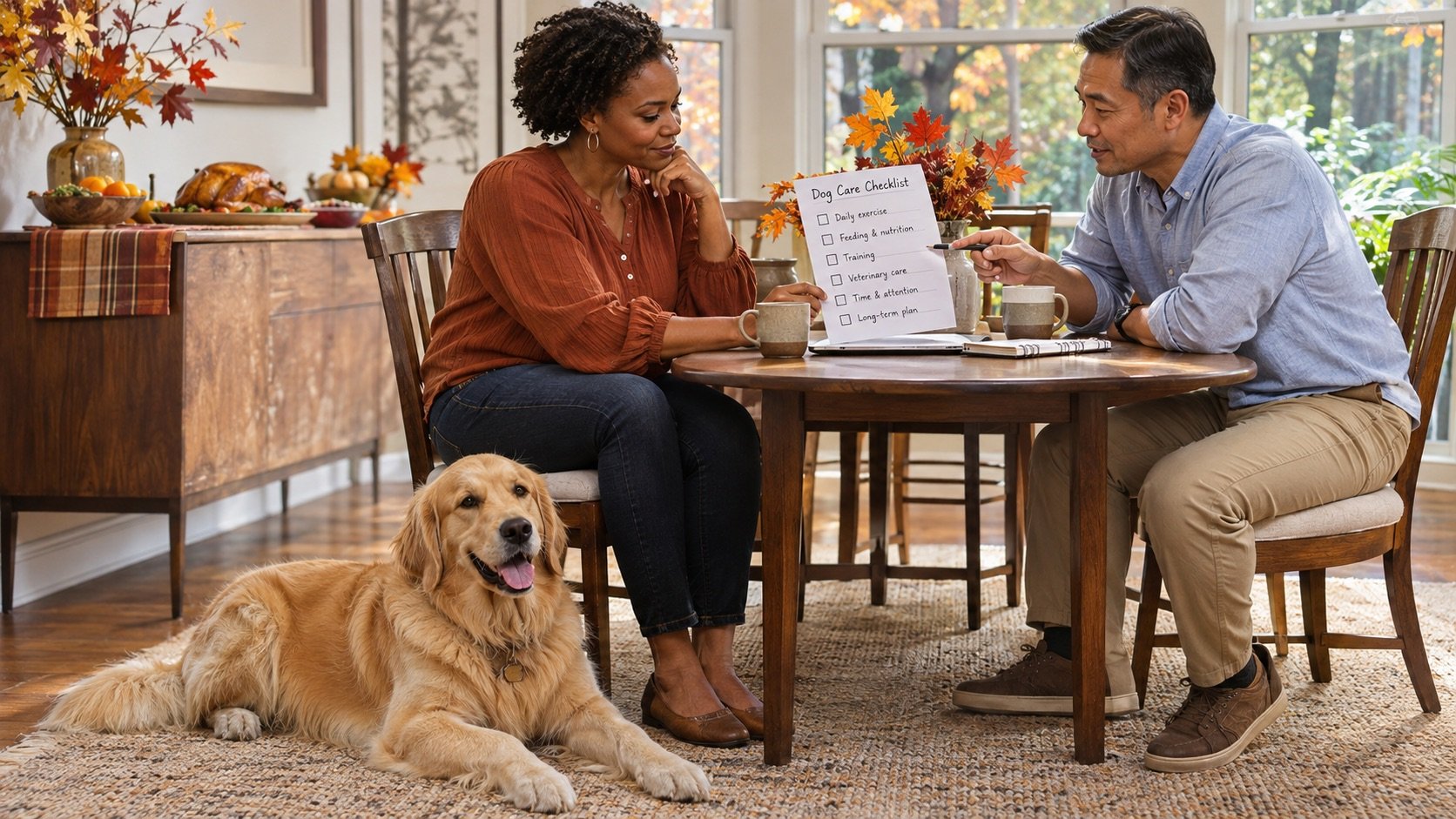
It’s easy to picture the moment: a bow, a surprised face and a puppy in somebody’s arms. It’s harder to picture who takes the puppy out before work three weeks later.
That ordinary morning is part of the gift, too. So are the vet visits, housetraining, exercise, supervision and decisions about where the dog can live. A family needs a plan for all of it before anybody buys a bow.
Some dogs given as gifts settle into homes that are glad to have them. The question is whether this person wants a dog, can care for one and has a say in choosing it. The holiday doesn’t answer any of those questions.
Key takeaways
A dog should not be acquired on impulse or because a gift date is approaching.
The ASPCA recommends giving a pet only when the recipient has shown sustained interest and can provide responsible care.
The AVMA advises families to avoid impulsive pet decisions, involve the household and choose a dog that fits the home and lifestyle.
Children can participate in care, but an adult must be ready to carry the responsibility.
An adoption promise, starter kit or planned shelter visit can preserve the spirit of the gift without choosing a living animal for someone else.
The holiday image is not the whole story
A puppy under a tree is an emotional image because it compresses a long relationship into one dramatic moment. The trouble is that the moment can crowd out the questions that matter.
Who will take the dog outside before work? Who will pay for veterinary care? Does the lease permit the dog? Is anyone in the home allergic? What happens when the family travels, the child loses interest or the dog grows larger and more energetic than expected?
The American Veterinary Medical Association tells prospective dog owners to avoid acquiring animals on impulse or as gifts, involve the family and consider whether the dog fits the household, schedule and living situation. Its guidance frames pet ownership as a promise to care for another living being for life.
That promise cannot be made honestly by the person holding the ribbon if the person receiving the dog has not had a meaningful voice.
What the ASPCA actually says about pets as gifts
The ASPCA’s position is not a blanket claim that gifted pets always fail. Its survey found that 96 percent of recipients said receiving a pet as a gift increased or did not change their attachment, and 86 percent of the pets were still in the home. The organization also says earlier studies found pets acquired as gifts were not more likely to be relinquished.
That’s a reason not to write off every gift adoption. Some recipients already wanted a dog and were ready for one. The date on which a dog arrives tells you much less than what the household discussed and prepared before that day.
The ASPCA still sets conditions. It recommends giving a pet only to someone who has expressed a sustained interest in owning one and has the ability to care for it responsibly. If the recipient is a child younger than twelve, the parents should be ready and eager to assume care. If the gift is a surprise, the giver should understand the recipient’s schedule, lifestyle, time and means well enough to judge whether responsible ownership is realistic.
The holidays add another complication: the recipient needs enough time to help a new animal adjust. A crowded house, travel, parties and changing routines can make that transition harder.
The lesson is not “never.” It is “do not confuse a successful surprise with an uninformed decision.”
A family decision needs more than enthusiasm
Wanting a dog matters, but it is only the beginning.
The AVMA asks families to consider daily care, housing restrictions, work schedules, other pets, future living changes, exercise needs, grooming, training and lifelong veterinary care. It also notes that puppies require extra time for housetraining, socialization, supervision and early medical care.
None of that makes adoption less exciting. It does give the family a chance to spot a mismatch before they bring a dog home and have to work it out under pressure.
A child may sincerely promise to feed and walk a puppy every day. Adults still need to assume that the promise may not survive school, activities, illness or adolescence. The dog cannot lose meals, exercise or medical care because a household chore chart stopped working.
The same applies when the recipient is an adult. A person may love dogs and still live in housing that prohibits one, work hours that make puppy care difficult, have an existing animal that needs a careful introduction or face costs they did not choose.
Someone can love dogs, want one someday and still be right to say they can’t take one home this month.
Let the recipient help choose the dog
Matching matters. A family may picture a small, quiet companion and meet a young dog who needs hours of activity and training. Another household may be prepared for a high-energy dog but not for intensive grooming or a breed-related medical risk.
The AVMA recommends choosing a dog suited to the family, home and lifestyle and involving everyone in the decision. Shelters and rescues can help explain a dog’s observed behavior and needs, while responsible breeders should provide health records and remain available when questions arise.
Participation also gives the recipient permission to say no, not now or not this dog. That answer may be disappointing for the gift-giver. It can be the responsible answer for the animal.
Nobody should feel they have to take a dog home just to show the person who bought it that they’re grateful.
Give the decision, not the dog
There are ways to make the moment special without choosing the animal in advance.
American Humane suggests an adoption kit instead of bringing a live animal into the holiday rush. The ASPCA has recommended a “Puppy Promise” or “Cat Commitment” that lets the family participate in the selection process after the celebration.
A thoughtful package could include a leash, collar, book on dog care, list of local shelters and rescues, or a written promise to cover an adoption fee or first veterinary visit. None of those items commits the recipient to a dog they have not met.
Then the family can check housing rules, discuss the budget, decide who is responsible for daily care, meet possible dogs and ask questions without racing a calendar.
You still get to give something real: a contribution, a trip together or a promise to help. The person who would be doing the daily care still gets to make the decision.
If the family is ready during the holidays
Some households have already discussed the decision, prepared the home and identified the right dog. A holiday adoption can still be responsible when the timing works for the dog and family.
Keep the first days quieter than the celebration. Set up a safe resting place, food and water, identification, a leash and a veterinary plan. Limit the parade of visitors. Use the food and routine recommended by the shelter, rescue, breeder or veterinarian before making abrupt changes.
Make sure everyone understands that the dog may be overwhelmed. A new pet is not entertainment for a room full of guests. Let the dog approach at a comfortable pace and provide space to rest.
The AVMA advises arranging a veterinary examination soon after bringing a new dog home and taking available vaccination, deworming and medical records to the visit. That appointment is part of the commitment, not an optional extra after the holiday spending is over.
A survey result is not a permission slip
The ASPCA survey is often used as a shortcut in arguments about holiday gifts. One side hears “gift” and assumes the animal will be surrendered. The other hears that many recipients reported attachment and assumes a surprise must be fine. Neither shortcut captures the organization’s position.
The 96 percent figure reports how surveyed recipients described their attachment: increased or unchanged. It does not mean 96 percent of all gift recipients were prepared before the dog arrived, nor does it measure whether every dog’s needs were met. The ASPCA reported that 86 percent of pets in that survey were still in the home. That is a survey observation, not a prediction for a new household. It is not a guarantee for the next family, the next puppy or a recipient whose circumstances the giver barely knows. The ASPCA’s conclusion is conditional: sustained interest and ability to care responsibly still matter.
That distinction is fair to people who have successfully welcomed a gifted dog. They need not defend themselves against a slogan that says every gift fails. It is also fair to the dog who would be arriving in an unprepared home. A statistic about other households cannot take the place of a conversation with this household. Good evidence can make a debate more honest without deciding a personal choice for everyone.
The adult plan cannot be a footnote
The most important question in a child’s puppy surprise may be one the child cannot answer: which adult will do the work when the child cannot? The AVMA says young people should be involved in care, but an adult must be willing, able and available to supervise it. The ASPCA makes that responsibility explicit for a gift to a child younger than twelve. A chore chart can be a useful teaching tool; it is not the dog’s backup plan.
Write down the adult’s responsibilities before you choose a dog. Who arranges veterinary visits and pays for treatment? Who takes the dog out on a school day when it is raining? Who takes over during travel, illness or a change in work hours? If the family is already exhausted by a busy season, ask whether they have enough time to help a new puppy settle and learn the household routine.
Those questions can produce a warm, enthusiastic yes. They can also produce “after the holidays” or “an adult dog would fit us better.” The AVMA notes that puppies need extra time for housetraining, socialization and supervision, while some adult dogs may already have skills that suit a family. There is no moral prize for choosing the youngest animal or making the fastest announcement. The decision should fit both the people and the dog.
A budget is part of the welcome
An adoption fee or purchase price is a beginning, not a full estimate. The AVMA lists food, preventive veterinary care, unexpected treatment, identification, training, grooming, boarding and supplies among the possible costs of living with a dog. Some will vary widely by place, dog and household. A single dollar figure wouldn’t do that decision justice. Start with the costs you can look up locally, then talk about who will cover care nobody planned for.
That is a reason to talk about costs before a surprise, especially if the person giving the dog will not pay them. A first veterinary visit is easier to schedule when someone knows who is responsible for it. So is a plan for care during a trip or an emergency absence. Giving a puppy without a discussion can transfer real expenses to a recipient who never agreed to them.
A gift-giver who wants to help can offer something concrete without deciding the animal’s future: pay an adoption fee after the recipient chooses, contribute to the first veterinary visit, or provide supplies after the shelter or veterinarian explains what the selected dog needs. Those offers can be written into a card. The recipient can then say yes, no or later without having to reject a living animal in front of an audience.
The budget discussion should also include time. A person with sufficient money may still be away from home for long hours or live in housing with a restriction. Someone with a modest budget may have a careful plan and community support. Neither case can be judged from the cost of a bow or the intensity of the holiday reaction.
The meeting belongs to the recipient
If the recipient wants a dog, let them meet possible dogs and ask their own questions. The AVMA advises choosing an animal that suits the household and says shelters, rescues and breeders should be able to discuss the dog’s observed needs and provide health information. A photo may be compelling, but it cannot tell a family how a dog handles their routine, other animals or a small living space.
A good meeting is not a test the dog must pass by performing on command. Ask what staff or caregivers have actually observed, what remains unknown, what care has already been provided and what support is available after placement. Ask about temperament, exercise needs, grooming and any known health concerns. If there is another animal at home, ask how to plan a careful introduction; do not assume two dogs will get along because both are friendly separately.
The recipient should be able to leave without choosing an animal that day. That is difficult when a child is holding a puppy and a camera is recording. It is easier when the family agreed in advance that the visit is for learning. American Humane recommends the adoption-kit approach precisely because it allows the trip and decision to happen after the pressure of the holiday moment.
A responsible source matters too. The ASPCA recommends shelters, rescues, trusted people and responsible breeders rather than an unknown or untrusted source. Ask for existing medical records and a way to contact the provider with questions. If those basics are unavailable, a holiday deadline is a poor reason to overlook the gap.
The first week is part of the decision
A family may be ready in principle but not ready on the busiest day of the year. American Humane cautions that holiday traffic, extra people, decorations and food can unsettle a new pet already adapting to a home. The ASPCA also says the recipient’s schedule should allow time for an easier transition. Those are animal-welfare considerations, not rules that every holiday adoption fails.
Imagine the first seven days rather than the first seven minutes. Where will the dog sleep and rest? What will the household do when guests come through the door? Who will give the dog predictable meals, walks and bathroom opportunities? When will the family bring the available medical records to a veterinarian? If there is a trip planned immediately after the celebration, who will be there for the animal’s adjustment?
A quiet beginning might be possible during a holiday break. For another household, the same week is full of travel and late nights. The calendar itself does not answer whether the family is ready; the plan does. Waiting until a calmer week can be an act of care even when everyone is eager to meet the dog.
The option to say “not now” protects the dog
We tend to treat a holiday gift as something a grateful person accepts. A dog needs a different social rule. The recipient should be free to decline, postpone or choose another animal without being cast as unkind. The family should be free to recognize a housing restriction, an allergy concern, a work schedule or an existing pet’s needs. The dog should not become a test of someone’s affection for the giver.
An invitation to adopt together leaves room for that honesty. It also lets the person who will perform daily care choose the timing and ask questions. If the answer is eventually yes, the adoption can become a family decision rather than a surprise someone has to manage. If the answer is no, the dog is spared an avoidable, rushed placement.
The evidence does not support a rigid claim that all gift pets fail. It does support asking whether the recipient wants and can care for this dog, and whether the animal’s needs will be met after the camera is put away. The goal is a home that can keep its promise.
A better holiday story
A few weeks from now, nobody will be thinking about the bow. They’ll be getting up for the morning walk, making the next vet appointment and finding out how this particular dog fits into the household. That’s what the family is saying yes to.
The ASPCA survey shows that a pet given as a gift can stay in the home and be welcomed. It doesn’t tell you whether the person on your list is ready. To find that out, ask before the holiday, let the household weigh in and give the person who will do the work a real choice.
If the answer is still up in the air, put an invitation in the card instead. You can offer to visit a shelter together or help with the first vet bill. Let the family choose the dog and the day, if and when they’re ready.
Sources and further reading
More stories
 Daily Doggy NewsPreparing Your Dog for a Holiday Boarding Stay
 Daily Doggy NewsThanksgiving Visitors and Dogs: A Practical Safety Plan
 Latest Daily Doggy NewsThanksgiving Scraps and Dog Pancreatitis
 Canine JournalKennel Cough: What Dog Owners Should Know
 Tyson’s LifeThe Boss Has Four Legs
 It MattersShould Ear Cropping Still Be Legal?