Why Does Your Dog Blink Back at You?
Training & Behavior
Peer-reviewed research suggests dogs respond differently to an owner's blinking, but one blink has no fixed meaning.
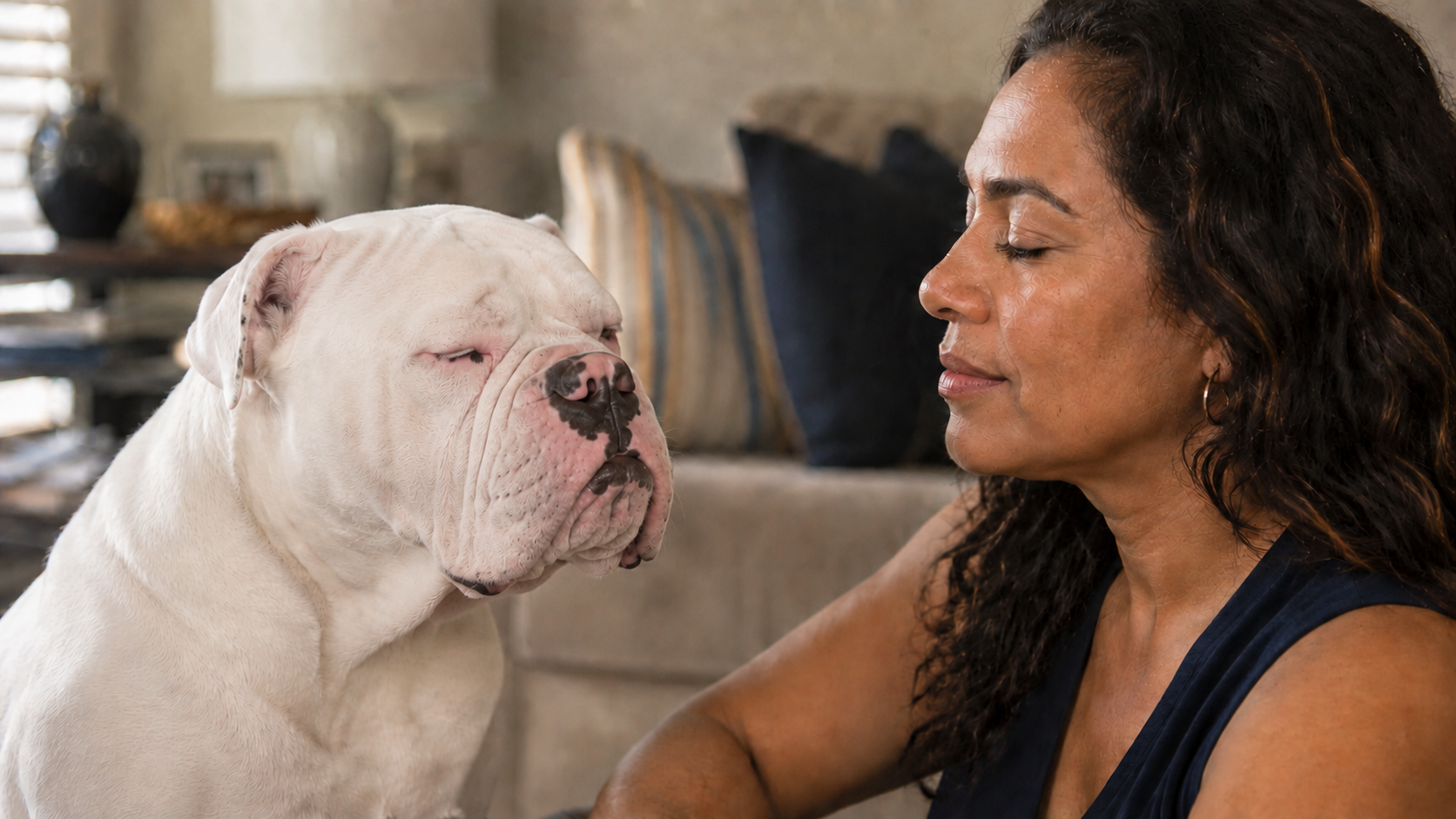
You're sitting on the couch looking at your dog. You blink. A second later, he blinks too.
It is an endearing moment, and it naturally raises a question: Why does your dog blink back at you? Did he copy you? Was it a quiet canine "I love you," or did his eyes simply need moisture at that exact second?
A peer-reviewed study in Royal Society Open Science suggests that who is doing the blinking matters. Dogs blinked more while watching videos of their owners blinking than while watching unfamiliar people do the same thing.
That gives us one useful piece of the puzzle. It does not turn a blink into a secret code.
How Researchers Tested Dog Blinks
Researchers at the University of Parma studied 35 pet dogs of different breeds. Each dog watched short video clips showing the dog's owner and two unfamiliar people.
In one condition, the person blinked once every three seconds. In the other, the person looked ahead without blinking. The dogs blinked more while watching the blinking videos, but when the team separated the results by person, the increase appeared while dogs watched their owners—not strangers.
The researchers also checked whether the dogs simply spent more time looking at their owners. Viewing time did not account for the difference. The dogs increased how often they blinked, but they did not synchronize each blink precisely with the human on screen.
That distinction matters. The study supports a relationship between a familiar person's blinking and a dog's blink rate. It does not establish intentional imitation or reveal what the dog felt.
What Earlier Peer-Reviewed Studies Found
The new work adds to several studies examining small facial movements in dogs.
In a 2025 Royal Society Open Science study, 54 pet dogs watched videos of other dogs blinking, licking their noses, or holding still. The dogs blinked more when they watched another dog blink. The researchers discussed automatic facial mimicry as one possible explanation, while making clear that the behavior was not proven to be deliberate communication.
An earlier Current Zoology study of live interactions examined whether dogs, cats, and people synchronized their blinks during mutual gaze. Some dog blinks occurred about one second after a human blink. Technical difficulties and interruptions left only seven dog-human pairs in the final timing analysis, however, so the finding cannot establish a general rule for every dog.
The latest video study controlled more of the visual scene and separated owners from unfamiliar people. That helped researchers test familiarity more directly, although a video can never reproduce an ordinary interaction at home.
Your Dog Pays Attention to Your Face
Dogs notice changes in our gaze, posture, movement, and expressions. Those details can help them anticipate what happens next—a walk, dinner, play, or an unexpected trip to the veterinarian.
A 2017 study in Scientific Reports found that 24 family dogs produced more facial movements while a person faced them attentively than while the person turned away. Blinking was an exception; it did not increase simply because the person was paying attention.
This suggests two things. Dogs adjust parts of their facial behavior in response to human attention, and not every eye movement should be treated as an intentional message.
Does a Blink Mean "I Love You"?
It is tempting to treat a soft blink like a canine hug. Current evidence does not support a fixed dog-to-human dictionary, though. One blink cannot reliably mean:
- "I love you" or "I trust you."
- "I agree with you."
- "I am completely relaxed."
- "Keep staring at me."
People also adjust their eye contact, posture, and facial movements during conversation without consciously assigning meaning to every motion. Dogs may do something similar during calm social moments.
A peer-reviewed Animal Cognition study evaluated canine facial expressions in positive, negative, and neutral situations. Facial movements changed with context, but no single movement provided a foolproof reading of a dog's emotional state.
Do Not Turn It Into a Blink Test
You can blink gently during a relaxed moment, but do not turn your dog's response into a test of love or loyalty.
If your dog turns away, yawns, blinks, or walks off, that does not score your relationship. Leaning into a dog's space, holding rigid eye contact, or blocking an exit can make some dogs uncomfortable.
Keep your posture loose. Use soft attention. Give your dog room to leave, and let him decide whether to continue the interaction.
Read the Whole Dog, Not Just the Eyes
If you are wondering why your dog blinked in a particular moment, step back and look at the rest of his body and the situation around him.
A comfortable dog may show
- Soft, loose body movement
- Relaxed facial muscles and soft eyes
- A relaxed, slightly open mouth
- Natural, steady breathing
- The freedom to approach or leave
An uncomfortable dog may show
- Stiff or frozen posture
- A tense jaw, lip licking, or repeated yawning
- Turning away, hiding, or trying to leave
- A tucked tail, growling, or hard staring
- Changes that intensify as pressure increases
Context still matters. A yawn can follow waking up. A blink can moisten the eye. Look for several signals and changes over time instead of building an interpretation around one eyelid movement.
When Blinking May Signal an Eye Problem
The studies examined ordinary blinking. Rapid blinking, persistent squinting, or holding an eye closed during daily life can point to discomfort rather than social behavior.
Contact your veterinarian promptly if blinking comes with:
- Redness, cloudiness, or swelling
- Thick, green, yellow, or unusual discharge
- Pawing or rubbing at the face
- Excessive tearing or sensitivity to light
- Holding one eye partly or fully closed
- A sudden change in vision or movement
A clinical review in Veterinary Medicine: Research and Reports explains that immune-mediated keratoconjunctivitis sicca, commonly called dry eye, can cause inflammation, discharge, discomfort, and corneal damage.
Do not use human eye drops or leftover pet medication unless a veterinarian tells you to. Using the wrong medication could irritate the eye, interfere with treatment, or delay care for a more serious problem.
What We Are Still Learning
The newest study included 35 dogs. The dogs watched short videos rather than interacting with people in a normal room. That removed scent, tone of voice, touch, shared movement, and the back-and-forth changes of a live encounter.
Researchers found that dogs blinked more while watching their owners blink. They could not determine what the dogs felt, whether the response was conscious, or whether every dog would respond the same way at home.
Those limits do not erase the result. They help us describe it honestly.
The Bottom Line
So, why does your dog blink back at you?
The best evidence suggests that familiarity matters. Your dog may respond differently to your blinking because your face carries a history that a stranger's face does not. The response could be automatic, socially influenced, or part of a broader interaction. One study cannot settle which explanation is correct.
Enjoy the quiet moment without forcing a meaning onto it. Your dog is paying attention. Return the favor by watching his whole body, respecting his space, and noticing when an ordinary blink becomes a sign that his eye may hurt.
This article provides general educational information and is not a substitute for professional veterinary care or individualized behavioral advice.
Sources
- Royal Society Open Science: Dogs' behavioral responses to owner and stranger blinking (2026)
- Royal Society Open Science: Dogs' facial responses to conspecific expressions (2025)
- Current Zoology: Mutual synchronization of eyeblinks among dogs, cats, and humans
- Scientific Reports: Human attention affects facial expressions in domestic dogs
- Animal Cognition: Canine facial expressions across emotional contexts
- Veterinary Medicine: Research and Reports: Immune-mediated keratoconjunctivitis sicca in dogs