
A go-bag for Tyson starts with the plan behind it: where to go, what records to carry, and how to keep supplies current.

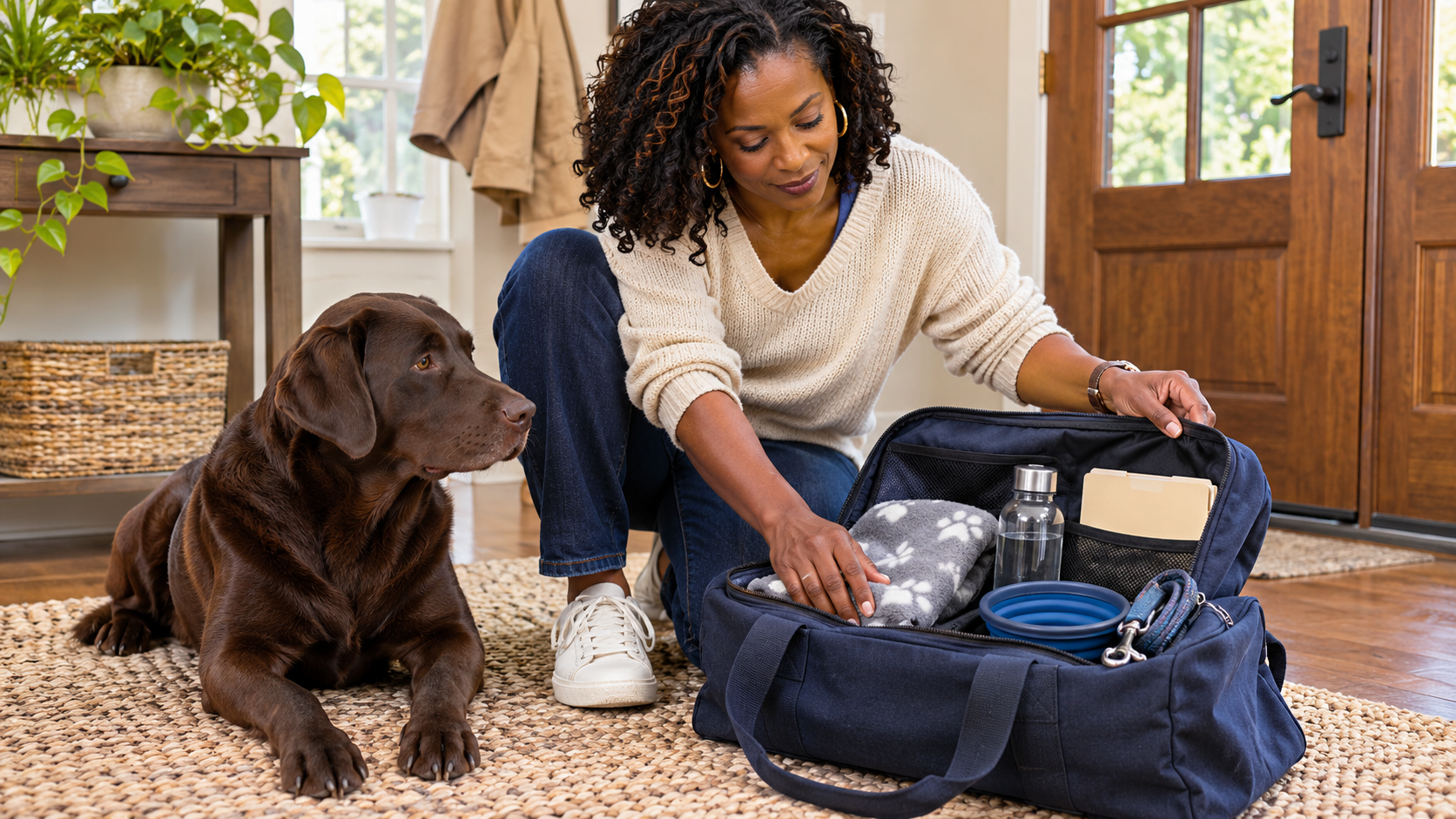
If I had to leave home with Tyson on short notice, the plan behind the bag would matter more than what's in it. Food and water are easy to picture. The harder parts are where we'd go, whether that place takes dogs, how I'd carry Tyson's records, and what someone else would need to know if I couldn't get home first.
I haven't been through an evacuation with Tyson. I also haven't confirmed a packed bag, a destination, a caregiver, or a list of products for him. This is the checklist I want to settle before an emergency settles it for me.
Start with the destination
A go bag doesn't tell you where to go. The American Veterinary Medical Association advises owners to pick a destination outside the affected area and to practice transporting pets with their supplies. The ASPCA says to take pets along when you evacuate and to follow instructions from local and state officials.
So I'd need more than the name of a hotel or shelter. I'd call to confirm the current pet policy, ask what records the place requires, and line up a backup. Some emergency shelters don't accept pets at all. Others open only when local officials announce them, and the rules differ from one to the next.
Miami-Dade County says its pet-friendly evacuation centers are announced as needed, and not every center opens in every emergency. A general list can't promise access. What works depends on the place, the event, and what officials are saying that day.
An unfinished bag is never a reason to stay. If officials say to leave, the plan has to work with whatever time we have.
Make identification easy to check
Current identification helps connect a dog with the right owner, but no tag or microchip guarantees a reunion. The ASPCA recommends current information on a collar and tag, a labeled carrier, and a registered microchip with up-to-date contact details.
A microchip is only as useful as the registry information attached to it. I'd want to know which registry holds Tyson's number and whether my phone number and address on file are current. I'd also keep a recent photo with his records. The Centers for Disease Control and Prevention lists recent photos, ownership information, medical records, and microchip details in its pet disaster-kit guidance.
Those records belong in waterproof storage. They shouldn't be printed on the outside of a bag or posted in a public article. The people who need the information should be able to get it, and everyone else walking past the kit shouldn't.
Plan food, water, and medicine
The agency checklists don't agree on how much to pack. AVMA lists three to seven days of food and at least seven days of water. The ASPCA uses longer planning ranges, and CDC recommends two weeks of food and water. Because the numbers differ, I'd name the source each time instead of blending them into one rule.
What Tyson actually needs depends on his food, his daily habits, how it's stored, and how long a disruption might last. I'd ask his veterinarian what makes sense for him and follow the product labels. I wouldn't make up a number of cups or gallons from a general webpage.
Medicine needs more care than food. AVMA, the ASPCA, and CDC all recommend packing any medicine the dog needs, and CDC adds written instructions and prescription information. The Food and Drug Administration says to keep pet medicines in their original labeled containers, out of reach of animals and children, and apart from human medicine.
A checklist doesn't authorize an early refill, a changed dose, or a stockpile. A veterinarian or pharmacist would have to tell me how much I can lawfully and safely keep, how to store it, and what to do if a medicine needs refrigeration and the power is out.
Rotate what expires
A bag can look complete while its contents quietly go bad. AVMA says to replace food and medicine before they expire. The ASPCA checklist says to rotate stored food and medication and to swap out bottled water on a schedule.
There's no single shelf-life rule for every product. Labels and medicine-specific instructions control. I'd put review dates on the checklist so checking the bag becomes a routine and doesn't depend on my memory.
Pack for transport
CDC's list includes a carrier that fits the dog, with bedding, plus a leash, a collar with identification, a harness, feeding equipment, and cleanup supplies. The ASPCA also suggests familiar bedding or toys and spare control equipment. FDA recommends getting pets used to their carriers before an emergency.
Equipment has to fit the individual dog. A product can be popular and still be the wrong size or design for Tyson. A first-aid kit belongs on the list too, but a kit isn't a treatment plan. The ASPCA and CDC both recommend asking a veterinarian to help put one together. I wouldn't add drug doses, sedatives, vomiting instructions, or emergency procedures from a generic checklist.
Leave a backup plan
An emergency can hit while the dog is home and the owner is somewhere else. FDA recommends arranging a nearby helper who has your contact details, care instructions, and authorization and spending limits for veterinary care in case you're stranded away from home. AVMA also recommends a designated helper.
I'm including this as a short backup step. I haven't named anyone for Tyson. A real plan would need that person's agreement, current contact information, and clear limits. It would also say which veterinary clinic to call and where the records are kept.
What I'd want ready
If I were building Tyson's go bag, I'd organize it around five things: where we're going, how I'll identify and transport him, what food, water, and medicine his own plan calls for, which records and contacts travel with us, and who can help if I can't get home.
The supplies are only the physical part. The phone calls, updated records, practiced transport, and current local information are what make the plan usable.
I hope Tyson and I never have to test it under pressure. Preparing doesn't mean I expect the worst. It means we'd have fewer decisions to make when time is short.
Sources and further reading
- American Veterinary Medical Association, "Pets and disasters"
- ASPCA, "Disaster Preparedness"
- ASPCA, "Disaster Preparedness for Pets: What to Plan and Pack"
- Centers for Disease Control and Prevention, "Build a Pet Disaster Preparedness Kit"
- U.S. Food and Drug Administration, "Take Care of Your Pets Before Disaster Strikes"
- U.S. Food and Drug Administration, "Properly Store Medications to Keep Your Pet Safe"
- Miami-Dade County, "Pet Preparedness During a Hurricane"
- Miami-Dade County, "Emergency Evacuations"
More stories
 Daily Doggy NewsPreparing Your Dog for a Holiday Boarding Stay
 Daily Doggy NewsThanksgiving Visitors and Dogs: A Practical Safety Plan
 Latest Daily Doggy NewsThanksgiving Scraps and Dog Pancreatitis
 Canine JournalKennel Cough: What Dog Owners Should Know
 Tyson’s LifeThe Boss Has Four Legs
 It MattersShould Ear Cropping Still Be Legal?