
How to Stop Dog Barking When Left Alone
Daily Doggy News · Training & Behavior
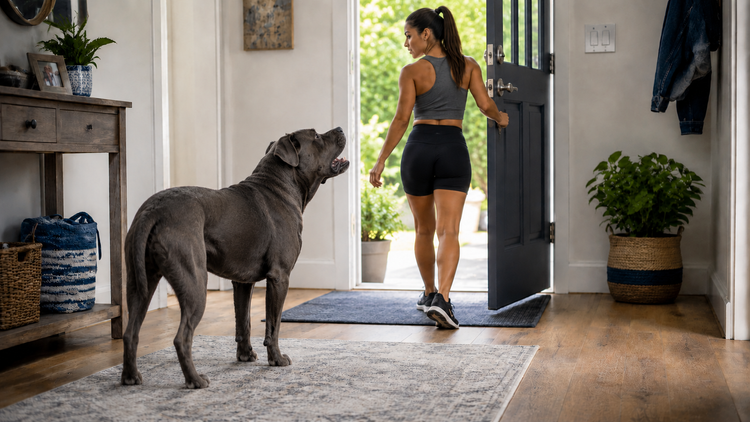
If your dog turns into a siren the second the door clicks shut, the answer is not a gadget that shocks the bark away. It is figuring out why the barking is happening in the first place.

Quick Answer
Record what your dog does after you leave and watch for the trigger. If you have a bored or alert dog, exercise, enrichment, background noise, and a resting spot they actually like can go a long way. If you see panic, pacing, panting, drooling, destruction, escape attempts, or accidents in the house, that is a different problem—one that usually needs gradual alone-time training and, in many cases, professional help.
Skip punishment entirely. By the time you return, the barking has already happened. Your dog is not connecting the scolding to something that happened earlier; the punishment can simply teach them that your return is frightening.
Top Takeaways
- Barking while alone does not automatically mean separation anxiety.
- Record the first 30 to 45 minutes to identify timing, triggers, and signs of distress.
- Practice absences short enough for your dog to remain calm, then increase them gradually.
- A crate may help a dog who already loves it, but confinement can intensify panic in some dogs.
- Sudden, severe, or injury-producing behavior warrants veterinary or behavioral help.
Why Is My Dog Barking When I Leave?
A dog that is dead quiet all evening can become a full-blown alarm system the moment you grab your keys. That leaves you wondering whether you should ignore it, rush back inside, or call a trainer.
Before you try to stop the noise, determine what is causing it. Common possibilities include:
- Separation anxiety or isolation distress
- Boredom and pent-up energy
- People, animals, vehicles, or noises outside
- Fear of unfamiliar sounds
- Frustration with a gate, room, or crate
- An inconsistent routine
- Needing to go to the bathroom
- Physical discomfort or a medical issue
- Age-related cognitive decline
A dog barking at the mail carrier needs a completely different plan from a dog that is genuinely panicking because you left. An anti-bark collar does not know the difference. It reacts to sound without understanding what is happening to your dog.
Is It Just Barking, or Separation Anxiety?
Separation anxiety is not simply your dog missing you for a few minutes. It is genuine distress tied to being away from you—or, in some cases, being left without any person present.
Dogs with separation anxiety may begin reacting before you leave. Picking up keys, tying shoes, closing a laptop, or grabbing a coat can become a signal that you are about to disappear.
Once you are gone, watch for:
- Barking, whining, or howling that does not let up
- Pacing or an inability to settle
- Heavy panting in a room that is not hot
- Drooling
- Scratching or chewing at doors and windows
- Frantic attempts to escape a crate or room
- Accidents in a dog who is normally house-trained
- Destruction focused around exits
- Injured paws, nails, mouth, or teeth
- A frantic or desperate greeting when you return
Timing matters. Separation-related behavior often appears while you prepare to leave or within the first few minutes after departure. A bored dog may chew something or bark at a passing vehicle but can still eat, play, and eventually settle. A dog experiencing panic often cannot.
Record Your Dog After You Leave
This is one of the most useful things you can do. You do not need expensive equipment; a spare phone, tablet, laptop, or basic indoor camera can work.
Record the first 30 to 45 minutes and pay attention to:
- How quickly the barking begins
- Whether your dog watches or attacks the exit
- Pacing, panting, drooling, trembling, or whining
- Barking connected to activity outside
- Whether your dog will eat a favorite treat
- Whether the dog eventually settles
- Signs that confinement is making the behavior worse
The footage can tell you more than trying to reconstruct the behavior from memory, and it gives your veterinarian, trainer, or behaviorist something concrete to evaluate.
If your dog is injuring themselves while trying to escape or the panic appears severe, do not keep repeating test departures on your own. Seek professional guidance first.
Before Your Next Departure
Real training takes time, but several changes can reduce triggers while you build a longer-term plan.
Meet the Physical Needs First
Give your dog an opportunity to exercise, sniff, play, and use the bathroom before you leave. The right amount of activity depends on age, breed, health, fitness, and weather. A slow sniffing walk can settle some dogs better than an intense game immediately before departure.
Give Your Dog Something Safe to Do
A food puzzle, stuffed toy, lick mat, or safe chew can occupy a bored or mildly worried dog. Some owners reserve a particular item for calm alone time so it becomes something special.
Make sure the item is appropriate for unsupervised use. A toy that is safe while you are watching is not automatically safe for several hours alone. If your dog normally loves the treat but refuses it once you leave, that can be a sign that the dog is too distressed to eat.
Reduce Outside Triggers
If the mail truck, wildlife, or a neighbor’s dog starts the barking, close curtains, move the bed away from windows, use privacy film on lower windows, or leave on a fan, radio, or white noise. These changes do not cure separation anxiety, but they can remove noise-related barking from the equation.
Create a Real Resting Spot
Use a space where your dog already relaxes while you are home. Familiar bedding, water, and a safe activity may help. The space does not need to be the smallest room available. Depending on the dog, a gated area, open crate, exercise pen, or full room may work better.
Will a Crate Fix the Barking?
Sometimes. A crate can help a dog that already considers it a safe, comfortable resting place—but only when it has been introduced gradually and has never been used as punishment.
For a dog that panics when confined, a crate can make the problem worse. Watch for:
- Biting or bending the bars
- Bloody gums or broken teeth
- Damaged nails
- Heavy drooling
- Frantic spinning or escape attempts
- Nonstop barking or howling
- Refusing to enter
- Accidents that occur only when crated and alone
If you see these signs, the answer is not a sturdier crate. The confinement itself may be part of the problem. Ask your veterinarian or a qualified behavior professional about a safer setup.
Training Your Dog to Stay Calm Alone
The rule that matters most is to practice only an absence your dog can handle without panicking. For one dog, that may be five minutes. For another, it may be five seconds.
Start Smaller Than You Think
Step behind an interior door, walk out of sight briefly, or touch the front door and return. Watch your dog’s body language and come back before barking, pacing, panting, or another stress signal begins. Repeat only after your dog is calm.
- Step out of sight for one or two seconds.
- Return calmly.
- Wait until your dog relaxes.
- Repeat at the same easy duration.
- Add a few seconds only when your dog is consistently comfortable.
Some days you may need to practice a shorter separation than the day before. That is normal. If barking or panic begins, reduce the difficulty instead of forcing your dog through it.
Change What Departure Cues Mean
Keys, shoes, coats, work bags, and garage-door sounds can become warnings. Practice them when you are not leaving. Pick up your keys and sit on the couch. Put on your shoes and make dinner. Carry your work bag into another room. Open and close the door without going anywhere.
With enough calm repetition, those cues stop predicting a frightening absence every time they occur.
Build a Positive Association
Give your dog something they genuinely enjoy just before a short, manageable separation. This does not replace gradual training, but it can help change the emotional association. If the dog stops eating the moment you disappear, the separation may be too difficult. Shorten it.
Keep Goodbyes and Hellos Low-Key
You do not need to ignore your dog for an arbitrary length of time or turn every return into a dramatic reunion. A calm, predictable routine works better than either extreme. Greet your dog without punishment or overwhelming excitement and allow them to settle.
Should You Let Your Dog Bark It Out?
A few barks followed by your dog settling comfortably may not indicate serious distress. A dog in full panic, however, is not building independence. The dog is repeatedly experiencing the exact fear you are trying to reduce.
Allowing an anxious dog to bark until exhaustion can make future departures harder because leaving begins to predict a long period of misery. If barking starts during a training session, return calmly, allow your dog to settle, and make the next repetition easier.
What Not to Do
Do Not Punish Your Dog When You Return
A damaged door or complaint from a neighbor is frustrating. But your dog cannot connect a scolding at 5 PM with barking that happened at noon. What looks like a guilty expression is usually a reaction to your voice and posture—not an admission that the dog understands the earlier behavior was wrong.
Do Not Try to Scare Anxiety Away
Shock collars, spray collars, or yelling through a camera may suppress sound, but a quiet dog is not necessarily a calm dog. Sometimes the dog has simply become too afraid to bark. That can add another layer of fear without treating the underlying problem.
Do Not Rush the Timeline
Jumping from a comfortable five-minute absence to an hour can undo progress. Let your dog’s behavior determine the pace instead of following a rigid calendar.
Never Give Human Anxiety Medication
Dosage, drug interactions, and medical risks must be evaluated by a veterinarian. Never give your dog medication prescribed for you or another person.
When to Call Your Veterinarian
Arrange a veterinary evaluation if:
- The barking or anxiety appeared suddenly.
- Your older dog seems restless or confused at night.
- House-soiling begins unexpectedly.
- Your dog appears painful or physically uncomfortable.
- The dog cannot eat, rest, or settle while alone.
- Escape attempts have caused injuries.
- The behavior is worsening.
- Gradual training is not helping.
- You cannot leave without triggering severe panic.
Pain, medication effects, urinary problems, sensory changes, and cognitive decline can resemble a training problem. A veterinarian should rule out medical causes.
Moderate or severe separation anxiety may require a combination of management, behavior modification, and medication. In the United States, veterinary formulations of fluoxetine and clomipramine are FDA-approved for canine separation anxiety as part of broader behavioral treatment plans.
Medication is not a shortcut or evidence that an owner has failed. For a dog that cannot become calm enough to learn, appropriate medication can make behavioral treatment possible. That decision belongs to a veterinarian. A board-certified veterinary behaviorist can be especially valuable for severe or complicated cases.
Veterinary Note
This article is educational and does not replace veterinary diagnosis or individualized behavioral treatment. Seek prompt veterinary help if your dog is injuring themselves, showing sudden behavioral changes, or experiencing severe panic.
Frequently Asked Questions
Why does my dog bark when I leave but not when someone else does?
Your dog may be particularly attached to you, or your departure routine may predict a longer absence. Record the behavior and see whether the dog settles while another trusted person remains home. That helps distinguish distress over your departure from distress over being completely alone.
Will my dog eventually stop barking when I leave?
Some dogs settle after a few minutes, but persistent barking should not be assumed to disappear. When anxiety drives the behavior, repeated panic can strengthen the pattern. Early, gradual training is better than waiting for the dog to outgrow it.
Should I ignore my dog’s barking?
A few protest barks that fade as your dog settles may be okay to monitor. Persistent barking or barking accompanied by pacing, panting, drooling, destruction, or escape attempts needs attention.
How long does separation-anxiety training take?
There is no universal timeline. Mild cases can improve comparatively quickly, while severe cases may take months. Progress depends on keeping practice sessions below the dog’s panic threshold.
Can I talk to my dog through a pet camera?
It depends on the dog. Some find the owner’s voice reassuring. Others become more agitated because they can hear the person but cannot find them. Test it once while observing your dog’s response before making it part of the routine.
What if my dog barks in the crate as soon as I leave?
Determine whether it is a brief protest or genuine panic. Frantic escape attempts, heavy drooling, damaged teeth, injured paws, or nonstop barking suggest that confinement is worsening the distress. Use a safer arrangement and seek professional guidance.
The Bottom Line
Getting your dog to stop barking when you leave is not about winning a fight over noise. It is about understanding what happens after the door closes.
Record the behavior, identify the trigger, and build the plan around the actual cause: more activity for a bored dog, fewer outside sights and sounds for an alert barker, or careful gradual practice for a dog with separation anxiety.
Start with something your dog can handle, move more slowly than feels necessary, and call for help when the distress is serious. The goal is not merely a quiet house. It is a dog who is genuinely comfortable being alone.
Sources
Keep Reading
More reporting, practical guidance, and stories from Inspired by Tyson.