
How Dog Training Platforms Build Focus and Calm
A defined destination can make everyday training clearer. Here's what platform training can—and can't—do for your dog.


The doorbell rings while you're trying to finish dinner. Your dog bolts for the door, jumps on the guest the second they step inside, then circles the kitchen a few times before things settle down.
Telling a dog “stop” might interrupt the moment, but it doesn't answer the question your dog is actually asking: what am I supposed to do instead?
A dog training platform gives that question somewhere to land.
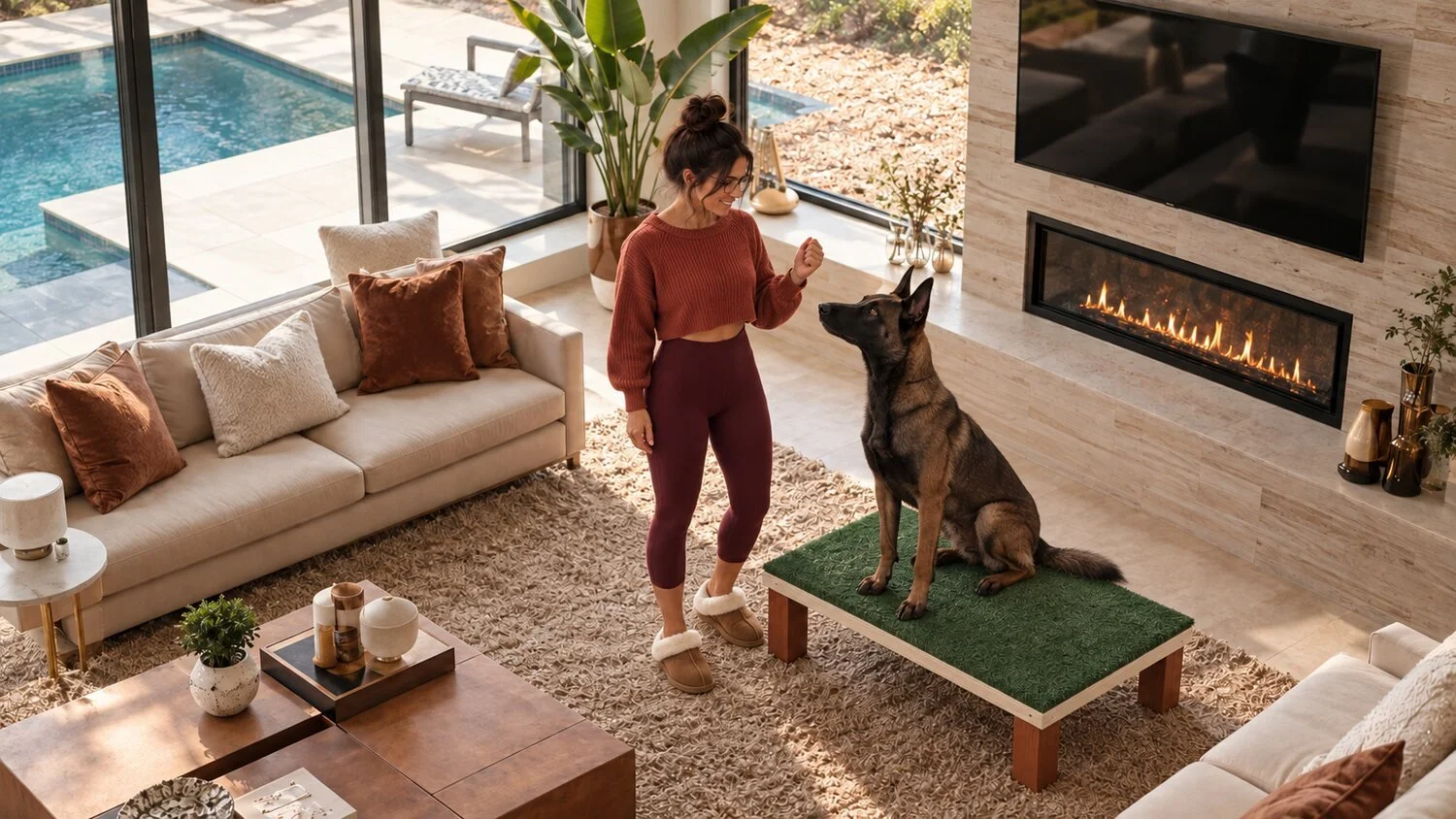
Platform training teaches a dog to go to a specific surface and stay there until you release them. That surface might be a mat, a bed, a place board, or an elevated platform. Owning the equipment isn't the point. The dog has to be taught, step by step, what that spot means and what behavior gets rewarded there.
An elevated platform makes that lesson easy to see. The edges give the dog a physical boundary—something they can feel under their paws, not just guess at. That's why platforms show up everywhere from basic household training to group classes to performance work, and why one can end up becoming part of everyday life at home.
What Is Platform Training for Dogs?
Platform training is a form of stationing. The dog learns to go to a particular spot, hold a position there, and wait for a release cue.
In the beginning, success might just be your dog glancing at the platform or putting one paw on it. Build from there and eventually the dog will put all four paws on, sit or lie down, hold that position while you walk away, and keep working through it even with distractions around.
The platform itself doesn't do the training. It gives you a clear location to work with. The timing, the repetition, the reinforcement, and the relationship between you and your dog—that's what actually builds the skill.
1. The Boundary Makes the Assignment Clearer
“Stay somewhere over there” is a hard thing to teach a dog, because “there” moves every time you say it. A platform gives you edges you can both see.
Your dog learns to recognize when all four paws are actually on the platform. And you get a consistent standard to work from. Reward while your dog is on the platform. If they step off before the release cue, calmly reset the exercise and make the next repetition a little easier.
A flat mat can work as a station too, but the edge is easier to blur when a dog stretches, rolls, or slowly creeps off the side inch by inch. Elevation isn't automatically the better choice for every dog, but it does make on-or-off a lot easier to call.
Clear criteria cuts down the guessing on both ends of the leash. Instead of correcting your dog for picking the wrong spot, you get to build value around picking the right one.
2. It Teaches an Alternative to Doorway Chaos
Platform training earns its keep when it gives your dog a specific job to do during a predictable, everyday headache.
If your dog jumps every time someone walks in, “don't jump” doesn't leave them with anything to actually do. Going to a station, lying down, and waiting gives them something real to practice before the next guest even shows up.
This is one spot where the research backs up the approach directly. In a 2008 peer-reviewed study, veterinary behaviorist Sophia Yin and her colleagues tested a positive-reinforcement protocol on dogs that barked, jumped, or crowded the door whenever people arrived. Six dogs went through the protocol first in a controlled setting. Then 15 more were trained by their own owners at home to go to a rug or bed, lie down, and stay there while the owner answered the door.
After training, barking, jumping, and time spent crowding the entrance all dropped significantly. Six dogs that didn't go through the training showed no real change.
That doesn't prove elevation specifically was the reason it worked—the study used a full protocol with shaping, gradually increased distractions, and a remote food dispenser. But it does show that teaching a dog to go to a designated spot can be a real part of solving visitor-related chaos.
3. A Familiar Station Can Support Focus
Dogs pick up on movement, smells, people, food, and sounds most of us barely notice. A platform doesn't make any of that disappear. What it gives your dog is a familiar behavior to come back to while they're learning to work around it.
Start the work in a quiet room. Once your dog understands the station, build up duration, distance, and distraction one at a time—not all three at once. Stacking them together usually just makes the exercise harder than it needs to be.
Reward-based training matters here too. A 2020 controlled study compared 63 dogs trained with electronic collars, without them, or mainly through positive reinforcement. The reward-based group responded faster to “sit” and “come” and often needed fewer repeats of the command than the electronic-collar group did. The researchers found nothing suggesting electronic collars were actually necessary to get there.
That study wasn't about platforms specifically, but it backs up the same approach behind platform training: show the dog what works, mark it, reward it.
Focus should never come from forcing a scared dog to stay put. If your dog freezes, leans away, keeps trying to get off the platform, or stops taking food they'd normally jump at, the session's too hard. Back off and pay attention to the whole dog—not just where the paws are.
4. The Skill Fits Real Household Routines
A platform earns its spot in your home once the behavior actually gets used outside of formal training sessions.
Your dog can practice going to the station while groceries come through the door, the kids are getting ready for school, dinner's on the table, or you're on a work call. If you've got more than one dog, separate stations give each one a job while you work with the other.
If the platform only appears after your dog has done something wrong, it can begin to feel like a punishment spot. Build positive associations with it during calm, ordinary moments too.
There's also a difference between a dog holding still and a dog actually feeling relaxed. A dog can stay in position while panting, scanning the room, or holding a tense posture the whole time. A platform can support a calm routine, but it can't force your dog to feel calm. Reading that takes paying attention to body language, and in tougher cases, bringing in a professional.
5. A Platform Can Belong After Training Ends
Some platforms are meant to come out for a class and go right back into a closet. Others stay in the room and take on a second job.
Give it enough surface area, and your dog might start choosing the platform on their own—for a nap, to watch the family, or to work on an appropriate supervised chew. It becomes a familiar, den-like spot of their own without turning into an enclosed crate.
That's part of why the look and the sizing matter. A compact platform can give you precise boundaries for focused training work, but a dog that needs to turn around, stretch out, and actually sleep needs more room than that. Puppies, senior dogs, and dogs with mobility issues might need a lower height or another accommodation—talk to your vet about what's right for your dog.
The goal isn't to drop a piece of training equipment in the middle of a home you've put real thought into and just live with it. The better question is whether your dog's space can do a job and still look like it belongs there.
How Popular Dog Training Platforms Differ
The basic idea shows up across several established training systems.
Blue-9's KLIMB dog training platform is built around a molded, washable, configurable design. Its resource library has a quick-start guide, a getting-started guide, and material aimed at trainers using individual platforms in group classes.
Cato Outdoors makes the Cato Board, a compact molded place board built for visitor routines, remote sits, recall, handling, steadiness work, and hunting-dog training. Its compact rectangular surface provides a consistent target for place work.
The KLIMB, the Cato Board, and the MARK all share that same core idea—a clearly defined station. Where they differ is in dimensions, height, material, portability, cleaning, intended use, and how well they fit into an actual home.
The MARK treats that need as furniture with a purpose. It's handcrafted in Florida and can be sized and finished around your dog, your training goal, and the room it's going to live in. It's a place to learn, and when it's sized right, a place to belong.
From Hollywood MARKS to Everyday Homes
The MARK has a history that goes back to performance training.
In “Dogs Are Den Creatures,” BiteLife trainer Eric Gonzales writes about first coming across the MARK in the early 1990s while being mentored by Hollywood dog trainer Omar Von Muller. Back then, the MARK was an elevated platform about 18 inches across, built to keep dogs in a precise spot while they worked independently for photo shoots, movie stunts, and other studio work.
Omar still teaches the method through The Mark System Blueprint. His program starts by luring a dog onto a large MARK, then works up to sending the dog from a distance, working with multiple MARKS, and eventually shrinking the target down to something much smaller. The location itself becomes part of the cue—the dog learns what to do and where to do it, together.
Gonzales adapted that studio concept for regular household dogs, using an open boundary instead of a crate door or a tether. His original writing leans on some dominance and pack-ranking language that was common in that era of dog training. The current evidence puts more weight on reinforcement, managing the environment, clear cues, and paying attention to how the individual dog is actually feeling.
Eric introduced me to the MARK while I was searching for better structure and clearer communication with Tyson. What Tyson and I learned together eventually inspired a different kind of platform—not just a temporary training prop, but handcrafted furniture that could actually stay part of our home.
What a Platform Cannot Do
A platform isn't a cure for aggression, fear, separation anxiety, or every kind of barking. Those behaviors can come from emotional, environmental, or medical causes. A station can support a bigger plan, but it should never be used to just hold a distressed dog in place while the real problem gets ignored.
A dog suddenly refusing to step up, sit, lie down, or jump can also be a sign of pain. If your dog's movement or behavior changes out of nowhere, talk to your vet. Fear, aggression, and serious anxiety may call for a qualified behavior professional.
How to Begin Without Overwhelming Your Dog
Pick a stable, nonslip platform that's big enough for what you're asking and right for your dog's mobility. Let them check it out on their own—no pulling or pushing them onto it.
Reward the small stuff: looking at it, walking toward it, touching it, and eventually all four paws on. Deliver the reward while your dog is still on the platform. Add a cue once the behavior starts becoming predictable, then teach a clear release word.
Build up duration before you add distance. Drop the duration back down when you introduce a new distraction. Short sessions that end in success beat long ones that end in frustration, every time.
For the full progression—from the first four paws all the way through real doorbells, mealtimes, and household distractions—follow The MARK Dog Platform: 7-Day Training Guide.
The Platform Gives the Cue Somewhere to Land
The real value of a dog training platform isn't the height. It's the clarity.
Your dog gets a destination they recognize. You get a consistent behavior to reward. With patient teaching, that station can sharpen focus during training, give your dog an alternative during the busy moments, and turn into a familiar place to rest.
The platform gives you the boundary. The relationship, the timing, and the repetition are what build the learning.
That's the idea behind the MARK: a better place to learn, and a beautiful place to belong.
This article provides general educational information and is not a substitute for veterinary or individualized behavioral advice. Research links are included so readers can review the studies and their limitations directly.
Give Your Dog a Clearer Place
Use the seven-day guide to begin training, or find the MARK size that gives your dog enough room to learn, settle and belong.
About the author
Stephen Gill
Stephen Gill is the founder of Inspired by Tyson and writes Daily Doggy News from real life with Tyson. His work covers dog ownership, behavior, safety, canine health, working dogs and the relationship between dogs and their people.
Read Stephen Gill's full author profile