Ear Study Links Treatment Plan to Less Yeast
A small study links a specialist ear-treatment plan with less yeast overgrowth.
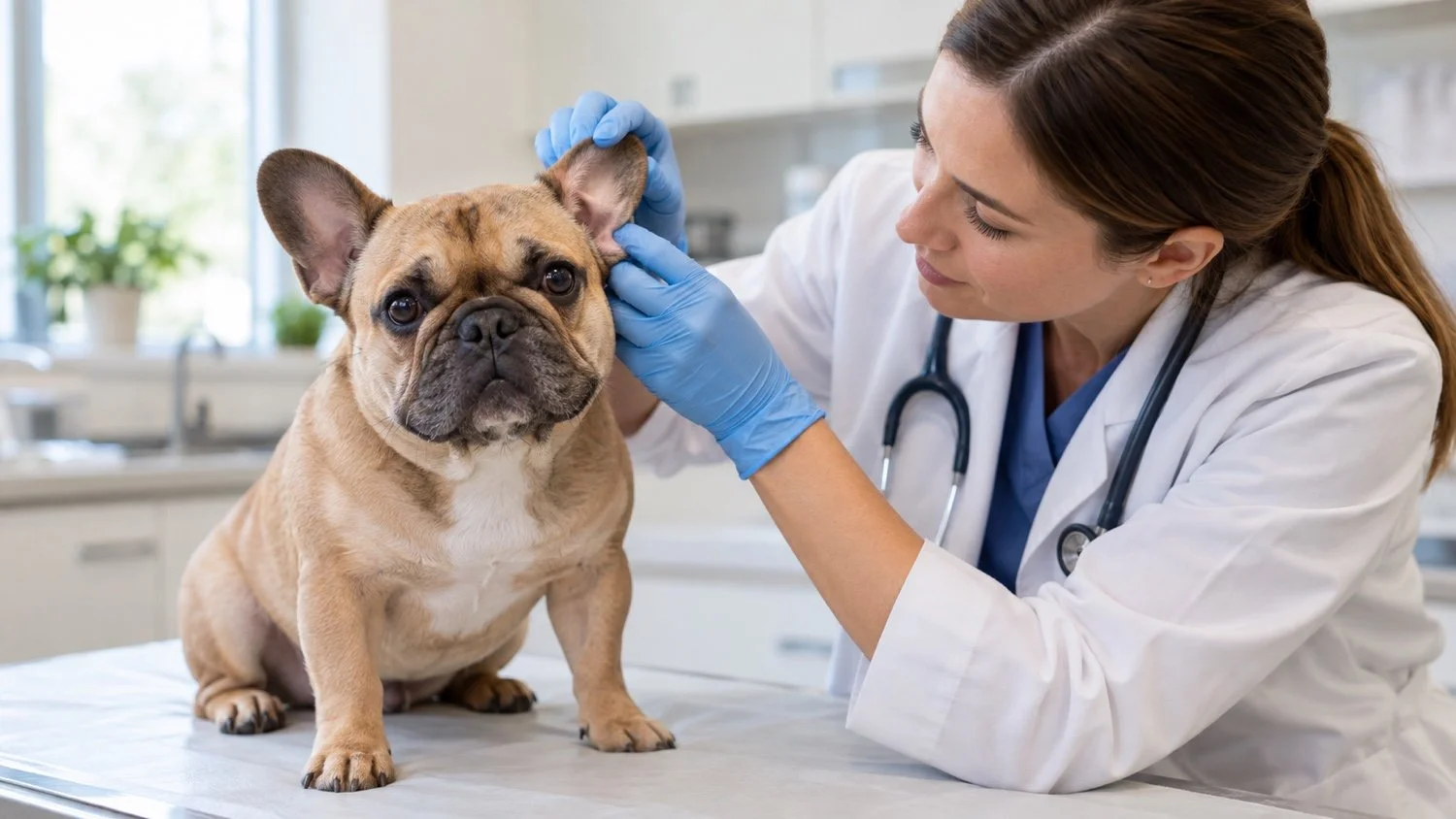
Credit: AI-generated with OpenAI image generation for Inspired by Tyson, October 8, 2026. No third-party image asset used.
Disclosure: AI-generated editorial illustration; not a documentary photograph.
Key Takeaways
A new Royal Veterinary College study looked at dogs with hard-to-treat bacterial ear infections who were treated with a strong topical antibiotic.
Adding an antifungal ear solution to that treatment was linked with far less yeast overgrowth afterward — but it did not prevent it in every dog. Four of 21 dogs still developed it.
The dogs were compared with an earlier group treated by the same team, not in a randomized trial, so the result is promising rather than final.
This is specialist-level treatment. It is not a home remedy, and it does not change what an owner should do for an itchy or smelly ear: get the ear examined.
What the Researchers Set Out to Answer
In some dogs treated for difficult bacterial ear infections, yeast called Malassezia was found above the study’s normal range after treatment. Researchers call this fungal dysbiosis. The study compared dogs treated at different times, so it cannot show that the antibiotic caused the yeast increase.
A Royal Veterinary College (RVC) team had already reported that this kind of yeast overgrowth “commonly occurs” after successful treatment with the antibiotic combination piperacillin-tazobactam used on its own. Their new paper, published online on September 25, 2026, in the Journal of Small Animal Practice, asked a follow-up question: what happens if an antifungal is built into the same treatment plan?
How the Study Worked
Twenty-one dogs with bacterial ear infections (otitis externa) were treated with piperacillin-tazobactam drops in the ear, with one dose in every two-day period swapped for a 1% clotrimazole antifungal solution. The team swabbed the ears at a first and second visit and grew the bacteria and yeast in the lab to estimate how many were present.
The researchers then compared those 21 dogs with 14 dogs they had previously treated with piperacillin-tazobactam alone. The authors describe this as a “sequential case-cohort design.” In plain terms, the two groups were treated at different times, and dogs were not randomly assigned to one treatment or the other.
The study’s institutions describe the dogs as having refractory bacterial ear infections — infections that had not resolved with earlier treatment. That is a different population from a dog seeing its family veterinarian for a first ear problem.
What They Found
Researchers detected no difference in bacterial cultures after treatment: 3 of 21 dogs in the combination group and 2 of 14 in the antibiotic-only group still had bacteria growing. The estimated relative risk was 1.00 (95% confidence interval 0.19 to 5.24). Because the interval is wide, the small study does not establish that the treatments were equivalent or rule out a meaningful difference.
Yeast rose far less often. Yeast counts went up in all 14 dogs (14/14) treated with the antibiotic alone, compared with 7 of 21 dogs given the combination.
Yeast overgrowth was reduced, not eliminated. Using the study’s definition — a yeast count above normal at the second visit — fungal dysbiosis developed in all 14 antibiotic-only dogs and in 4 of the 21 combination-treated dogs. Dogs treated with the antibiotic alone had 5.25 times the risk (95% confidence interval 2.17 to 12.68). The British Small Animal Veterinary Association (BSAVA), which describes the work as PetSavers-funded, summarized this as an 81% reduction in risk.
The authors’ own conclusion is carefully worded: the combination “is highly efficacious in the treatment of refractory bacterial otitis; incorporation of clotrimazole markedly reduces but does not abrogate fungal dysbiosis.” Abrogate means abolish. The yeast problem shrank; it did not go away.
Why the Study Design Matters
The comparison group is the main reason to read this result with care. In a randomized trial, dogs are assigned to treatments by chance at the same time, which helps make the groups alike. Here, the antifungal group was treated after the antibiotic-only group. Differences in the dogs, the time period, or how they were followed could influence the results in ways a small study cannot fully rule out.
The groups were also small — 35 dogs in total — and drawn from a specialist referral setting. The size of the yeast effect is large enough to be striking, but the precise figure could shift in a bigger, randomized study.
There is also context the researchers themselves offer. RVC professor Ross Bond told MRCVS that “dysbiosis tends not to occur in routine cases managed with conventional polypharmacy ear drop products” — that is, conventional multi-ingredient ear drops. The finding speaks most directly to the specialist situation in which a strong single-drug antibiotic is chosen for a resistant infection.
What This Means for Your Dog
For most owners, the practical message is the one veterinary guidance already gives: an ear problem needs an examination, not a guess.
Ear infections are diagnosed, not assumed. The Merck Veterinary Manual says the ear should be examined with an otoscope and that cytology — looking at ear debris under a microscope — identifies bacteria, yeast and inflammatory cells to guide treatment. AAHA’s allergic skin disease guidelines say cytology should be performed in every case of otitis externa.
The eardrum matters. Merck advises veterinarians to verify that the eardrum is intact before applying topical treatments, because some ear medications can damage hearing or balance when it is not.
Recurring infections usually have a cause. Allergy is a common one. AAHA notes that more than half of allergic dogs have allergic ear inflammation, and that in some it is the only sign. Treating the underlying cause is key to preventing repeat infections.
Rechecks are part of treatment. Merck says dogs with bacterial and yeast ear infections should have repeat cytology every one to two weeks until there is no evidence of infection.
Persistent cases may need a specialist. AAHA lists infections that are not responding to treatment, resistant organisms, and middle-ear involvement as reasons for referral to a veterinary dermatologist.
Do not reuse leftover ear medication, combine products, or add an antifungal on your own because of this study. The drugs in this research were chosen for specific dogs after examination and laboratory testing, and the protocol is not a home treatment.
Questions to Ask Your Veterinarian
- Is my dog’s eardrum intact, and does that affect which medication is safe?
- What did the ear cytology show — bacteria, yeast, or both?
- Do we need a culture, and if so, why?
- If this infection keeps coming back, what underlying cause should we look for?
- Could treatment lead to yeast overgrowth, and how will we check for it at the recheck?
- When should we come back, and at what point would you recommend a veterinary dermatologist?
The Bottom Line
A small RVC study found fungal dysbiosis in 4 of 21 dogs treated with an antibiotic-and-antifungal protocol, compared with 14 of 14 dogs in an earlier antibiotic-only group. The sequential, nonrandomized comparison cannot show that the antifungal caused the difference. Researchers detected no difference in bacterial cultures, but the wide confidence interval does not prove the treatments were equivalent. The finding applies to specialist cases; for owners, an ear exam and follow-up plan remain the practical next steps.
Sources
- Gallow G, Juhola J, Ferguson EA, Loeffler A, Hendricks A, Frosini SM, Williams S, Brennan E, Bond R. “The addition of clotrimazole reduces but does not abrogate fungal dysbiosis during effective antibacterial therapy for canine otitis externa.” Journal of Small Animal Practice, published online Sept. 25, 2026. doi:10.1111/jsap.70199 (full-text/source details verified through Jordan’s research gate).
- BSAVA. “Clotrimazole reduces fungal dysbiosis risk without compromising antibacterial therapy for canine otitis externa, study shows.” Sept. 30, 2026.
- MRCVS. “Study reveals new insights for canine otitis externa treatment.” Oct. 1, 2026.
- Hoff S. “Otitis Externa in Animals.” Merck Veterinary Manual, last updated April 2026.
- Miller J, et al. “2023 AAHA Management of Allergic Skin Diseases in Dogs and Cats Guidelines.” JAAHA 2023.
- BSAVA. “Fungal dysbiosis following antibacterial monotherapy in canine otitis externa.” Dec. 12, 2024 (background on the earlier RVC work).