

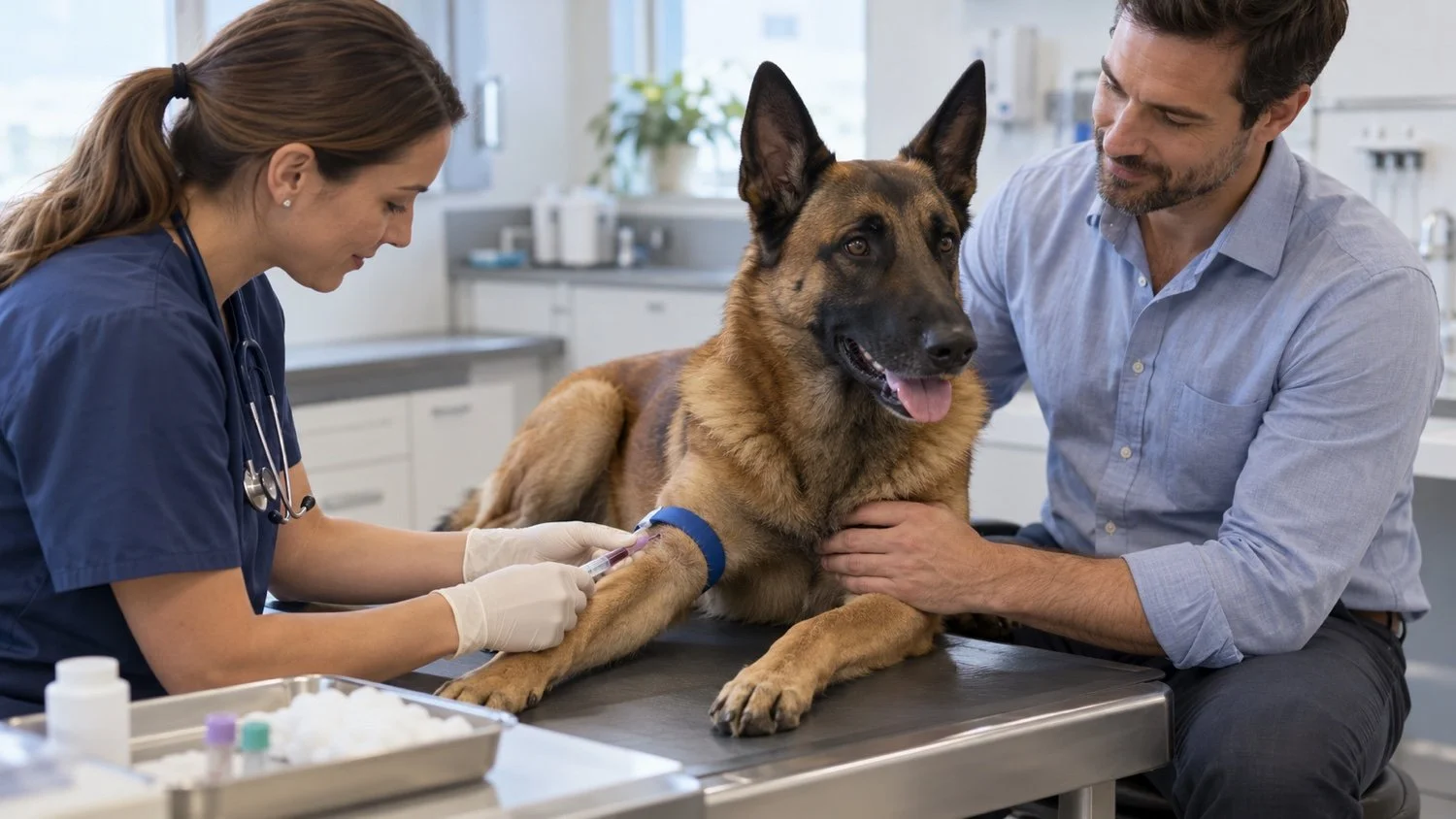
A study of a canine point-of-care HbA1c analyzer reported promising separation between selected diabetic and non-diabetic dogs. The findings do not establish a stand-alone test for every dog or show that using the device improves long-term health.
The study evaluated Vet Chroma, a point-of-care analyzer that measures hemoglobin A1c, usually shortened to HbA1c. The Journal of Veterinary Internal Medicine paper examined whether the analyzer could measure canine HbA1c consistently, how its readings compared with another laboratory method, and how well it separated selected dogs with diabetes from those without the disease.
HbA1c is hemoglobin with glucose attached. Because red blood cells remain in circulation over time, HbA1c can reflect average glucose exposure across several weeks, rather than a single moment. The study authors describe it as another potential measure to interpret alongside a dog’s history, clinical signs, examination, and other laboratory findings.
The time window and assay matter. Current AAHA guidance describes HbA1c as a marker of average blood glucose over the preceding 2–3 months and notes that a separate canine mail-in dried-blood-spot card has not been validated in diabetic dogs. That note concerns a different product; it should not be read as a finding about the Vet Chroma point-of-care analyzer evaluated in this study. Validation cannot automatically be transferred from one assay to another.
Researchers evaluated three distinct groups: 51 dogs with diabetes and 44 hospital-based non-diabetic controls for diagnostic performance, plus a separate group of 42 clinically healthy dogs aged 6 months to 2 years to establish a reference interval. This was a validation study of one analyzer, not a trial showing that the test changes treatment decisions or improves outcomes in ordinary practice.
What the study found
At a threshold above 3.22% HbA1c, the analyzer’s results separated the diabetic dogs from the non-diabetic comparison group with an area under the receiver operating characteristic curve of 0.969. The reported sensitivity was 90.2%, and the specificity was 100% in this sample.
Those figures need context. Sensitivity describes how often the test identifies dogs in the diabetic group at the chosen threshold. A result of 90.2% means the threshold did not identify every diabetic dog in the study. Specificity describes how often the test correctly classifies dogs in the comparison group as not having diabetes. The study reported no false positives among its selected non-diabetic controls at that cutoff; it did not prove that false positives are impossible in a broader population. Current AAHA guidance bases diagnosis of diabetes in dogs on compatible clinical signs together with hyperglycemia and glucosuria. This study does not establish HbA1c as a stand-alone diagnostic test or replace that clinical framework.
The statistical confidence intervals also matter. The paper reports a 95% confidence interval of 78.6% to 96.7% for sensitivity and 92.0% to 100% for specificity. In other words, the sample produced an encouraging result, but the underlying precision of those estimates remains limited by the number and makeup of dogs studied. The 100% figure should never be shortened to “perfect” or presented as a guarantee.
Average HbA1c was higher in the diabetic group than in the non-diabetic group: 5.10% versus 1.58%. The analyzer’s mean intra-assay and inter-assay coefficients of variation were 3.92% and 8.47%, respectively, and linearity across the studied clinical range was strong (R² = 0.973). These are analytical-performance findings under study conditions; they do not tell an owner how to interpret one dog’s result.
Why one test result is not a diagnosis
The study itself points to reasons for caution. HbA1c results from Vet Chroma were not interchangeable with results from the laboratory comparator assay. That means a value from one method should not be treated as though it were numerically identical to a value from the other. The study also found variable interference from lipemia, which involves excess fat in the sample, and icterus, which reflects bilirubin. Such effects can complicate interpretation in some samples.
Storage conditions were another part of the validation. The study found that refrigerated samples remained stable for up to five days and frozen samples for up to three months, while results were not reliably stable after six months of frozen storage. These details matter to laboratories and clinics handling samples, and they show why validation includes more than simply checking whether two groups produce different averages.
The reference interval also has a defined scope. Researchers calculated a population-based interval of 1.25% to 2.75% using 42 clinically healthy dogs between six months and two years old. A reference interval based on young, healthy dogs should not automatically be applied to every age, breed, or health status. It also is not the same thing as a diagnostic cutoff for diabetes.
What a point-of-care result could add
A point-of-care instrument is designed to provide a result near the time and place of a clinical visit. If future work supports broader use, a canine-specific HbA1c measurement could offer veterinarians another piece of information about glucose exposure. The study’s authors describe the analyzer as a possible rapid in-clinic measure, with results interpreted alongside clinical and clinicopathologic findings.
That is a more careful claim than saying the analyzer “diagnoses diabetes.” The study did not evaluate whether adding this measurement to care leads to earlier diagnosis, changes medication plans, improves glucose control, prevents complications, or lengthens a dog’s life. It evaluated analytical performance and separation between groups already classified for the research.
Further work can help answer how the threshold performs in a wider variety of dogs and clinical settings, how results vary across health conditions, and how the measurement should be used over time. Clinicians would also need assay-specific reference information and clear guidance about potential interferences and comparisons with other methods.
The authors’ funding disclosure identifies Boditech Med Inc., the maker associated with the Vet Chroma analyzer. That does not invalidate the study, but readers should have the information when weighing a product-specific validation. Independent replication and testing in broader clinical populations would help establish how well the findings travel beyond this study.
What dog owners should know
Owners cannot use the study’s cutoff as an at-home rule, and this article does not recommend buying or using a medical device. If a dog is drinking or urinating more than usual, eating more while losing weight, or showing other concerning changes, contact a veterinarian. Those signs have more than one possible cause, and only a veterinary professional can evaluate them in context.
For owners whose dogs already have diabetes, the useful question is not whether one new number replaces the current monitoring plan. It is whether a veterinarian believes an additional measure is appropriate, available, validated for the dog’s circumstances, and interpretable alongside other results. The research does not establish that the Vet Chroma assay should replace existing testing or veterinary judgment.
The news is that researchers have evaluated a canine HbA1c point-of-care analyzer and reported encouraging discrimination between selected diabetic and non-diabetic dogs. The limits are just as important: one analyzer, a defined study population, non-interchangeable comparison methods, potential sample interference, and no evidence yet that using the test improves clinical outcomes.
That makes the result a promising addition to the research conversation—not a home diagnosis, not a universal threshold, and not a substitute for a veterinarian’s assessment.
This report is educational and does not replace veterinary diagnosis or advice.