Florida Dog Owners Have Prescription Choices

AI-generated editorial illustration; the people and veterinary clinic depicted are fictional.
Image credit: Inspired by Tyson
Florida dog owners can ask for a written prescription and choose where it is filled, subject to pharmacy capability and legal restrictions. This law does not guarantee a lower price or replace veterinary advice.
Florida dog owners now have a clearer choice when a veterinarian prescribes medication: take a written prescription to a pharmacy they select, or have the veterinary clinic fill it when the clinic can.
That choice is not a new coupon, a price guarantee, or a reason to distrust your veterinarian. It comes from House Bill 89, now Chapter 2026-77, which took effect July 1, 2026. Before dispensing, a veterinarian or authorized staff member must clearly inform the client of the available filling options.
It makes “Can I fill this somewhere else?” a routine question for Florida dog owners.
What Florida veterinarians must disclose
Section 474.224 of the Florida Statutes requires a licensed veterinarian, or an authorized member of the veterinary staff, to explain two choices before dispensing a prescription medication.
The client may receive a written prescription that can be filled at the pharmacy of the client’s choice. If the veterinary establishment is able to fill the prescription, the client may choose that option instead.
During an in-person appointment, the disclosure is made verbally. During a veterinary telehealth consultation, it is provided electronically.
This is an informed-choice rule, not a preference for one option. In-clinic dispensing may be convenient; another pharmacy may better suit an owner. The choice belongs to the client, subject to the prescription and applicable law.
What counts as a written prescription
“Written” does not necessarily mean a paper slip.
Florida’s law and the state’s veterinary guidance recognize two common forms: a paper prescription handed to the client or an electronic prescription sent directly to a pharmacy.
An electronic prescription sent directly to the selected pharmacy can meet the requirement; an owner need not always leave with a paper copy.
Owners should still confirm how the prescription will be sent and whether the pharmacy can process it. A legal right to choose a pharmacy does not guarantee that every pharmacy carries every veterinary medication or is able to dispense every prescription.
The acknowledgment is generally one time
The veterinarian or an authorized staff member must document the option the client chooses with a one-time acknowledgment signed by the client, stating that the client is aware of the available options. The clinic must keep that acknowledgment in the animal’s medical record.
DBPR says the law sets no deadline for obtaining acknowledgments from existing clients. If a clinic cannot verify a prior signature, it may request one at a later visit.
The form also has limits. It may not include statements, warnings, notifications, or assumptions about the efficacy or safety of using an outside pharmacy. Its purpose is to document disclosure and choice—not to frighten or pressure a client into filling the prescription in one place.
Why clinics are posting signs
Dog owners may also notice a new sign near the checkout counter or point of sale.
Veterinary establishments must display a clear and conspicuous notice describing the client’s prescription-filling options. DBPR has published a sample sign and says inspectors will review compliance during a clinic’s next scheduled inspection. According to the agency’s guidance, a missing sign may be corrected on site, and an inspector may provide one for the establishment to post.
The Florida Board of Veterinary Medicine has also proposed amending Rule 61G18-15.002 to add the prescription-disclosure sign to the list of items verified during premises inspections. The proposal was published September 18, 2026. As of October 10, the Florida Administrative Code still identifies the April 5, 2018 version as the latest adopted rule, so the signage-inspection amendment remains proposed rather than final.
The statute is in force; the inspection-rule change remains proposed.
Two important exceptions
The disclosure, acknowledgment, and signage provisions do not apply in every situation.
The first exception covers emergencies in which immediately dispensing medication is necessary to preserve life or prevent suffering. A veterinarian treating an urgent patient does not have to delay necessary medication to complete the ordinary disclosure process.
The second involves a controlled substance whose dispensing is restricted by federal or state law. A client’s pharmacy preference does not override restrictions that legally control how a medication may be dispensed.
Ask the clinic if you are unsure whether an exception applies.
What the law does not promise
The Florida law gives owners information and a choice. It does not promise that using an outside pharmacy will lower the price.
Medication costs can vary by product, quantity, pharmacy, availability, and other circumstances. The statute does not cap prices or declare that one dispensing option is less expensive.
It also does not require every pharmacy to accept or fill every veterinary prescription. Stocking, dispensing capability, prescription requirements, and legal restrictions remain separate questions. Before leaving the clinic, an owner who wants to use an outside pharmacy should confirm that the pharmacy can receive and fill the prescription.
The law does not require owners to go elsewhere, either. If the clinic can fill the prescription and the owner prefers the convenience, the clinic remains a valid choice.
Questions worth asking before leaving
A short, specific conversation can prevent delays after the appointment:
- Can I receive this as a paper prescription, or can you send it electronically?
- Can the pharmacy I selected fill this particular veterinary prescription?
- Does an emergency or controlled-substance restriction apply?
- Have I already signed the one-time acknowledgment?
- If the pharmacy has a question, whom should it contact at the clinic?
- Who should I call if I have questions about administering the medication?
Questions about dosage, timing, side effects, substitutions, or changing products should stay with the veterinarian and, when appropriate, the dispensing pharmacist. Choosing where to fill a prescription is not the same as choosing how to use the medication.
A practical change, not a fight with veterinarians
The strongest reading of this law is also the least dramatic: it makes the prescription conversation more transparent.
Veterinary clinics remain responsible for diagnosing, prescribing, counseling clients, and protecting patient welfare. Owners gain a clearer explanation of their filling options. Those responsibilities can coexist.
The law requires the disclosure, signed acknowledgment, and posted sign. DBPR advises clinics to review their policies, forms, records, systems, telehealth practices, and signage. Owners may see changes at different points in the visit, but the central message should be consistent.
Florida dog owners can ask for a written prescription and can select where to have it filled, subject to pharmacy capability and legal restrictions. They should generally sign the acknowledgment only once. They can also choose the veterinary clinic when it can dispense the medication and that option works best for them.
That is the real value of the law: not a guaranteed bargain, but a clearer decision.
This article explains Florida law for general information and is not legal or veterinary advice. For controlling language, consult section 474.224, Florida Statutes, and current guidance from the Florida Department of Business and Professional Regulation’s Board of Veterinary Medicine.
This article explains Florida law for general information and is not legal or veterinary advice. For controlling language, consult section 474.224, Florida Statutes, and current guidance from the Florida Department of Business and Professional Regulation’s Board of Veterinary Medicine.
Sources
- Florida Statutes §474.224 and Chapter 2026-77, Laws of Florida
- Florida DBPR, Board of Veterinary Medicine, Important Information (Hot Topics)
- Florida DBPR, Board of Veterinary Medicine FAQs: Prescription Disclosure
- Florida DBPR, HB 89 sample sign template
- Florida Senate, HB 89 bill summary and vote record
- Florida Administrative Register Notice 31384658 and Rule 61G18-15.002 history
 Stephen Gill
Daily Doggy News
 New World Screwworm Outbreak: What Dog Owners Need to Know
 USDA Expands Federal Oversight of Commercial Dog Breeders
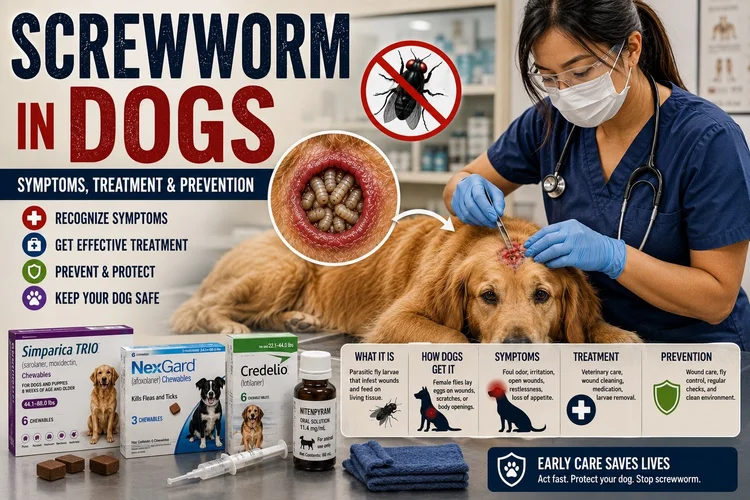 Screwworm in Dogs: Symptoms, Treatment & Prevention
 Yulin Dog Meat Festival: Why Asia Must End Dog Meat
 Why Does Tyson Sleep on My Feet Every Night?