Wild Dogs’ 2,500-Mile Journey Reveals Fragile Corridors
A record-setting journey across Zambia shows African wild dogs can still move between distant ecosystems. The harder question is whether those journeys lead to breeding, genetic connectivity—and survival.

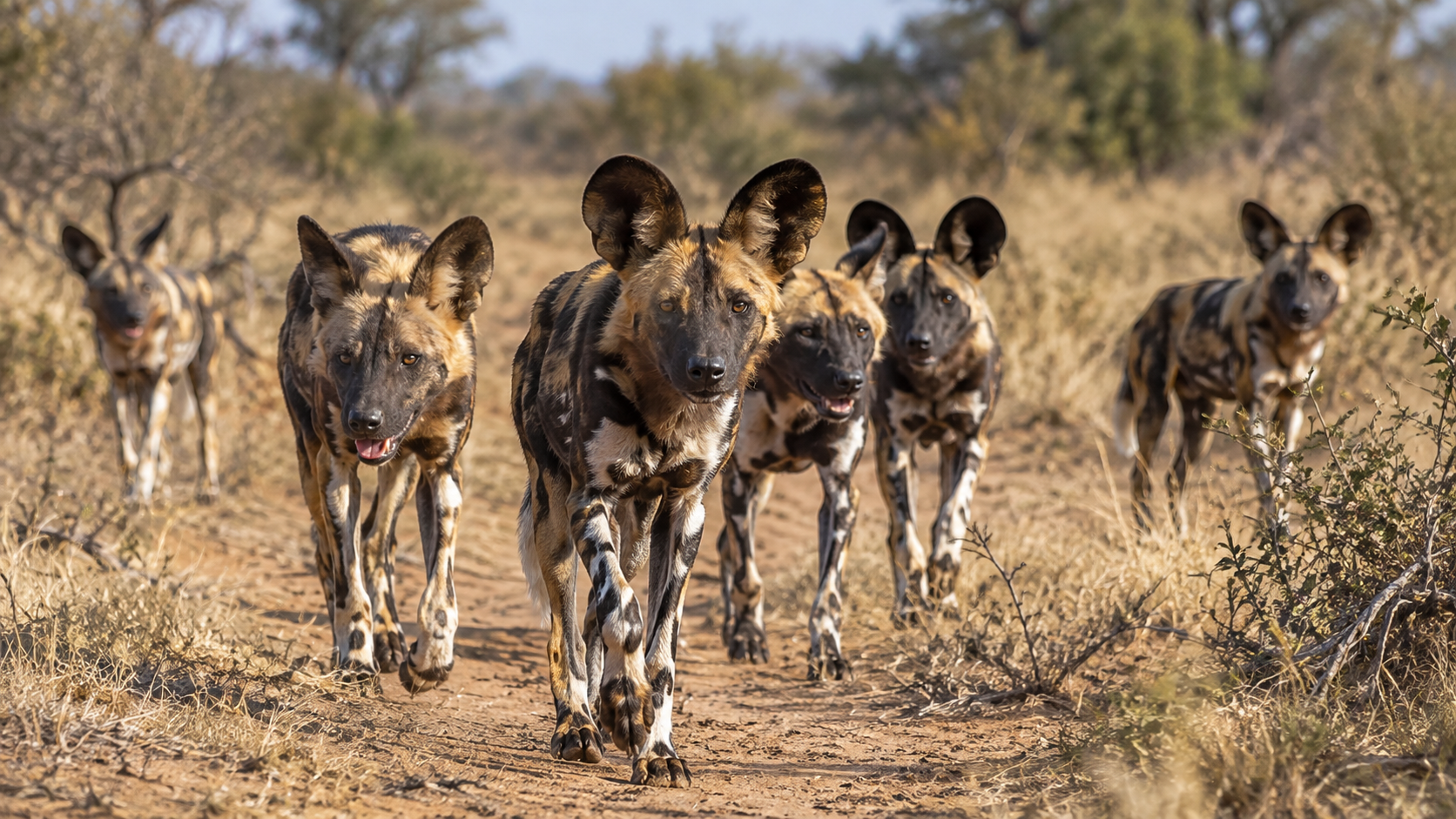
Three male African wild dogs from Zambia traveled 4,126 kilometers—more than 2,500 miles—after leaving their natal pack, the longest path recorded among the recent dispersals documented in a new Ecology paper.
Reuters described the journey as the longest recorded dispersal for any African mammal. The primary study also places the trip in a broader pattern: four highlighted dispersing groups collectively traveled 9,863 kilometers across a landscape of protected areas, farms, roads, cities and unprotected land.
That scale of movement is striking for an endangered carnivore whose populations are scattered across increasingly fragmented landscapes. But the study's most important finding is not simply that wild dogs can travel extraordinary distances.
It is that movement between ecosystems does not automatically produce successful breeding, immigration or durable population recovery.
The dogs can still cross the map. What happens after they arrive is much less certain.
A journey that started in Kafue
In July 2025, four 3-year-old females left the Mayukuyuku Pack in Kafue National Park. Three males of the same age left the same pack about two weeks later.
The pack had 18 adults and yearlings before the departures, and both dispersing groups came from a cohort of 19 pups that had survived to adulthood.
Leaving was not unusual in itself. African wild dogs live in cooperative packs in which breeding is generally concentrated in a dominant male and female. Young adults may remain and help relatives or disperse in search of breeding opportunities elsewhere.
What followed was unusual.
The females initially moved through the Lunga Lushwishi Game Management Area, while the males headed east into largely unprotected central Zambia.
Their routes brought them near major cities including Kabwe, Kitwe and Ndola. When the males reached Ndola, they reversed course and retraced roughly 200 kilometers of their earlier route.
Then, on September 18 and 19, the two groups encountered one another again in an unprotected area between Kitwe and Ndola.
By that point, the females had traveled 1,404 kilometers and the males 1,203 kilometers from their natal range.
They separated again after a day.
That detail matters because it shows how different movement is from successful dispersal. Finding other wild dogs—even familiar ones—does not necessarily mean a new pack forms, breeding follows or a population gains a new reproductive member.
Built to move through difficult country
The Ecology paper helps explain how wild dogs can cover such distances.
Previous GPS research cited by the authors found that wild dogs outside protected areas shift into a distinct travel pattern.
Their mean speed increases about 1.7-fold and their movements become substantially straighter, with a 2.4-fold decrease in mean turning angle compared with typical movement inside protected areas.
That behavior may help them move quickly through landscapes made risky by people, roads and other pressures.
The paper describes wild dogs as unusually capable of navigating unfavorable terrain, an ability connected to the way the species has evolved alongside larger competitors such as lions and spotted hyenas.
The Mayukuyuku males demonstrated that flexibility repeatedly.
After moving back south, they navigated around Kabwe, skirted two large reservoirs and eventually reached the Chisomo and Petauke Game Management Areas in the Luangwa Valley ecosystem.
In November, they came remarkably close to another possible social connection.
Four females from the Kasweta Pack in South Luangwa National Park had also dispersed. The paths of the two groups passed within 1.6 kilometers of one another within a six-day period.
The Kasweta females had traveled 1,538 kilometers. The Mayukuyuku males had traveled 2,356 kilometers.
Yet again, proximity did not become lasting connection.
The males continued moving and, by April 1, 2026, had traveled 4,126 kilometers before settling in a new range in the Luano Game Management Area.
Nearly 10,000 kilometers—and little demographic payoff
This is where the study becomes more complicated than a record-distance story.
The four highlighted dispersals—the Mayukuyuku males, Mayukuyuku females, Luamfwa females and Kasweta females—combined for 9,863 kilometers of movement.
Yet the researchers wrote that these movements produced little genetic or demographic connectivity.
That distinction is central.
A corridor can be physically open enough for an animal to cross without reliably producing the social outcome that conservation ultimately needs.
Wild dogs are searching not simply for habitat but for other wild dogs under the right social and demographic conditions.
Immigration can be difficult because unfamiliar wild dogs may fight, sometimes fatally.
So a 4,126-kilometer journey proves remarkable mobility. It does not prove that a disperser successfully joined a breeding population, reproduced or strengthened gene flow between distant populations.
The researchers nevertheless see the continued movement between major ecosystems as important.
Observed movements have linked Zambia's major wild dog populations, extended into Mozambique and approached the borders of Zimbabwe, Malawi, the Democratic Republic of Congo and Angola.
The authors argue that this enduring ability creates an opportunity to conserve a functional metapopulation across a much larger landscape—if the routes remain passable and the animals survive them.
The danger hidden along the route
Survival is the other half of the story.
EWD-1355, a 3-year-old female from the Luamfwa Pack in South Luangwa National Park, dispersed with two littermate sisters in October 2021.
Over 11 months, they traveled more than 2,300 kilometers into Mozambique and back, crossing rivers, highways, protected areas and human-dominated landscapes.
They eventually reached the home range of a large pack in Lower Zambezi National Park.
But they did not join that pack, and no males left it to join them.
They moved on.
In June 2022, EWD-1355 died in a wire snare set for bushmeat hunting.
The Mayukuyuku females later encountered a similar threat.
After traveling 1,899 kilometers, the collared female repeatedly returned to a fixed location in an area where active snares were present.
Because wild dogs often remain near injured packmates, the researchers inferred that one of the uncollared females had been snared.
On October 23, the collared female also died. The paper says she probably died in a snare after her collar was cut off with a knife.
The fate of the remaining sister is unknown.
Those details are presented with deliberate scientific caution.
The first snaring was inferred from movement behavior and local conditions; the second was considered probable rather than directly observed.
What is not uncertain is the broader threat.
Wire snares are difficult for wild dogs to detect, and the risk increases when they leave well-protected areas.
The paper identifies snaring, road deaths and conflict associated with livestock killing as major hazards in human-dominated landscapes.
Connectivity is still possible—but it is not secure
The study gives conservationists two messages at once.
First, wild dogs retain an extraordinary capacity to move between distant ecosystems.
Genetic research and observed dispersals both support the idea that populations that appear isolated on a map may still have pathways between them.
Second, those pathways are fragile.
The animals must navigate human settlement, roads, reservoirs and areas where wire snares can turn a successful thousand-mile movement into a dead end.
Zambia has an unusually large share of land under some form of wildlife protection, and some important corridors—particularly in the Luangwa Valley—already benefit from protection.
Others do not.
The researchers argue that maintaining corridors between stronghold populations should therefore remain a high conservation priority.
That becomes especially important if wildlife populations inside protected areas grow.
More animals can mean more dispersal beyond park boundaries, creating opportunities for connectivity but also increasing the potential for conflict and mortality.
What the record really tells us
The 4,126-kilometer journey is extraordinary, but the bigger lesson is not that African wild dogs can simply overcome fragmentation.
They cannot.
Their movement abilities give them a chance to cross fragmented landscapes.
Whether that movement becomes successful immigration, breeding and long-term population connectivity depends on what they encounter along the way—and on whether the corridors remain open and survivable.
For dog readers, that is the useful distinction behind the headline number.
Distance shows what these animals are physically capable of doing.
The rest of the study shows why capability alone is not enough.
African wild dogs can still reach across enormous gaps between ecosystems. The challenge now is keeping those routes intact—and keeping the dogs alive long enough for movement to become meaningful connection.
Sources
- Primary study: Creel, Scott, et al. “Extraordinary movements connecting distant ecosystems by African wild dogs (Lycaon pictus).” Ecology, 2026.
- Reporting: Reuters — “African wild dogs trek thousands of kilometres to find mates, study shows” , September 15, 2026.
This article reports on peer-reviewed research published in Ecology and Reuters reporting on the study. Researchers distinguish physical movement between ecosystems from successful immigration, breeding, genetic exchange and long-term demographic connectivity.
About the author
Stephen Gill
Stephen Gill is the founder of Inspired by Tyson and writes Daily Doggy News from real life with Tyson. His work covers dog ownership, behavior, safety, canine health, working dogs and the relationship between dogs and their people.
Read Stephen Gill's full author profile