
Romania Tests a Humane Alternative to Dog Culling
A German-run shelter is sterilizing tens of thousands of dogs a year to prove Romania can manage strays without killing them. The effort is real. Whether it works is still unmeasured.



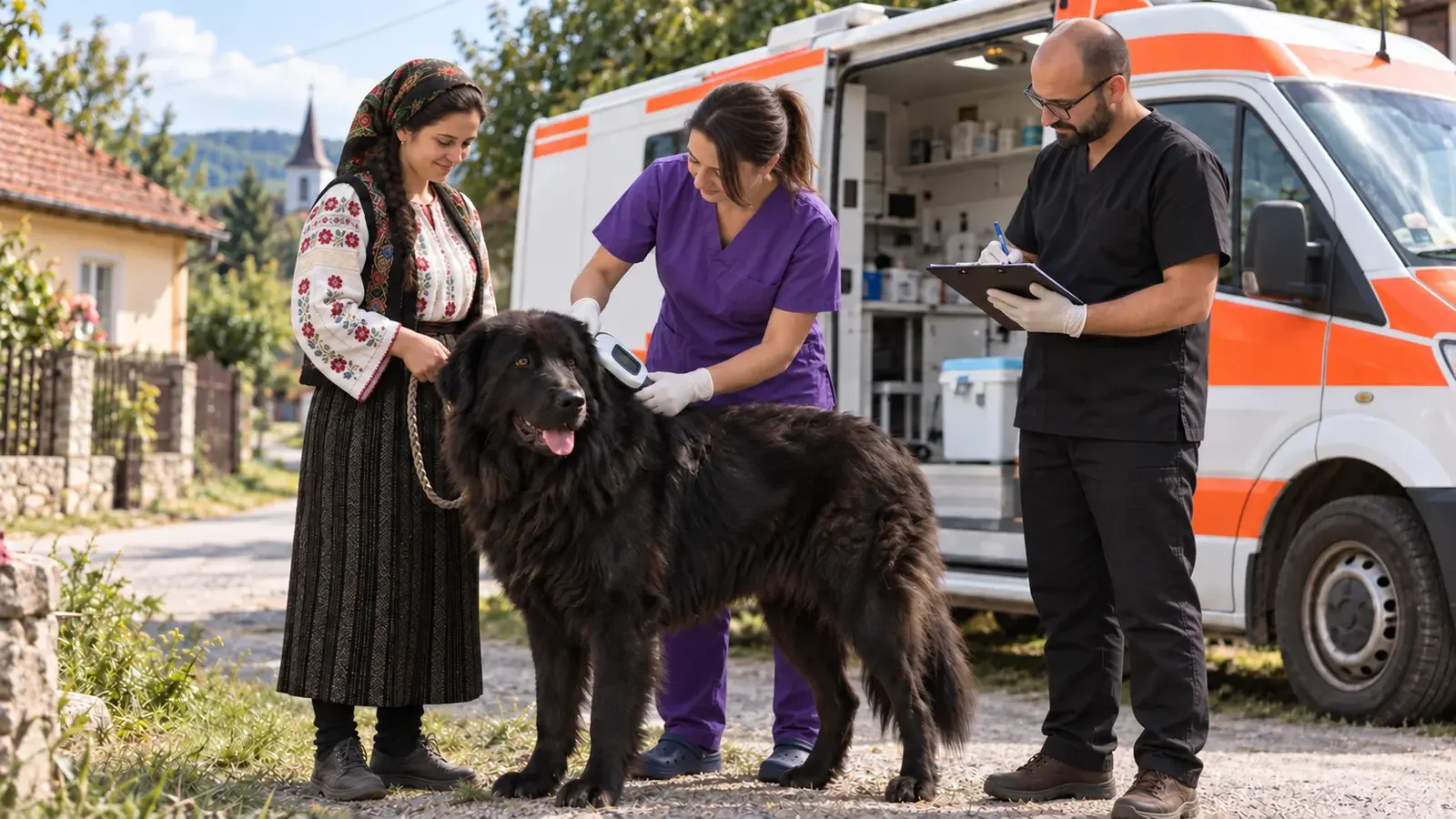
Every morning at dawn, eight veterinary vans leave the Smeura animal shelter in a forest in central Romania and fan out to villages, where their teams sterilize dogs for free. Reuters reported the operation from the village of Cateasca on September 17, 2026, describing a pilot run by the German group Tierhilfe Hoffnung with one goal: to show Romania there is a better way to manage stray dogs than capturing and killing them.
Thirteen years after Romania authorized the euthanasia of unclaimed strays, the country still has one of Europe’s largest roaming dog populations. Pressure to change course has grown since an undercover investigation this year documented severe conditions in publicly funded shelters, and a dog-population reform proposal remains before parliament.
A shelter built to shrink itself
Smeura sits on a former fox farm near Pitești. Tierhilfe Hoffnung says it houses more than 6,000 dogs and calls it the largest animal shelter in the world, a title it says it is not proud of. Reuters describes the shelter as unsubsidized.
Adoption alone cannot keep up. Reuters reports that Smeura sent more than 2,200 dogs out for adoption last year; the organization’s own site puts 2025 rehomings at 2,787. Either way, new dogs keep arriving.
Manager Matthias Schmidt told Reuters that intensive, large-scale sterilization is necessary because the dogs keep coming. According to Reuters, Smeura has performed nearly 40,000 sterilizations so far in 2026, covering both strays and owned pets. The organization reports 37,986 in 2025 at about 35 euros each, funded by donations.
In Cateasca, owners lined up with their own animals. The practical goal was simple: prevent unwanted litters from becoming the next dogs abandoned on the street.
How the pilot works
The program is more structured than a charity clinic. The German Animal Welfare Federation, which co-designed it, says the pilot launched in Argeș County in 2024 and runs for five years in cooperation with Romania’s national and regional veterinary authorities. A representative of the Argeș veterinary directorate attended the opening of its sterilization and registration center, which the federation describes as the first of its kind in the country.
The core idea is enforcement of rules that already exist. According to the federation, Romanian law requires owners to sterilize, microchip, register and vaccinate their dogs against rabies, but many do not, often because they cannot afford it. The pilot pays for sterilization, while authorized veterinarians handle identification, registration and vaccination.
The federation estimates Argeș County has about 185,000 dogs, roughly 85,000 of them ownerless, and says 34,650 animals were sterilized there in 2024. Schmidt described the five-year aim to Reuters: identify dogs, vaccinate them against rabies, register them nationally and sterilize them.
There is one important constraint. The federation says current Romanian law does not allow sterilized strays to be released where they were found. That limits the program to owned dogs and to strays the shelter can house or rehome.
Why Romania kills strays
The current framework is Law 258/2013, published in Romania’s Official Gazette on September 26, 2013, weeks after a 4-year-old boy was killed by stray dogs in Bucharest. Under the law, captured strays are held for 14 working days. Owners can reclaim them in the first seven; after that, anyone can adopt. Dogs neither reclaimed nor adopted may be euthanized by a veterinarian on an individual decision issued by a mayor’s delegate, with timing determined by shelter capacity and budget.
The mood at the time was intense. Bucharest City Hall told the Associated Press that about 10,000 residents were treated for dog bites in the first eight months of 2013, according to later reporting, and some anti-stray activists organized to kill dogs on the street themselves.
Inside the public shelters
Four Paws sent undercover investigators to nine publicly funded shelters between January 8 and 18, 2026, and published its findings in May. The group reported frozen or empty water buckets, untreated open wounds, overcrowded and feces-soiled kennels, and underweight dogs. It also found that the shelters it visited did not routinely vaccinate dogs against rabies or neuter them on arrival.
Four Paws reported high death rates. At the no-kill Brăila City shelter, about 40% of 1,035 dogs died in 2024. At Focșani, of 1,114 dogs, 56% were euthanized and another 24% died that year. The Associated Press separately reported Four Paws data from a Galați County shelter: of 644 dogs admitted in 2024, 134 were adopted, 28 were euthanized, and 412 died of “other causes.” These are the group’s figures, based on its visits and freedom-of-information requests, and have not been independently audited.
The Associated Press reported that Romania’s national veterinary authority, ANSVSA, did not immediately respond. In a separate statement to Newsweek Romania in May, ANSVSA said it carried out more than 800 inspections in 2024 and 2025, issued sanctions and promotes sterilization, but acknowledged it generally cannot inspect private property without the owner’s consent or a warrant.
The case for culling
Supporters of the 2013 law point to Bucharest. In early 2015, the head of the capital’s animal authority said about 51,200 dogs had been captured since October 2013, about 23,000 adopted and most of the rest euthanized, leaving roughly 4,000 on the streets. He said only 89 people were bitten in December 2014, the lowest in 30 years, according to Romania Insider. Those are the agency’s own figures.
The problem did not disappear. In January 2023, a woman jogging near Lacul Morii on Bucharest’s outskirts was killed by a pack of dogs. One district mayor argued afterward that the city was not euthanizing enough and that crowded shelters were consuming resources better spent on capture.
Rabies also remains a real concern. A man from Iași County died in July 2025 after a free-roaming dog bit him and he did not receive post-exposure treatment, according to the WHO Collaborating Centre for Rabies Surveillance and the journal Eurosurveillance. It was the first locally acquired human case of terrestrial rabies in the European Union since 2012.
What the evidence says
The international standard does not back either side’s strongest claims. The World Organisation for Animal Health states that euthanasia used alone is not effective for dog population management, and that reducing dog numbers is not an effective way to reduce rabies; vaccination coverage is. But WOAH also says catch-neuter-vaccinate-return is not a standalone fix and must be combined with responsible ownership, registration and identification.
Bucharest’s numbers show removal can sharply cut dog counts and bites in one city, at the cost of tens of thousands of dead dogs and with no guarantee the gains hold. The Argeș pilot, combining sterilization, registration and vaccination, is closer to WOAH’s guidance, but its results have not yet been published.
A law in limbo
The clearest current reform is L35/2026. Romania’s Senate adopted the proposal in April 2026 after the constitutional deadline expired, then sent it to the Chamber of Deputies as PL-x 317/2026. The measure would require local long-term dog-population plans, support sterilization and microchipping, promote adoption and responsible ownership, and allow community-dog sterilization and return under regulated conditions.
The proposal is not law. As of September 22, 2026, the Chamber of Deputies’ official record listed PL-x 317/2026 as sent to permanent committees for a report, with no final vote recorded. A separate proposal, PL-x 318/2026, concerns broader animal-protection enforcement and should not be confused with the dog-population measure. For now, Romania’s 2013 capture-and-euthanasia framework remains in force.
What remains unknown
Romania has no verified national stray count; the widely cited 500,000 figure is described by Four Paws as a rough estimate. The German Animal Welfare Federation says it will scientifically evaluate the Argeș pilot and is training staff to document stray numbers, but no results are public. National euthanasia totals are not transparent, according to Four Paws. And whether parliament will change the 2013 law remains open.
Why it matters to dog owners
Stray populations are fed by owned dogs that roam and by unwanted litters that get abandoned. Romania’s experiment rests on a simple premise: sterilizing, vaccinating and registering owned dogs may prevent the strays that culling later tries to remove. The next few years of data from Argeș will show whether that premise holds at scale.
This report distinguishes verified facts from organizational claims and unresolved evidence. It is general information, not veterinary or legal advice.
About the author
Stephen Gill
Stephen Gill is the founder of Inspired by Tyson and writes Daily Doggy News from real life with Tyson. His work covers dog ownership, behavior, safety, canine health, working dogs and the relationship between dogs and their people.
Read Stephen Gill’s full author profileRead More
 Newest Daily Doggy NewsWild Dogs’ 2,500-Mile Journey Reveals Fragile CorridorsA record journey shows why movement alone does not guarantee survival or genetic connection.
 Related: Human–Dog PartnershipWhat Hunting Dogs Teach Us About PartnershipA global study finds shared communication patterns across five societies.
 Newest Canine JournalKLIMB vs Cato Board vs MARKA detailed comparison of three dog-training platforms.
Newest It MattersClear the Shelters Takes More Than AdoptionFee waivers open a door; preparation and support help keep animals home.
Newest Canine JournalKLIMB vs Cato Board vs MARKA detailed comparison of three dog-training platforms.
Newest It MattersClear the Shelters Takes More Than AdoptionFee waivers open a door; preparation and support help keep animals home.
 Newest Tyson’s LifeWhy Your Dog Sleeps on YouWhat closeness, comfort and routine can mean when a dog chooses your space.