What Hunting Dogs Teach Us About Partnership
A global study found some striking similarities in how hunting dogs and their people communicate, across five societies that are otherwise very different. The lesson from it reaches a lot further than the hunting trail.
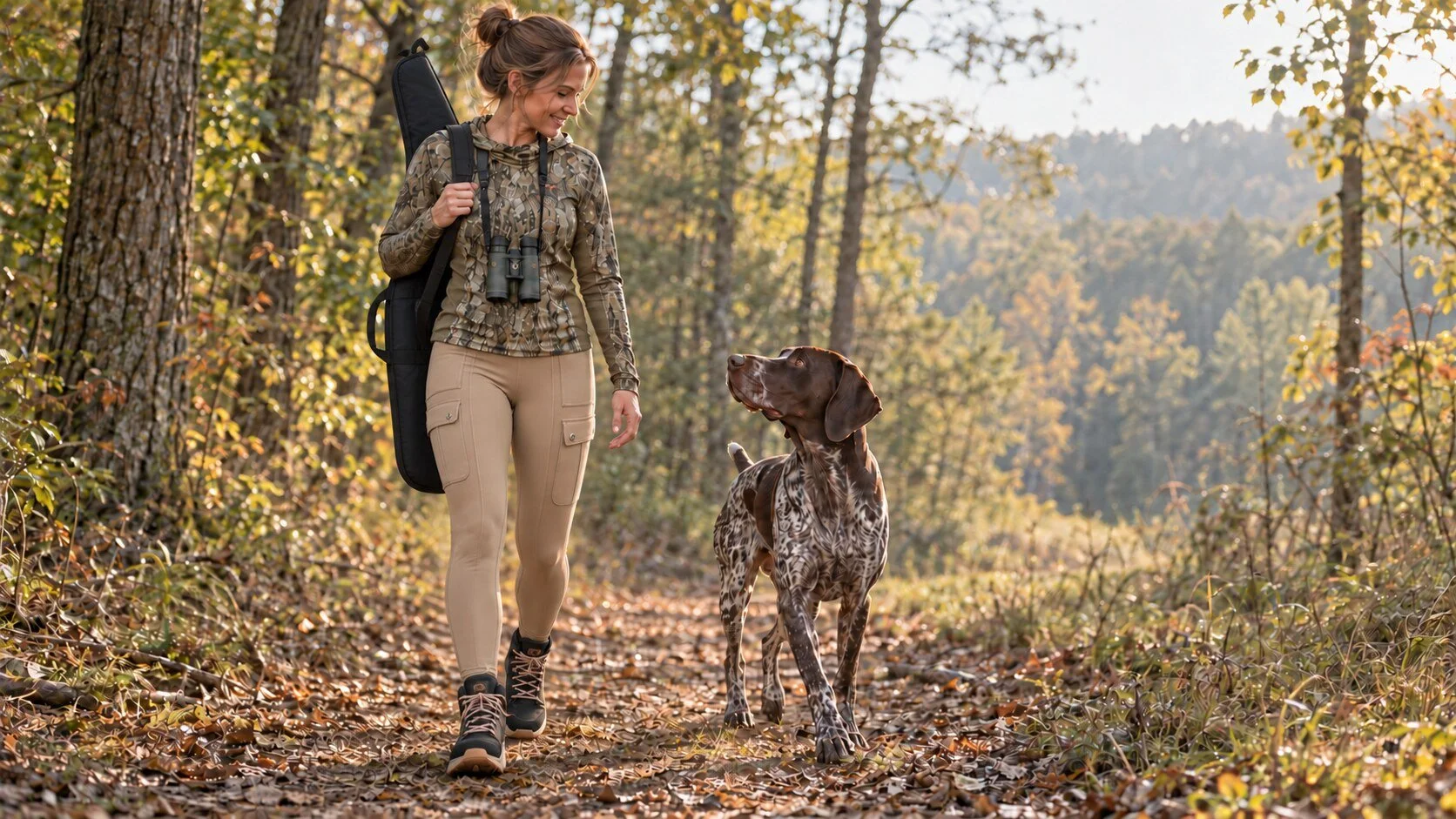
A dog pauses at the edge of a trail and looks back.
The person behind him is watching the direction of his body, the tension in his posture, where his attention has landed. Neither one of them needs a sentence. They're both just reading each other.
A global study of hunting dogs suggests this kind of partnership might be more consistent across cultures than researchers expected going in.
Scientists tested hunting dogs and their owners in rural communities in Vanuatu, Mongolia, Madagascar, Peru, and Germany. The language, the environment, the training customs, even what role the dog played day to day — all of it was different from place to place.
Even so, the researchers found a lot of recognizable cooperation. Dogs watched their people, picked up on gestures, and looked toward them when a task got hard. Owners, on their end, were often able to read what the dog was telling them.
The details shifted from place to place. The basic conversation didn't.
Why researchers studied hunting dogs
Most of what science knows about the dog-human bond comes out of Western, educated, industrialized, rich, and democratic societies — researchers shorten that to WEIRD. Family dogs brought into a university lab don't represent the full range of relationships dogs have with people around the world.
The study, published June 23, 2026, in Scientific Reports, was built to get around that. Researchers looked at dog-owner partnerships across five continents and five very different cultural settings.
Hunting dogs made sense as the comparison point because hunting is one of the oldest jobs dogs and humans have done together. It gave researchers a shared task without pretending the work looked identical everywhere.
German hunting dogs were generally trained more formally and had to pass hunting exams. In Vanuatu, dogs were central to tracking down wild pigs in dense forest, where whether a hunter could read his dog decided whether the hunt worked at all. Dogs in Mongolia and Madagascar split their time between hunting and guarding. In the Shipibo-Konibo communities in Peru, people sometimes hunted without dogs at all.
Those differences let the researchers ask something practical: when the surroundings, the training, and the customs all change, what part of dog-human communication is still standing at the end?
Six tests examined the partnership
Researchers recruited at least 30 dog-owner pairs at each site and ran six established social-cognition tests, plus a questionnaire for the owners.
The tests looked at whether dogs came when called, followed a pointing gesture to find food, helped an owner figure out where food was hidden, adjusted their behavior based on whether a person could see them, reacted to an unfamiliar object, and communicated with people once a problem became unsolvable.
There's no single score here declaring which dogs had the "best" relationship with their owner. Each task measured one narrow behavior, and not every dog completed every valid trial. Cooperation isn't one skill you can grade with a single trick.
Dogs kept watching the humans
Across all five populations, dogs looked toward their people constantly during the tests. They watched their owners around an unfamiliar object and turned toward a person once a task became impossible to solve.
The researchers think dogs everywhere may just be running a constant check on the humans around them. Looking gives a dog information — is this safe, is the person paying attention, can we communicate right now, did the plan change.
A dog looking back at you isn't necessarily asking the same question every time. He might be checking direction, asking for help, waiting on permission, or just reading your reaction.
At home this shows up in small moments. A dog looking between you and the door. Pausing at a familiar spot on the walk. Bringing you a toy and waiting. Glancing back when the routine at home shifts. The meaning is in the situation and the pattern, not in any one glance by itself.
The important part is that the attention runs both directions.
Pointing produced a careful result
Dogs were also tested on whether they'd use a human pointing gesture to find hidden food. Overall, researchers found no statistically significant difference in performance across the five populations, which backs up the idea that following a point isn't just a Western family-dog thing.
There's a real qualifier here though. Dogs in Germany, Madagascar, and Mongolia scored significantly above chance. Vanuatu and Peru didn't clear that bar statistically, and in Peru only eight dogs even produced valid trials for that part of the test.
So the honest read isn't that every group passed the pointing test the same way. It's that researchers didn't find a significant difference between the populations overall, even though sample size and trial limits affected some of the individual results.
That distinction sounds technical, but it's what keeps a genuinely interesting study from turning into an overblown headline.
Owners learned to read their dogs
One of the more interesting tests flipped the direction of communication. A dog knew which of four containers had food hidden in it. The owner then had to read the dog's behavior and pick the right one.
Owners in every population scored above the 25 percent chance level. Owners in Vanuatu stood out, picking the right container far more often than chance and beating most of the other groups.
Researchers tied that back to how much the dogs matter to hunting in Vanuatu's dense forest. Hunters there rely heavily on reading what their dog is telling them. Doing that work over and over turns a shift in posture, direction, or pace into real information.
The same thing plays out on a smaller scale at home. You learn the look your dog gives right before he needs to go outside. You notice how she approaches when something's wrong. You know the difference between an invitation to play and a request to be left alone, because you've watched those patterns build over time.
Communication builds through attention and repetition, not through one lucky guess.
Similar didn't mean identical
German dogs generally came to their owner faster when called and stuck with an unsolvable box longer than dogs in several other populations. They were also more likely to approach the unfamiliar object alongside their owner and engage in play during the social test.
Formal training, working exams, living setup, and familiarity with structured testing may all have played into that. Researchers also wondered whether Western culture pushes a more one-to-one relationship between a dog and a single primary owner.
Those are interpretations, not proof that one culture builds a better bond than another. A dog built for independent work in one environment shouldn't be judged against a dog that's closely directed in a different one.
The study also found that how owners rated their relationship quality didn't predict most of the test results. Saying you have a close bond with your dog didn't automatically mean he followed a point better, came back faster, or solved the communication task.
There was one exception. Around the unfamiliar object, dogs whose owners reported a higher relationship score were more likely to approach it together with them.
Affection matters. It just isn't a stand-in for practice, clear communication, and a shared history of working through problems together.
Give your dog something to do with you
Your dog doesn't need to hunt to get something out of cooperative work. The lesson isn't that every family dog needs a job. It's that a partnership gets clearer once both of you have something you both understand how to accomplish.
Some options worth trying:
- Follow a short, safe scent trail together.
- Ask your dog to find a hidden toy.
- Practice a hand target or a directional cue.
- Teach him to carry something appropriate to a basket.
- Pause on a walk and reward him for checking in on his own.
- Build a calm-place routine where he settles on cue.
Keep the task doable. Reward the attempts that work, and stop before excitement turns into frustration. Reward-based training helps a dog figure out what works without piling on fear or conflict — the American Veterinary Society of Animal Behavior recommends reward-based methods for training and behavior work.
None of this is about measuring your relationship against somebody else's dog. A senior dog searching for a toy at his own comfortable pace and a young working dog running a directional cue are both experiencing real cooperation.
Notice your half of the conversation
Dogs are watching where we look, how we move, whether we're available, what happens after they come to us. We need to be watching them back.
Notice when your dog looks back on a walk, pauses at something unfamiliar, brings you an object, changes direction, or tries to lead you somewhere. Not every movement is a hidden message. But the patterns that repeat can tell you when your dog is confused, confident, worried, or ready to work with you.
Respond the same way every time. Keep your cues clear. Reward cooperation and don't punish uncertainty. Once a dog learns that the subtle stuff actually gets a response, he doesn't need to escalate to barking, pulling, or avoiding you just to get noticed.
This study isn't the final word on every dog-human relationship out there. It focused on hunting dogs, leaned partly on tasks built in Western research, and couldn't pull valid data from every dog in every test. It's a wider view, not a finished answer.
But it's still worth carrying home.
Partnership doesn't come from affection alone. It grows out of attention, communication, trust, and what two individuals learn to get done together.
Your dog is already watching your side of that relationship.
Make sure you're watching his.
This article provides general educational information and is not a substitute for veterinary or individualized behavioral advice. Primary reporting is based on "Striking Global Similarities in Dog-Human Interactions," published in Scientific Reports, and supporting information from the University of Jena and the researchers' public data archive.
About the author
Stephen Gill
Stephen Gill is the founder of Inspired by Tyson and writes Daily Doggy News from real life with Tyson. His work covers dog ownership, behavior, safety, canine health, working dogs and the relationship between dogs and their people.
Read Stephen Gill's full author profile