What to Do When a Loose Dog Approaches?
A neighborhood encounter with an off-leash dog can become risky quickly. Here is how to create distance, protect your dog, and respond safely if the situation escalates.
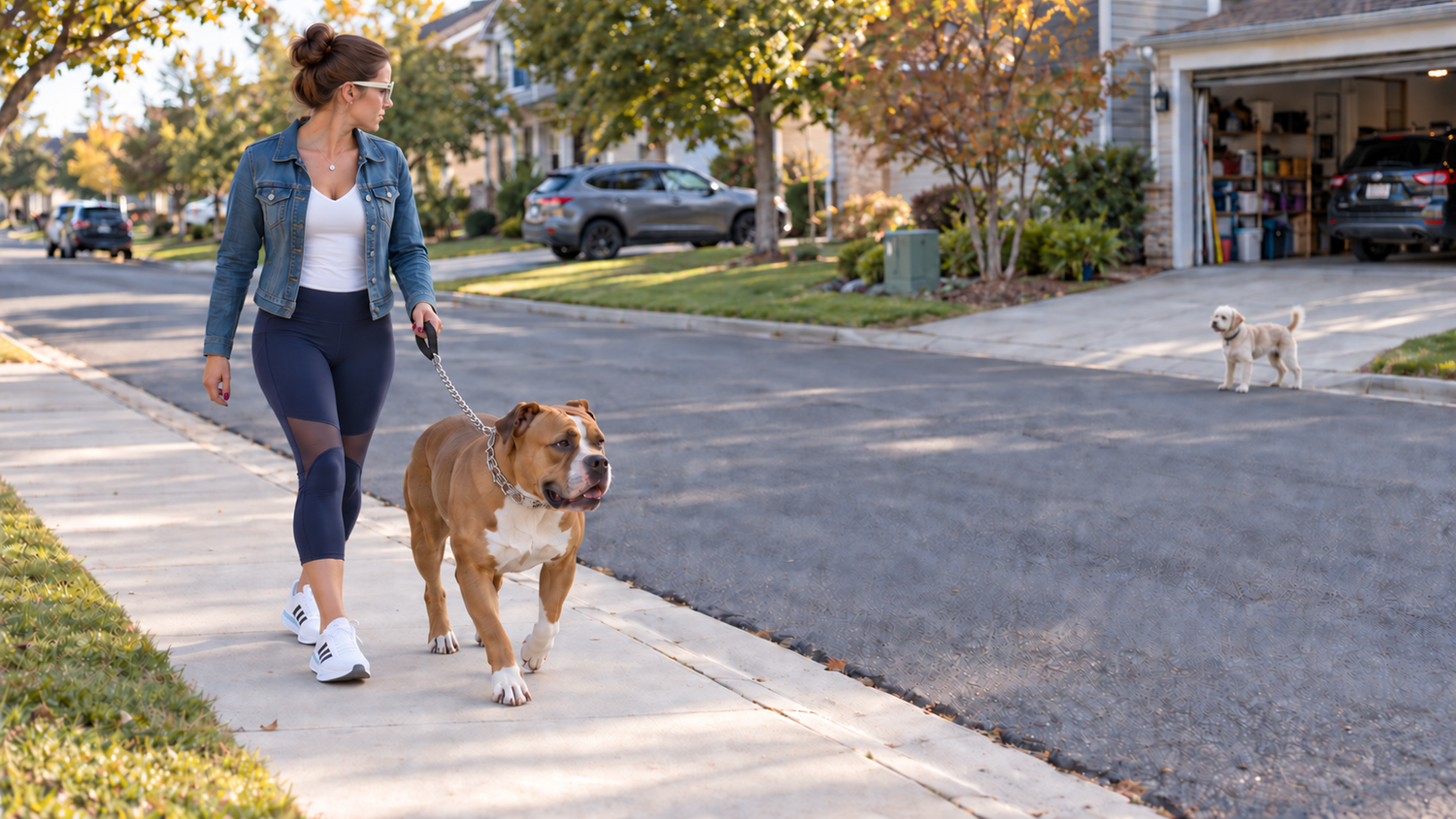
Staying calm and creating distance early gives both dogs fewer reasons to react. (Inspired by Tyson)
A neighbor a few houses down keeps a Chihuahua that is not reliably leashed. Twice now, I have been walking Tyson past his garage when the Chihuahua bolted across the street toward us, barking the whole way. The first time, it nearly got hit by a car.
Tyson glanced at the dog and then at me. I focused on staying composed, kept the leash short enough for control without yanking or holding it rigidly tight, and continued walking instead of stopping. The Chihuahua's owner did not move from the garage either time. During the second encounter, another person eventually ran across the street and retrieved the dog.
That is the ordinary version of many loose-dog encounters: a poorly supervised dog, an owner who is not responding quickly, and another dog owner deciding in real time how much space to create.
The need for that decision became especially clear after a serious incident reported in San Francisco's Tenderloin neighborhood on September 8. Police responding to the 500 block of Larkin Street at about 9:20 a.m. found a woman with life-threatening injuries and an unleashed dog beside her. CBS News Bay Area reported that witnesses said the owner was present when the attack began and later left; police said the owner had not been located at the scene. The investigation remains ongoing. The incident should not be used to draw conclusions about every loose dog or an entire breed, but it raises a practical question: What should you do when an unfamiliar dog is coming toward you?
Quick Answer
If an off-leash dog approaches while you are walking your dog:
- Turn around or cross the street before the dog gets close.
- Keep your dog beside or behind you.
- Tell the owner clearly that you do not want the dogs to meet.
- If the loose dog keeps coming, stop instead of running.
- Stand partly sideways and avoid staring directly into the dog's eyes.
- Use a calm, firm voice: “No,” “Stop,” or “Go home.”
- Put a solid object between the dogs when possible.
- Keep your hands away from their heads and collars if a fight starts.
Distance is the one thing you control. Use it early.
Leave before the greeting begins
Cross the street, turn down another block, or step behind a parked car, fence, or closed gate the moment you spot an unattended dog. Do this before you know whether the dog is friendly. Waiting to find out costs you the room you needed to leave.
The American Kennel Club recommends communicating clearly that you do not want the dogs to interact and using an emergency U-turn instead of continuing to close the distance.
A leashed dog cannot create distance freely when another dog runs straight toward him. That restriction can add frustration or fear to an already uncomfortable encounter. Walking away is not a verdict on whether either dog is friendly. It is a preventive decision made before the dogs have to settle the question themselves.
Put your dog behind you
Teach a cue that moves your dog to your side or behind your legs. Begin inside with a treat guiding him into position, mark and reward the movement, and add a cue such as “behind” once he follows reliably. Practice in quiet outdoor areas before using it around a real distraction.
Your body can then become part of the barrier while you move away. Keep the leash short enough for control, with enough softness to avoid constant pressure. The goal is controlled movement—not a locked-tight leash or a sharp correction.
If the loose dog keeps coming
Do not run. Sudden flight can invite pursuit.
Stop if the dog is already too close for a safe turn. Keep your arms controlled, angle your body partly sideways, and avoid a sustained stare. Use a low, firm voice. Simple cues such as “No,” “Stay,” or “Go home” may interrupt a dog with some prior training.
Look for an escape route without turning your back: a vehicle, trash container, bench, fence, or gate. A bag or folded jacket can serve as a temporary barrier, but do not swing it at a dog that has not attacked. Screaming, kicking, or flailing can raise arousal, so reserve physical defense for an actual attack.
Should you pick up a small dog?
There is no universally safe answer. If the approaching dog is still far away, your dog is comfortable being lifted, and you can retreat into a secure place, calmly picking your dog up may help. It can also draw attention upward or put your hands and face closer to the encounter. Once dogs are in contact, bending down adds bite risk. Prioritize distance, a solid barrier, and your own safety.
If the dogs make contact
Keep your hands away from both dogs' heads and collars. A highly aroused dog may redirect a bite toward the nearest hand without recognizing whose hand it is. Use a solid barrier if one is available, call for help, and call emergency services if a person is being attacked or seriously injured.
Once separated, keep the dogs apart. Do not bring them together again to test whether they have settled; adrenaline and arousal may remain high.
Check beneath the fur
I learned this one the hard way. On another walk, a small Yorkie got loose and ran into the street toward us, nipping while I held Tyson back. Tyson never lunged or fought back. After the owner retrieved the Yorkie, I checked Tyson and found a small cut on his lip. In the confusion, I had not realized he had been injured.
Check your dog's mouth, skin, and coat after any physical encounter, even one that looked minor. Punctures can hide under fur. Call your veterinarian after a bite, especially if another dog grabbed, shook, or pinned your dog. Seek urgent veterinary care for uncontrolled bleeding, breathing difficulty, collapse, severe pain, weakness, or a wound near the chest, abdomen, neck, or eyes.
If a person is bitten or scratched, wash the wound thoroughly with soap and running water for about 15 minutes, as recommended for possible rabies exposure, and obtain medical care. This is especially important for a deep wound, infection signs, unknown rabies-vaccination status, or bleeding that will not stop. Get the owner's contact information and the dog's rabies records if you can do so safely, and report the incident to the appropriate local agency.
A leash creates time and distance
A leash is a physical safety and management tool—not proof of dominance and not a guarantee that a dog will obey. It prevents a dog from immediately closing the distance, gives the handler time to turn away, and reduces the chance that fear, excitement, or sudden arousal will become direct contact.
Even a well-trained dog can miss a cue when the environment becomes intense. Recall training matters, but management matters too. Outside secure off-leash areas, a properly fitted leash and collar or harness give both the dog and handler a larger margin for error.
We cannot know exactly why the Yorkie approached Tyson. Fear, excitement, territorial behavior, frustration, or social interest can look similar when events unfold quickly. The safety problem was simpler: an unsecured dog was able to close the distance.
Prepare during ordinary walks
Teach these skills before you need them:
- A fast emergency U-turn
- “Behind” or “middle”
- Attention to the dog's name
- A hand target
- A reliable recall
- Calm movement past other dogs at a safe distance
Carry a charged phone. Check that the leash, collar, or harness fits and remains in good condition. Skip headphones on walks where you may need every second of warning, while still allowing your dog appropriate time to sniff and explore .
None of this makes a loose dog your responsibility. It means you are not inventing a plan in the moment something goes wrong. The plan already exists because you practiced it when the street was quiet.
This article provides general educational information and is not a substitute for veterinary, medical, legal, or individualized behavioral advice.
The Takeaway
Most loose-dog encounters are managed through prevention, not confrontation. The earlier you create distance, the fewer urgent decisions either dog has to make.
Top Takeaways
- Leave before the greeting starts; do not wait to learn whether the dog is friendly.
- Keep the leash short enough for control without holding it rigidly tight.
- Put your body or a solid object between the dogs when it is safe to do so.
- If contact occurs, keep your hands away from their heads and check for hidden wounds afterward.
Sources and Further Reading
- American Veterinary Medical Association — Dog bite prevention
- American Kennel Club — Handling an approaching off-leash dog
- CDC — Dog-bite prevention and response
- World Health Organization — Rabies and wound washing
- American Veterinary Society of Animal Behavior — Humane dog-training position statement
- San Francisco Chronicle — September 8 Tenderloin dog attack
- CBS News Bay Area — Witness and police reporting on the incident
About Stephen Gill
Stephen Gill is the founder of Inspired by Tyson and editor of its dog-focused publications. He writes about practical dog ownership, canine news, safety, behavior, and everyday life with Tyson.
Learn more about Stephen Gill →Related Stories
 Training & Behavior
Can Kindness Help a Fearful Dog Trust You?
Training & Behavior
Can Kindness Help a Fearful Dog Trust You?
 Canine Journal
How Training Can Reshape Your Dog's Brain
Canine Journal
How Training Can Reshape Your Dog's Brain
 Dog Lifestyle
Why Dogs Need Time to Sniff on Walks
Dog Lifestyle
Why Dogs Need Time to Sniff on Walks
 Newest Daily Doggy News
Farm Bill Could Deliver Hope for Working Dogs
Newest Daily Doggy News
Farm Bill Could Deliver Hope for Working Dogs