Bringing Home Tyson: First-Year Puppy Lessons

What Tyson's first year taught me about puppy training, safety, enrichment, handling, and house-training.
Bringing home a puppy requires early handling, reward-based training, careful supervision, enrichment, and a consistent house-training routine.
I Didn't Want a Bulldog
Tyson was not supposed to be my dog.
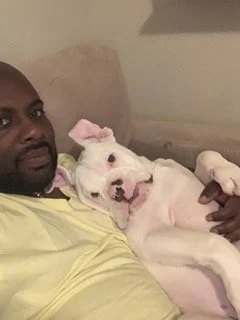
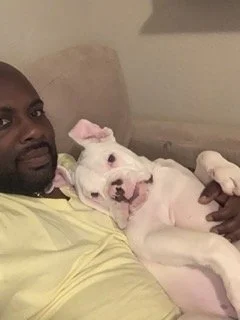
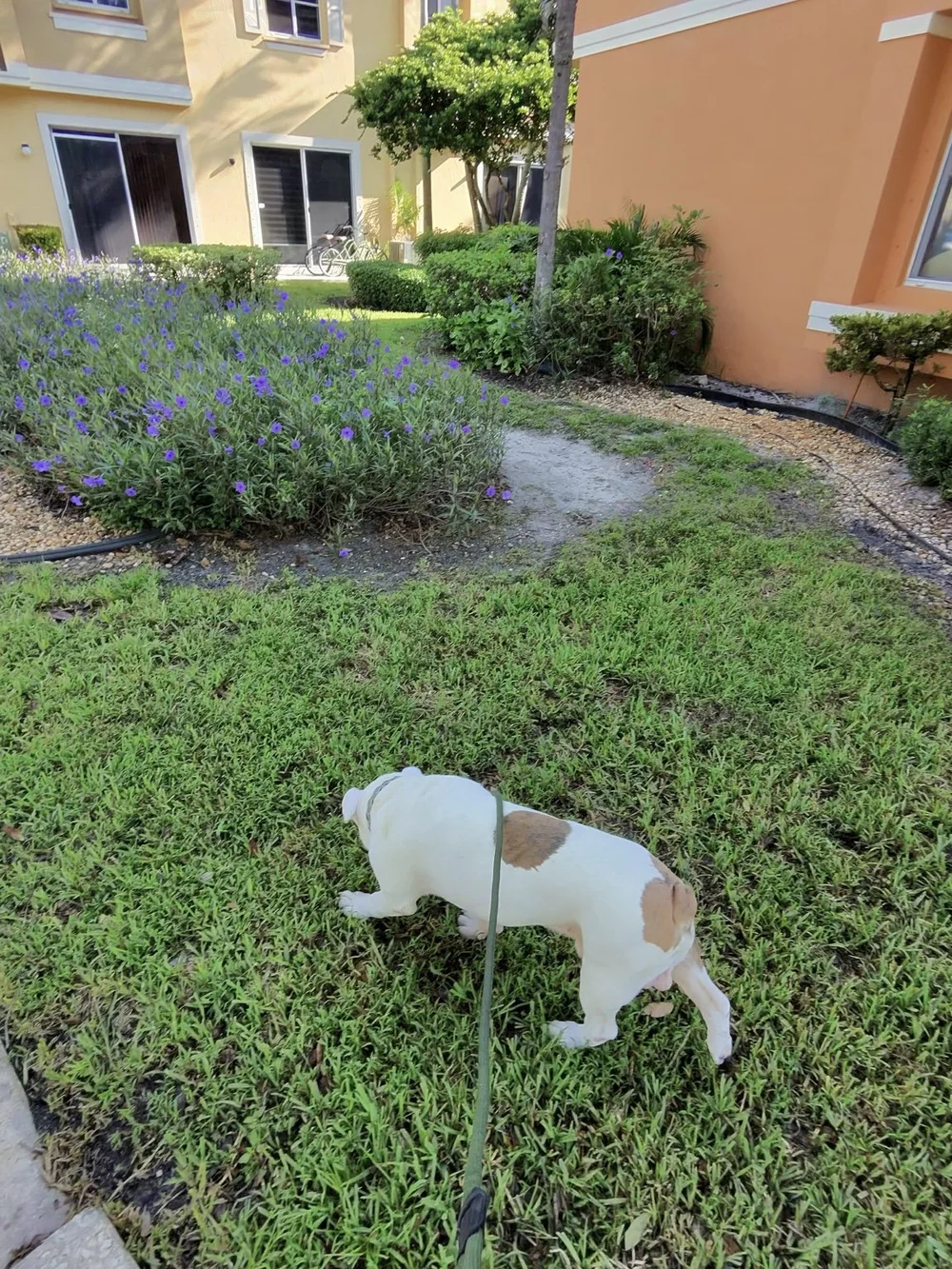
At the time, I was living in Washington, D.C., and a good friend of mine told me about a puppy who needed a home. Her brother worked with a woman whose boyfriend had given her a white Olde English Bulldogge. After the relationship ended, she no longer wanted the dog, and my friend's brother brought him home.
His name then was Angel.
When my friend asked whether I wanted him, my answer was basically no. If I was going to get a dog, I wanted a Boxer. I had already decided what kind of dog I thought fit me, and a bulldog was not it.
Then I saw him.
That was the end of that plan.
I wanted him, and one of the first things I did was change his name. Angel became Tyson.
Looking back, that moment was the beginning of Inspired by Tyson long before I knew there would ever be a business, a publication, or a collection of stories built around him. At the time, he was simply this white bulldog puppy who came into my life through a chain of people and circumstances that I never could have planned.
What I know now is that bringing home a puppy is the easy part. The real work starts the same day.
What I Would Do Differently From Day One

If I could go back to Tyson's first months with me, there are things I would change immediately. Not because he turned out to be a bad dog. He did not. He became the dog who changed my life.
But I made the mistake a lot of first-time owners make: I thought some training and handling could wait.
It should not have.
Start With the Feet
The first thing I would change is almost embarrassingly simple: I would play with his feet every single day.
I would touch his paws while he was relaxed. I would hold each toe for a second. I would gently handle his nails. I would bring the nail clippers near his feet without actually cutting anything. I would reward him for staying calm. Then I would do it again the next day.
I should have made paw handling boring.
Instead, by the time nail trimming mattered, I was asking an older, stronger dog to accept something I had never taught him was normal.
That lesson lines up with the puppy-development guidance in Your Bulldog Puppy Month by Month by Terry Albert, Tom Geiselhardt, DVM, and Betty Fisher. The book emphasizes using a puppy's early months to establish routines, handling, grooming, socialization, and household expectations while those experiences are still new.
The point is not to force a puppy to tolerate everything. It is to introduce ordinary care gradually, positively, and repeatedly so that veterinary exams, ear checks, nail care, brushing, and other handling are familiar rather than sudden battles later.
For Tyson, I learned that lesson after the easy window had already passed.
Training Should Have Started Earlier
I also waited too long to put real structure around training.
When Tyson was very young, a lot of our time was play. Then somewhere around five or six months, as he became more confident and physically mature, his personality got louder too. He started barking at me in ways that made it obvious he had opinions about how things were going to work.
That was when I realized I needed professional training.
If I did it again, I would not wait for the challenging behavior to show up before building the foundation.
Basic cues, boundaries, calmness, recall, handling, house rules, and attention should begin in puppyhood in short, age-appropriate sessions. A confident, independent dog does not need harsh treatment. He needs consistency. The clearer the rules are from the beginning, the less negotiating you have to do when that puppy becomes a powerful adolescent dog.
Tyson taught me that discipline is not about dominating a dog. It is about making expectations understandable.
Puppies Are Super Babies
The other thing nobody can really explain until you live through it is how much supervision a puppy requires.
A puppy can be fast, curious, fearless, and completely unreasonable about what belongs in his mouth.
With a bulldog puppy, I learned to look at the floor differently. Socks, plastic, dropped food, little household objects—anything Tyson could reach had the potential to become something he wanted to investigate with his mouth.
At one point, Tyson swallowed an entire sock.
There is no profound training lesson hidden in that story. I spent the next stretch of time waiting for the sock to pass, and when it finally did, I had the unforgettable job of helping remove what was left as he passed it.
That was enough to change how I looked at puppy-proofing.
Today, I would treat a puppy's environment much more like you would treat a home with a crawling baby: if swallowing it could create an emergency, it should not be where the puppy can get it.
Veterinary guidance matters here because swallowed objects can cause a partial or complete gastrointestinal obstruction. Merck Veterinary Manual describes foreign-object obstruction as potentially life-threatening, and VCA notes that clothing is among the objects dogs may swallow. If a dog swallows a sock or another foreign object, contact a veterinarian rather than assuming it will pass simply because Tyson's did.
Albert, Terry; Geiselhardt, Tom, DVM; and Fisher, Betty. Your Bulldog Puppy Month by Month: Everything You Need to Know at Each Stage to Ensure Your Cute and Playful Puppy Grows Into a Happy, Healthy, and Well-Adjusted Companion. DK, 2017.
Make the Food Work Too
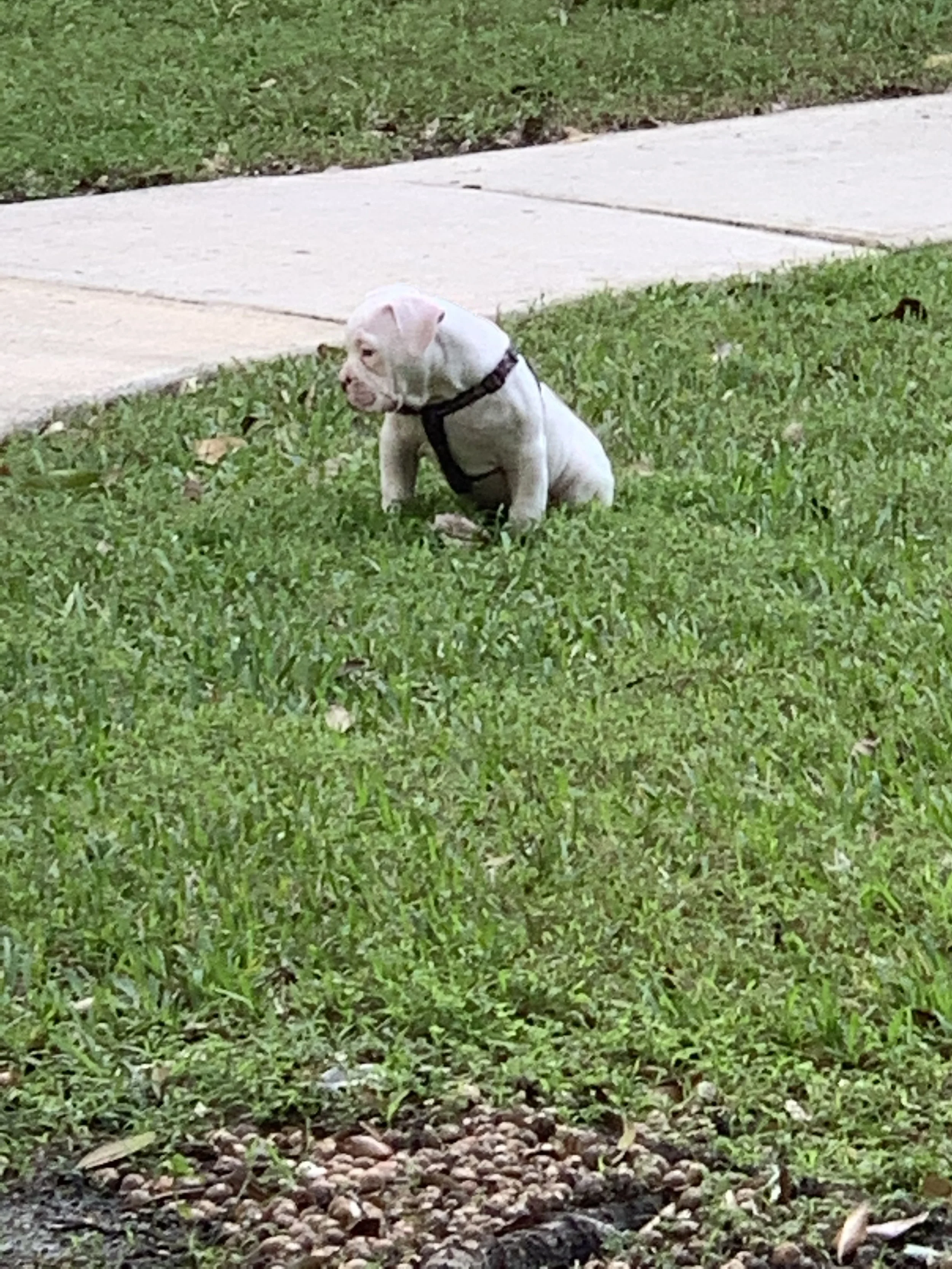
One of the smartest things I did with Tyson as a puppy was stop thinking of breakfast as something that had to arrive in a bowl.
He ate ORIJEN puppy food, and because he was extremely food-motivated, I could use part of his measured daily ration to make him think, move, search, and pay attention.
I had a food-dispensing ball that I could fill with his dry food. Tyson had to push it, kick it, roll it, and work out how to make the kibble fall out. At one point, my living room and entry area were mostly empty, so for about a week that became his breakfast routine. He did not just stand over a bowl. He had to work for the meal.
That kind of enrichment is not something I invented. Ohio State University's Veterinary Medical Center specifically describes using puzzle toys filled with an appropriate amount of a dog's regular dry food, including toys that can replace a food bowl for a meal. The important part is that the food still counts toward the dog's normal daily intake.
That distinction matters. I would not tell an owner to starve a puppy so he will train. What worked for Tyson was using food he was already going to eat as part of the training and enrichment process.
For Tyson, food was attention.
Teach the Cue, Then Let the Food Help
The command I cared about most was come.
I would take a piece of his kibble and toss it across the room. Tyson would run after it. If he did not see exactly where it landed, he had to use his nose to find it. Then he would come back to me and earn another piece.
We repeated that over and over.
What looked like a puppy chasing food was also becoming a simple pattern: go out, find something, return to me, get rewarded.
From there we worked on sit, down, stay, and come.
To teach sit, I used the food in my hand to guide him into position and rewarded him when his rear hit the floor. For down, I moved the food toward the ground and rewarded the position. Once he understood the spoken cues, I paired them with hand signals. Eventually, the gesture itself could be enough.
The American Veterinary Society of Animal Behavior recommends reward-based training and notes that puppy training should use frequent rewards such as food, praise, play, or petting. That matches what I saw with Tyson: when the lesson was clear and there was something worth earning, he paid attention.
The bigger lesson for me is that training does not have to be a separate hour carved out of the day. A puppy's regular food, play, walks, doors, toys, and routines can all become opportunities to practice attention and self-control.
I just wish I had understood that from the very beginning instead of waiting until Tyson started telling me—loudly—that he had his own ideas.
House-Training Means Living on Puppy Time
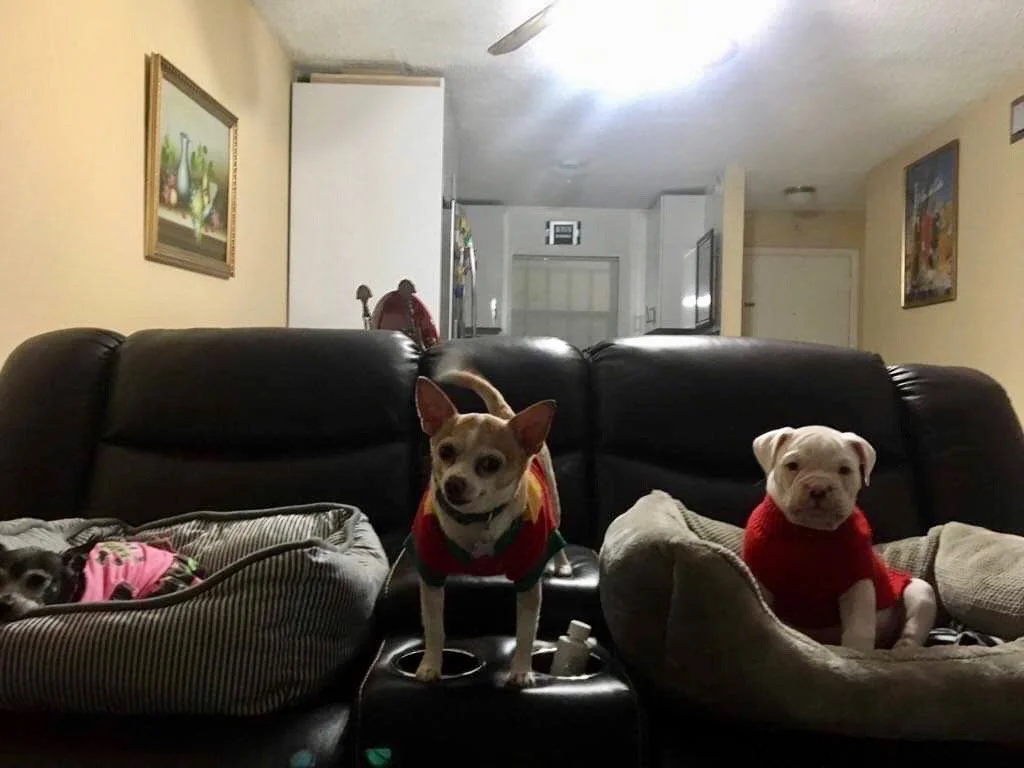
Puppies do not care that you just sat down.
When Tyson was young, taking him out every hour or two was part of the deal. If you are not going to take a puppy outside that often, you need a clearly taught indoor toilet area such as a puppy pad setup and the consistency to use it properly.
Veterinary behavior guidance from VCA recommends beginning house-training as soon as a puppy comes home. Puppies may need elimination breaks after sleeping, eating, drinking, and energetic play, as well as every one to two hours while awake.
That sounds excessive until you actually live with a puppy.
Then it sounds normal.
The practical lesson is supervision. Watch the puppy, learn the signs, and give him a chance to succeed before the accident happens. Punishment after the fact does not teach a puppy where he should have gone.
With Tyson, I also learned that a puppy's schedule controls yours for a while. That is part of bringing one home.
Play Had a Job Too
Tyson and I played a lot of tug-of-war.
I could keep him busy until he was worn out and ready for a nap, but looking back, the better lesson is not simply "wear the puppy out." It is to give a puppy appropriate physical play and mental work while also teaching him how to settle.
Structured play can reinforce attention, rules, and the idea that interacting with you is rewarding. For a growing puppy, the amount and intensity of exercise should still be appropriate for his age, health, and development.
Tyson did not need every minute of his day scheduled. But he did need outlets for that bulldog energy and curiosity. Food puzzles, searching with his nose, short training sessions, tug, and ordinary play gave him something productive to do.
American Veterinary Society of Animal Behavior. Puppy Socialization Position Statement. https://avsab.org/wp-content/uploads/2024/12/Puppy-Socialization-Position-Statement-FINAL.pdf
American Veterinary Society of Animal Behavior. Position Statements and Handouts. https://avsab.org/resources/position-statements/
The Ohio State University Veterinary Medical Center, Behavioral Medicine. Enrichment for Dogs. https://indoorpet.osu.edu/sites/default/files/imce/IndoorPet_EnrichmentForDogs.pdf
VCA Animal Hospitals. House Training for Puppies and Dogs. https://vcahospitals.com/macarthur/know-your-pet/house-training-your-puppy
What Tyson May Have Learned Before He Came Home

One thing I have always believed helped Tyson was that he spent enough time with his mother before coming to me.
There are behaviors I noticed later that made me wonder how much of his early life stayed with him.
One of them was cleanliness.
If Tyson had diarrhea or made a mess in the house, he would get visibly upset about it. Sometimes he would even try to lick the mess. I used to connect that behavior to what mother dogs do in the whelping box.
There is a real biological behavior underneath that observation: newborn puppies depend on maternal licking for stimulation to urinate and defecate, and mothers also groom and clean their puppies. Merck Veterinary Manual notes that maternal grooming helps puppies eat, eliminate, and remain in the nest during the neonatal period. VCA similarly explains that mother dogs lick newborn puppies to clean them and stimulate elimination.
What I cannot responsibly say is that Tyson's later reaction to a household accident was definitely caused by learning that behavior from his mother.
That part is my interpretation as the person who lived with him.
The broader lesson is stronger: time with a puppy's mother and littermates matters. Merck notes that experiences with the mother and littermates during roughly the first seven to eight weeks contribute to social-skill development, while socialization still needs to continue after a puppy goes home.
So when I think about Tyson keeping his space clean, I can say what I observed. I can also say that early maternal care matters. What I cannot do is turn one dog's behavior into proof of exactly what he learned and where he learned it.
That distinction matters to me more now than it did when Tyson was a puppy.
What Tyson's First Year Taught Me
If I could raise Tyson all over again, I would not try to make the first year perfect.
I would make it more intentional.
I would handle his paws every day before nail clipping ever became a fight.
I would start structured training earlier instead of waiting for adolescence to announce itself.
I would use his food, play, toys, walks, and everyday routines as opportunities to teach attention and self-control.
I would puppy-proof the house like I was living with a baby who could run, chew, swallow, climb, and make decisions faster than I could react.
I would expect house-training to take repetition instead of convenience.
And I would pay more attention to the small habits that seem unimportant when a dog is tiny but become very important when that dog is ninety pounds.
The funny thing is that Tyson still turned into the dog I needed.
Maybe not because I did everything right.
Maybe because we learned each other.
He learned my routines. I learned his signals. He learned what I expected. I learned when I had waited too long to teach something.
That is really what this story is about.
Tyson did not come into my life because I went looking for an Olde English Bulldogge. He came through a friend, with another name, after somebody else decided they no longer wanted him.
I thought I wanted a Boxer.
Then I saw Angel.
I renamed him Tyson.
And years later, I can trace an entire business, a publication, a body of work, and a huge part of my life back to that decision.
If you are bringing home a puppy now, the best advice I can give is not complicated:
Start earlier than you think you need to.
Touch the paws. Teach the recall. Reward the calm moments. Put the socks away. Use the food to teach. Give the puppy safe things to think about. Take him outside again even though you just sat down.
The puppy stage goes by fast.
The habits you build during it can stay with you for years.
Merck Veterinary Manual. Social Behavior of Dogs. https://www.merckvetmanual.com/behavior/behavior-of-dogs/social-behavior-of-dogs
VCA Animal Hospitals. Why Do Dogs Lick Humans? https://vcahospitals.com/resources/behavior-dog/why-do-dogs-lick-humans
VCA Animal Hospitals. Breeding for Dog Owners: Caring for Newborn Puppies. https://vcahospitals.com/know-your-pet/breeding-for-dog-owners-caring-for-newborn-puppies
Sources & Further Reading
The approved draft includes veterinary and behavior sources from Merck Veterinary Manual, VCA Animal Hospitals, the American Veterinary Society of Animal Behavior, and Ohio State University Veterinary Medical Center.
Keep Reading


About the Author
Stephen Gill is the founder of Inspired by Tyson and writes about canine health, training, behavior, and everyday life with dogs.