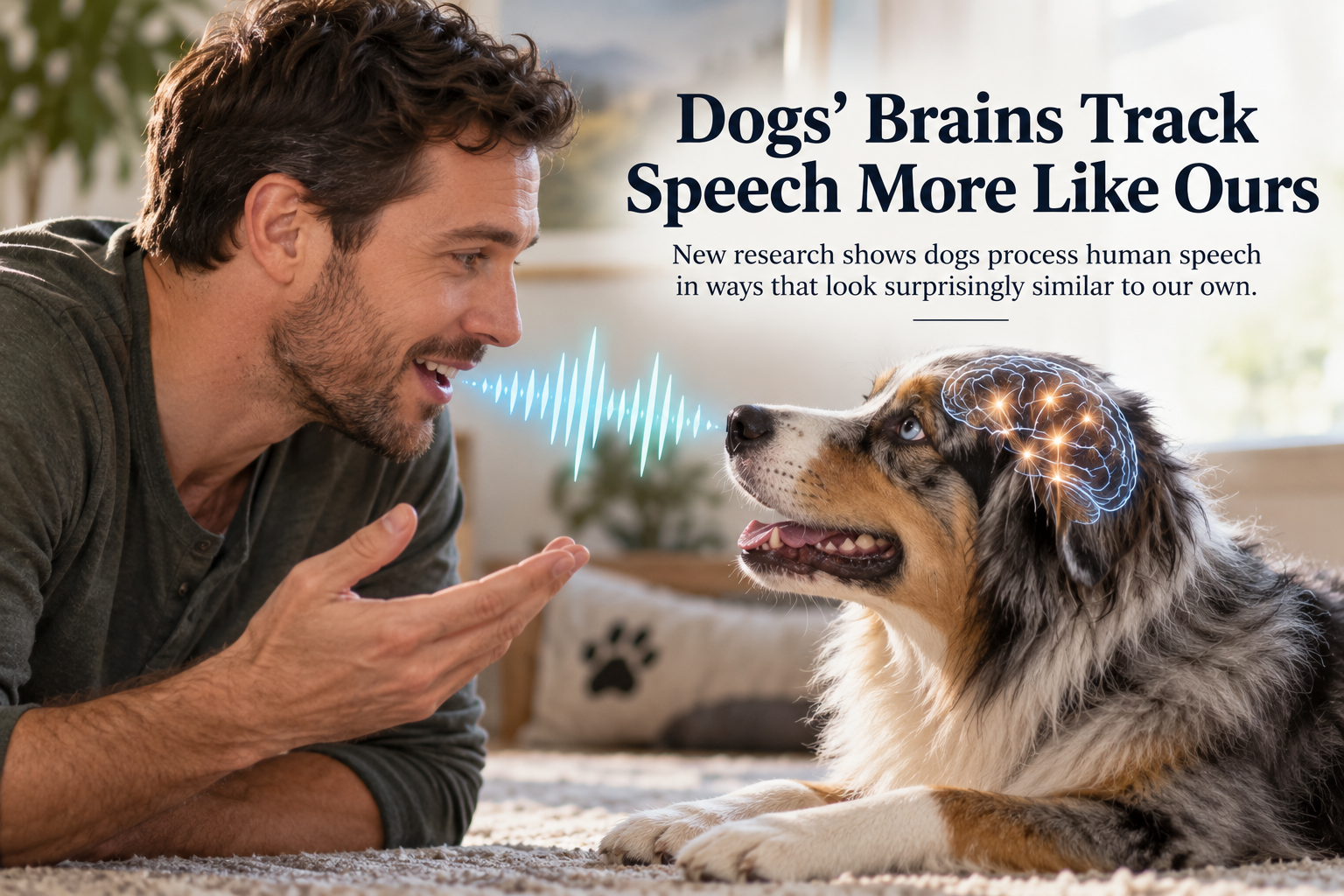

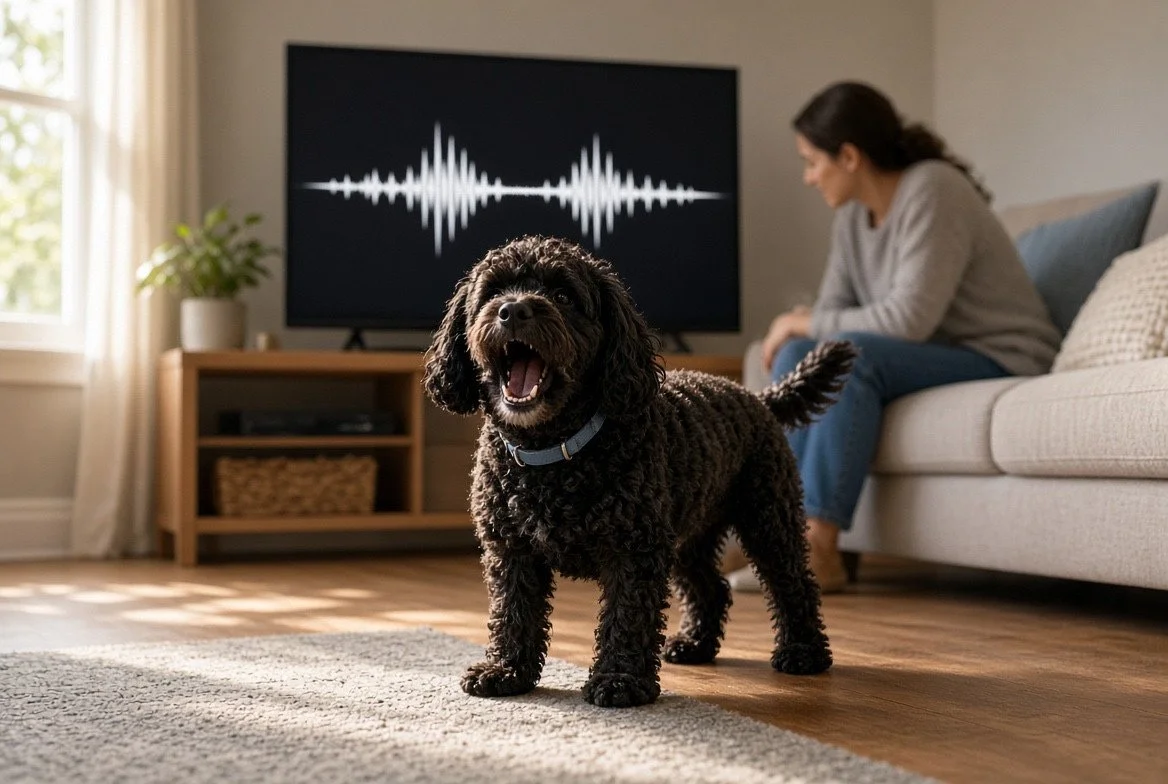
Picture holding up your phone while your dog barks at the window, and the screen says “I want to play.” It’s a fun moment. That caption alone doesn’t prove what your dog meant.
Here is where the evidence stands. AI can pick out patterns in dog sounds and sort some recordings into useful categories. The research reviewed for this article does not show a reliable system that turns an ordinary bark into an exact English sentence. A tidy caption on a screen tells you what the software produced, not what your dog meant.
That doesn’t make the science dull. In September 2026, Kaunas University of Technology researcher Rytis Maskeliūnas explained that patterns found by AI still need behavioral observation and controlled experiments before anyone can say what they communicate. Think of it as promising clues first, with the hard work of testing meaning still to come.
What researchers are actually measuring
Noticing that a bark happened is one task. Working out which dog made it is another, and identifying the situation it was recorded in is another again. An emotion classifier goes a step further and assigns labels people have defined, such as fear or excitement. It can only be as good as those labels.
Translation asks for much more. It would need evidence that the output reliably captures meaning, including for dogs and situations the system never saw while it was being built. A model that recognizes a recording made during a stranger’s visit hasn’t shown what the dog was trying to say. That’s our reading of the research, not a claim that dogs speak in human-style sentences.
What one widely discussed study found
A 2024 study, “Towards Dog Bark Decoding,” used recordings from 74 dogs in Mexico, most of them from three breeds. The researchers took a model originally trained on human speech and adapted it to several dog-sound classification tasks.
One test used four researcher-defined categories of sounds recorded around strangers: two kinds of barking, a squeal and a grunt. The model got 62.18% right. Simply picking the most common label every time would have scored 56.37%. So the result is a real improvement on a narrow test. It is not a measure of how much canine language the model understands.
For this test, the model was checked on dogs whose sounds it had not trained on. Even so, a small sample concentrated in a few breeds, plus a short list of labels, leaves open how it would do in other homes and everyday moments. The study never asked the model to translate barks into sentences.
Progress beyond the familiar headlines
Other researchers are hunting for possible building blocks of dog communication. A separate 2024 paper identified candidate sound sequences and looked at how they lined up with activities seen in videos. Human reviewers then judged whether the proposed meanings seemed plausible. That gives scientists hypotheses to test. It is not a dictionary you can point at an unfamiliar dog.
The tools are improving as well. The 2025 Dog2vec study started with more than 6,000 hours of source videos and ended up with roughly 150 hours of cleaned dog vocalizations. Its tests were about classification and detection. Keep those two numbers apart, the same way you’d keep sorting sounds apart from translating them.
Work like this can push the field forward without answering the question in our headline. A bigger pile of recordings, or a better score on a defined task, is a reason to look closely at the methods and the next experiments. Neither one validates a consumer translator on its own.
Questions to ask about an accuracy claim
When you see a percentage, start with what counted as correct. Was the system naming a breed, a recording situation, a human-assigned emotion or an actual meaning? Those scores measure very different things.
Next, ask how it was tested. Were completely different dogs and recording sessions used for testing? Did it hold up in new homes? How often did it mix up the categories, and could it say “I’m not sure”? Asking doesn’t assume every product fails these checks. It just tells you what the number is worth.
Before you pay for anything, look for independent evidence about the exact feature being sold, and read the subscription and cancellation terms. This article does not test or recommend a particular app, collar or paid service.
Keep watching the whole dog
The RSPCA explains that barking can come with excitement, frustration, fear and distress, among other things. If your dog starts barking more than usual, its guidance is to get a vet check so any underlying health problem can be looked into.
Look at posture, movement and what’s going on around your dog, too. The RSPCA cautions that a wagging tail doesn’t necessarily mean a dog is friendly. A cheerful caption on an app is never a reason to ignore discomfort or keep going with an interaction your dog is trying to leave.
Treat an app’s interpretation as tentative. Don’t frighten your dog or set off barking just to test a device. And if a change in behavior worries you, get appropriate professional help rather than trying to diagnose it from a recording.
Think about the microphone too
A recording can pick up people and private conversations along with the dog. Before you upload anything, check whether the processing happens on your phone or somewhere else, who receives the audio and how long they keep it. It’s also worth knowing whether recordings are used for training and how you delete them. These are sensible precautions, not claims about any particular company’s practices.
For now, AI is giving researchers new ways to study the sounds dogs make. You can stay curious and still ask for evidence that matches the promise. Understanding the dog in front of you takes what it always has: paying attention to the whole situation.