Dog Intestinal Blockage: Signs and What to Do
A swallowed sock, bone, toy, or piece of plastic can turn into a real emergency fast. Vomiting, loss of appetite, abdominal pain, lethargy, and changes in bowel movements are common warning signs of an obstruction, but some dogs show only mild symptoms at first.
Quick Answer
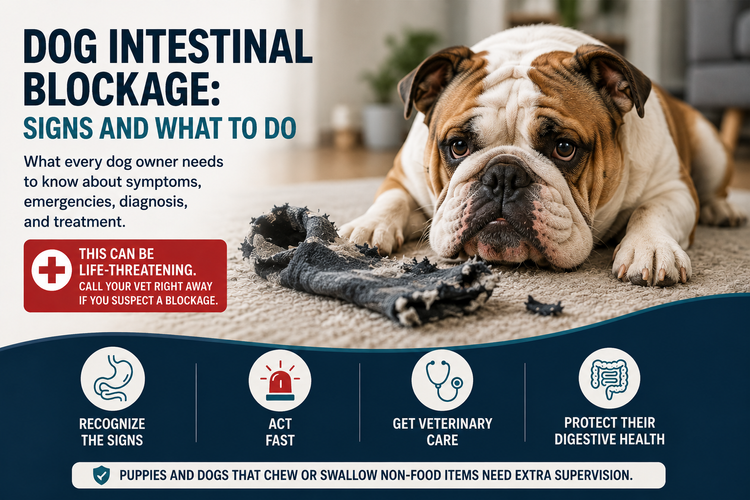
A dog intestinal blockage happens when something stops food, fluid, gas, or waste from moving normally through the stomach or intestines.
Common signs include vomiting, refusing food, abdominal pain, lethargy, dehydration, diarrhea, straining to defecate, or passing only small amounts of stool.
If you know or strongly suspect your dog swallowed something it shouldn't have, contact your veterinarian or an emergency animal hospital promptly — even if your dog still seems normal.
Don't try to push an object through with sauerkraut, bread, pumpkin, oil, laxatives, or a bigger meal. Don't induce vomiting unless a veterinarian or veterinary poison-control professional specifically tells you to.
When a Possible Blockage Is an Emergency
If your dog might have swallowed something that could get stuck, call the vet early rather than waiting around for a full checklist of symptoms to show up.
Get your dog seen if he:
- keeps vomiting or trying to vomit
- can't keep food or water down
- suddenly refuses to eat
- seems weak, unusually tired, or withdrawn
- has a painful, tense, or swollen belly
- cries, growls, flinches, or won't let you touch his abdomen
- keeps straining to defecate
- is only passing tiny amounts of stool
- has blood in vomit or stool
- swallowed string, ribbon, fishing line, fabric, plastic, a toy, corn cob, rock, or bone
- swallowed something sharp
- keeps getting worse after a known or suspected ingestion
Your dog doesn't need every item on that list to have an obstruction. Passing stool doesn't rule one out either.
Material already sitting lower in the colon can still come out even after a blockage has formed higher in the gastrointestinal tract.
What Is a Dog Intestinal Blockage?
An intestinal blockage — also called an intestinal obstruction or bowel obstruction — happens when material can't move normally through the gastrointestinal tract, either partially or completely.
Foreign objects are an important cause. Dogs explore with their mouths, and plenty of them end up swallowing things that were never meant to be food: socks, underwear, pieces of blankets or towels, toys, balls, rocks, sticks, bones, corn cobs, food wrappers, plastic, string, ribbon, fishing line, hair ties, carpet scraps, and garbage.
Some of that passes through without incident. Some of it doesn't.
An object can sit in the stomach, become stuck on the way into the intestine, or lodge farther down the tract.
A blockage can be partial, allowing some liquid or material to squeeze past, or complete. That difference helps explain why dog blockage symptoms can look so different from one dog to another.
A dog with a complete obstruction may become very sick very quickly. A dog with a partial obstruction might still eat a little, drink, or occasionally pass stool while the condition quietly worsens.
Linear Foreign Bodies Can Be Especially Dangerous
String, ribbon, thread, fabric strips, dental floss, and fishing line fall into a category called linear foreign bodies.
Instead of sitting in one spot, part of the material can become anchored while the intestine continues trying to pull the rest forward.
The intestine can bunch or fold along the material, and the foreign body itself may damage or even cut into intestinal tissue.
If string, fishing line, ribbon, or another long object is protruding from your dog's mouth or rear end, don't tug it free. Let a veterinarian evaluate it.
Signs of Intestinal Blockage in Dogs
There's no single symptom that confirms a bowel obstruction on its own. Vomiting is common, but plenty of other illnesses cause vomiting too. Loss of appetite happens for all kinds of reasons. Diarrhea can even occur despite the assumption that a blocked dog must be unable to defecate at all.
That's why a veterinary examination matters. Symptoms, recent behavior, physical examination, and diagnostic imaging together tell a much fuller story.
Vomiting
Vomiting is one of the most commonly reported signs of a gastrointestinal foreign-body obstruction. Some dogs vomit repeatedly. Others may bring up food, water, foam, or bile. Repeated vomiting also increases the risk of dehydration and electrolyte problems.
Loss of Appetite
A dog that normally races toward the food bowl but suddenly refuses a meal is worth paying attention to, especially after chewing or swallowing something questionable.
Abdominal Pain
Dogs can't simply tell us that their stomach hurts, so behavior matters. A dog may become restless, struggle to get comfortable, repeatedly change position, tense his belly, react when the abdomen is touched, or avoid normal activity.
Lethargy
A normally active dog becoming unusually quiet can be an important clue. As an obstruction progresses, dehydration, pain, electrolyte disturbances, inflammation, infection, or reduced blood flow to the intestine can make a dog progressively sicker.
Diarrhea
Diarrhea does not rule out an obstruction. Some dogs with gastrointestinal foreign bodies develop diarrhea, sometimes with blood.
Straining or Passing Small Amounts of Stool
Some dogs repeatedly attempt to defecate or produce only a small amount. But bowel movements alone cannot reliably tell you whether a blockage is present.
Dehydration
Repeated vomiting, reduced drinking, and gastrointestinal dysfunction can all contribute to dehydration.
How to Know if Your Dog Has a Blockage
You usually can't confirm this at home. That's worth saying plainly because people searching how to know if a dog has a blockage are often hoping there is one test they can perform themselves.
There isn't.
Sometimes you have a strong suspicion because you watched your dog swallow something. Other times nobody saw it happen, and a missing sock, damaged toy, shredded blanket, chewed plastic, or unexplained vomiting becomes the first clue.
Medical History
Your veterinarian may ask:
- When did the symptoms begin?
- Has your dog vomited?
- Is your dog eating and drinking?
- Has your dog had diarrhea?
- Is your dog passing stool?
- Could anything be missing from the house?
- Does your dog regularly swallow non-food objects?
- Was your dog chewing a toy, bone, fabric, plastic, or trash?
- Could your dog have eaten medication or a toxic substance?
If you know what was swallowed, tell the veterinary team exactly what it was and approximately when it happened. Bring the packaging if you still have it.
Physical Examination
A veterinarian will assess your dog's overall condition and may feel the abdomen for pain, tension, abnormal masses, or other changes.
X-Rays
Abdominal radiographs are commonly used when a veterinarian suspects a foreign body. Some objects appear clearly on X-rays. Others, including certain plastics and fabrics, may not.
Ultrasound
Abdominal ultrasound can provide additional information, especially when a foreign body is not obvious on routine X-rays.
Blood and Urine Tests
Bloodwork usually won't tell a veterinarian that a sock is stuck in the intestine. It can, however, show what the obstruction may already be doing to the dog.
What if the X-Ray Doesn't Show Anything?
A normal or unclear X-ray doesn't necessarily end the investigation. Some foreign objects do not show clearly on routine radiographs, and imaging findings can occasionally remain inconclusive even when clinical suspicion remains high.
Depending on the dog's condition, a veterinarian may recommend additional imaging, repeat examinations, monitoring, or surgery.
My Dog Ate Plastic. What Should I Do?
If you're dealing with a dog ate plastic situation, the risk depends heavily on what was swallowed. A tiny flexible scrap and a large rigid piece are not the same problem.
Plastic may:
- remain in the stomach
- become lodged in the intestine
- have sharp or irregular edges
- break into multiple pieces
- contain chemicals or residues
- cause choking before reaching the stomach
Call your veterinarian and describe what was swallowed, how large it was, whether it was hard or flexible, when it happened, your dog's size, and whether symptoms have started.
What if My Dog Swallowed a Bone?
A dog swallowed bone situation carries its own concerns. A bone can become lodged, cause an obstruction, splinter into sharp fragments, or injure gastrointestinal tissue.
Contact your veterinarian rather than attempting to force the bone through with additional food.
Should You Make a Dog Vomit After Swallowing Something?
Not automatically.
Inducing vomiting makes sense in some veterinary situations and can be dangerous in others. Sharp objects, large objects, corrosive substances, and certain other materials can cause more damage coming back through the esophagus.
Don't automatically reach for hydrogen peroxide, salt, mustard, oil, or another internet remedy. Whether vomiting should be induced depends on what your dog swallowed and your dog's condition.
Can Sauerkraut Help a Dog Pass a Foreign Object?
No.
There isn't good veterinary evidence behind using sauerkraut to push a foreign object through a dog's gastrointestinal tract. Similar internet advice sometimes recommends bread, pumpkin, asparagus, oils, or bulky meals.
A suspected intestinal obstruction is not something to experiment with at home.
Plain sauerkraut as food is a separate nutrition question. Our updated guide looks at sodium, ingredients, fermentation, and probiotic considerations before offering sauerkraut to your dog.
If the question is whether sauerkraut can fix an intestinal blockage, the answer is different: don't use it as an emergency treatment. Call your veterinarian.
Can Pumpkin Push an Object Through?
Pumpkin gets mentioned frequently for digestive problems because it contains fiber. That doesn't make it a treatment for a foreign-body obstruction.
The same applies to bread, rice, bulky meals, oils, fiber supplements, and laxatives.
Can an Intestinal Blockage Clear on Its Own?
Sometimes. Some swallowed objects do pass naturally. That doesn't mean every object should simply be given time to work its way out.
A veterinarian may choose careful monitoring when an object appears small and smooth enough to pass and the dog remains stable.
How Is a Dog Bowel Obstruction Treated?
Treatment depends on:
- what caused the obstruction
- where it is located
- how long it has been present
- whether it is partial or complete
- whether intestinal tissue remains healthy
- whether perforation has occurred
- the dog's overall condition
Endoscopy
If an object remains in the stomach or another accessible portion of the upper gastrointestinal tract, a veterinarian may sometimes remove it using an endoscope while the dog is under anesthesia.
Surgery
Many gastrointestinal foreign-body obstructions require surgery. A surgeon may open the stomach in a gastrotomy or open the intestine through an enterotomy.
If intestinal tissue is badly damaged, the affected section may need to be removed and the healthy ends reconnected.
Supportive Care
- intravenous fluids
- pain medication
- anti-nausea medication
- electrolyte correction
- antibiotics when indicated
- nutritional support
- hospitalization and monitoring
Why Waiting Can Make a Blockage More Dangerous
A blockage doesn't just prevent food from moving forward. Pressure can build inside the intestine. The trapped material and distended bowel can interfere with circulation.
Tissue that loses its blood supply can become damaged or die. If the intestinal wall perforates, gastrointestinal contents and bacteria can leak into the abdomen.
What Happens After Intestinal Blockage Surgery?
Recovery depends on how sick the dog was before surgery and how much damage occurred. Dogs may be monitored in the hospital while receiving IV fluids and pain control.
Veterinary teams watch appetite, vomiting, abdominal pain, hydration, temperature, bowel function, the incision, and signs of infection.
What Is the Prognosis for a Dog With an Intestinal Obstruction?
Many dogs recover well, especially when a gastrointestinal foreign body is recognized and treated promptly.
Outcome depends on factors including:
- how long the obstruction was present
- where it was located
- what caused it
- whether the intestine was damaged
- whether perforation occurred
- whether peritonitis or sepsis developed
- whether intestinal resection was necessary
- the dog's underlying health
Preventing Foreign-Body Obstructions
Put High-Risk Items Away
Keep laundry, children's toys, food wrappers, garbage, string, ribbon, hair accessories, and other swallowable objects where your dog can't reach them.
Choose Toys That Match Your Dog
A toy should be appropriately sized and durable enough for the way your dog actually plays. Inspect toys regularly and discard them when pieces begin coming loose.
Supervise Chewing
Chews and bones require supervision. Remove pieces once they become small enough to swallow.
Teach “Drop It” and “Leave It”
Training can't prevent every accident, but reliable cues give you a better chance of interrupting scavenging before an object disappears down your dog's throat.
Pay Attention to Dogs That Repeatedly Eat Non-Food Items
Persistent consumption of non-food material may be described as pica and can have behavioral or medical contributors. If it happens repeatedly, bring it up with your veterinarian.
Frequently Asked Questions
What are the first signs of intestinal blockage in dogs?
Common early signs include vomiting, reduced appetite, abdominal discomfort, lethargy, diarrhea, or changes in bowel movements.
How long can a dog survive with an intestinal blockage?
There is no safe universal waiting period. Suspected obstruction should be evaluated promptly.
Will a dog still poop if he has a blockage?
Possibly. A dog with a partial obstruction may still pass stool. Passing stool does not rule out an intestinal blockage.
Can a dog have a blockage without vomiting?
Yes. Vomiting is common but not universal.
Can a dog eat normally with an intestinal blockage?
Some dogs with partial obstructions may still show interest in food, especially early in the process.
Can a dog pass plastic?
Some small pieces may pass. Others can become lodged in the stomach or intestine.
What should I give my dog to help pass an object?
Don't automatically give oil, fiber, laxatives, pumpkin, bread, sauerkraut, or a bulky meal. Contact your veterinarian.
Should I induce vomiting if my dog just swallowed something?
Only if a veterinarian or veterinary poison-control professional specifically instructs you to.
What if my dog swallowed something but seems fine?
Lack of immediate symptoms does not guarantee the object is harmless. Contact your veterinarian for guidance.
How do veterinarians check for intestinal blockage?
Diagnosis may involve medical history, physical examination, abdominal X-rays, ultrasound, blood testing, and sometimes additional imaging or surgery.
Does every intestinal blockage require surgery?
No. Some objects can pass under veterinary monitoring and some stomach objects can be removed with endoscopy. Many true obstructions do require surgery.
The Bottom Line
Dogs swallow strange things. Sometimes the story ends with an embarrassing discovery in the backyard the next day. Sometimes it ends in an operating room.
Vomiting, appetite loss, abdominal pain, lethargy, dehydration, diarrhea, straining, and abnormal stool can all be symptoms of blockage in dogs, but no single symptom proves — or rules out — an obstruction.
If you saw your dog swallow something potentially dangerous or the symptoms make you suspect a bowel obstruction in dogs, call your veterinarian.
Sources & Further Reading
- Cornell University College of Veterinary Medicine — Gastrointestinal Foreign Body Obstruction in Dogs
- American College of Veterinary Surgeons — Gastrointestinal Foreign Bodies
- VCA Animal Hospitals — Ingestion of Foreign Bodies in Dogs
- Merck Veterinary Manual — Noninfectious Diseases of the Gastrointestinal Tract
- ASPCA — Is It Ever Safe to Induce Vomiting?
- VCA Animal Hospitals — Pica in Dogs
About Stephen Gill
Stephen Gill is the founder of Inspired by Tyson and editor of its dog-focused publications. His work focuses on practical dog ownership, canine news, health, safety, behavior, and issues affecting dogs and the people who care for them.
Learn more about Stephen Gill →