
CRISPR Beagles Spark a Stunning Allergy Breakthrough
Approximately 8–10 minute read
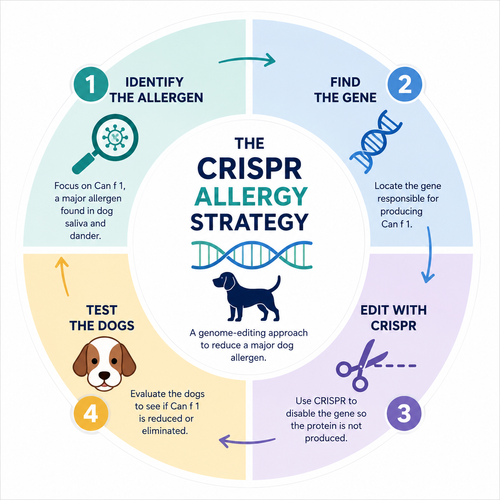
If you've ever loved dogs but couldn't live with one because your eyes water, your nose runs, or you can't breathe right around them, you know how much that limits your options. Scientists have now tried something different: instead of managing the problem, they went after its genetic source.
Two Beagles named Bailey and Alfie are at the center of an experiment involving CRISPR gene editing and one of the major proteins behind human dog allergies. Researchers targeted Can f 1, a major canine allergen associated with saliva and hair or dander, and the results have sparked headlines about the possibility of truly hypoallergenic dogs.
Not exactly. What they accomplished is still remarkable, but there's an important difference between eliminating one major allergen and eliminating every possible cause of a person's dog allergy.
Meet Bailey and Alfie
Bailey and Alfie aren't a new breed — they're Beagles. Researchers at biotechnology company Kindred Companion Sciences used CRISPR-Cas9 gene-editing technology to disrupt the Can f 1 gene.
The research was published in The CRISPR Journal on August 5, 2026. Scientists edited canine cells and then used a reproductive technique called somatic cell nuclear transfer to produce the dogs. Bailey and Alfie were born on September 22, 2024.
According to the published research, testing found no detectable Can f 1 protein in salivary and hair/dander samples from the gene-edited Beagles. The researchers also reported normal birth weights and no congenital abnormalities detected during their clinical evaluations.
That matters because the scientists weren't simply selecting dogs that naturally happened to produce less allergen. They targeted the biological source directly.
What Is Can f 1?
Something a lot of dog owners get wrong about allergies is that dog hair itself usually isn't the actual allergen.
People with dog allergies react to proteins produced by dogs. Those proteins can travel through saliva, dander and other biological material. They can then wind up on a dog's coat, furniture, clothing and other surfaces around the home.
Can f 1 is one of the most important canine allergens. It belongs to a family of proteins called lipocalins and accounts for a substantial portion of dog-specific allergic reactivity in sensitized people.
Instead of asking, "Can we breed a dog that sheds less?" researchers asked a much more ambitious question: What happens if the dog doesn't produce Can f 1?
CRISPR gave them a way to test that idea.
Why CRISPR Changes the Conversation
CRISPR-Cas9 is a gene-editing system that allows scientists to target specific genetic sequences and make controlled changes. The technology has transformed biological research and is being explored or used across medicine, agriculture and other fields.
Researchers didn't edit Bailey and Alfie for novelty coloring, smaller ears or an unusual appearance. They targeted a biological trait connected to a human health problem.
For years, families dealing with dog allergies have heard about so-called hypoallergenic breeds. Poodles, doodles and other low-shedding dogs are often marketed toward allergy sufferers.
But the science has never supported the idea that a particular breed is universally allergen-free.
A published study measuring Can f 1 in dog hair and homes found no evidence supporting the classification of certain breeds as hypoallergenic.
CRISPR Beagles represent a fundamentally different strategy. Rather than attempting to manage how an allergen spreads, researchers are trying to stop one major allergen from being produced at its biological source.
Are Bailey and Alfie Truly Hypoallergenic?
This is where the hype needs to slow down.
Bailey and Alfie lacked detectable Can f 1 protein in the testing reported by the researchers. But that does not automatically mean that every person with a dog allergy could live with them symptom-free.
That's because Can f 1 isn't the only canine allergen. Scientists have identified multiple dog allergen components, and different people can be sensitized to different proteins.
Can f 1 is the switch targeted in this experiment. Other canine allergens still exist, and individual immune responses differ.
Removing one major allergen could potentially make an important difference for someone whose allergy is heavily driven by Can f 1. Someone sensitized to a different canine allergen could have a very different experience with the same dogs.
That's why describing Bailey and Alfie as completely "allergy-free" goes beyond what the current evidence demonstrates.
One Experiment Has Everyone Talking
There's also a personal connection behind the research. Kindred Companion Sciences scientist and co-founder Matt Walker has dog allergies himself.
The published study included skin-prick testing in one sensitized human participant. The researchers reported allergic reactivity to extracts from control dogs but no detectable skin response to extracts from the gene-edited dogs.
That's compelling proof-of-concept evidence.
It is also important to recognize what it isn't: one sensitized participant isn't a large clinical trial.
Researchers will need considerably more evidence involving more dogs, longer follow-up and people with different allergy profiles before anyone can determine how broadly this approach might work.
- Researchers produced two gene-edited female Beagles.
- The targeted gene was associated with Can f 1.
- No detectable Can f 1 protein was found in reported testing.
- The researchers reported normal development to date.
- How people with different allergy profiles will respond.
- Whether unexpected health effects could appear later.
- How consistently the approach would work on a larger scale.
- Whether gene-edited dogs should eventually be sold as pets.
What About the Dogs?
This part shouldn't get lost underneath all the excitement. Bailey and Alfie aren't simply scientific achievements.
They're dogs.
Any technology involving animals needs to consider what the change means for the animal, not only what it might do for humans.
The research paper reports that the dogs have shown normal growth and no clinically apparent health or behavioral abnormalities to date. Researchers also performed genetic analyses looking for unintended CRISPR edits and reported no detected changes at the predicted off-target sites.
Those results are encouraging, but Bailey and Alfie are still young. Long-term observation will be important before anyone fully understands whether removing Can f 1 could have consequences that aren't obvious today.
Preventing or reducing a health-related problem is one thing. Changing a dog's appearance simply because someone wants a certain eye color, coat pattern or other designer characteristic is another.
The technology itself doesn't decide where that line belongs. People will have to.
Could This Change Dog Ownership?
Potentially.
Think about someone who's wanted a dog for years but can't comfortably spend time around one. Or a family in which one child desperately wants a dog while another family member has serious allergies.
There may eventually be broader possibilities involving working dogs and service dogs as well.
If researchers can demonstrate that allergen-targeted dogs safely reduce reactions for appropriately matched people, some individuals who previously couldn't comfortably live with dogs might gain that opportunity.
That's genuinely exciting.
The Bigger Question
This breakthrough raises something bigger than allergies: How much should humans genetically change the animals we live with?
Humans have already reshaped dogs dramatically through selective breeding. A Chihuahua and a Great Dane are members of the same species, yet generations of selective breeding produced enormous differences in size and appearance.
CRISPR could potentially make certain genetic changes much faster and more precisely than generations of conventional breeding.
That precision could eventually help scientists investigate inherited disease and other canine health problems.
It could also be misused.
The difference may ultimately come down to why the genetic change is being made in the first place.
Bailey and Alfie have pushed that conversation out of science fiction and into the present.
Don't Throw Away the Allergy Medicine Yet
For people currently dealing with dog allergies, nothing about Bailey and Alfie's story means conventional allergy precautions suddenly disappear.
There still isn't a conventional dog breed guaranteed to be completely hypoallergenic. Research comparing dogs marketed as hypoallergenic with other dogs found no evidence supporting the blanket classification of certain breeds as hypoallergenic.
If someone in your household has significant dog allergies, talk with a qualified healthcare professional or allergist rather than relying only on a breed label.
Bailey and Alfie don't change that reality.
At least not yet.
The Bottom Line
CRISPR Beagles Bailey and Alfie represent a stunning allergy breakthrough because researchers demonstrated a fundamentally different approach to the dog-allergy problem.
Rather than simply looking for dogs that shed less, scientists targeted Can f 1 at its genetic source.
That's the breakthrough.
The hype begins when that gets translated into "scientists created dogs nobody can be allergic to."
We don't know that.
Other canine allergens exist. Human allergies vary from person to person. Bailey and Alfie are only two dogs, and long-term evidence about health, safety and broader effectiveness is still needed.
But none of those limitations make the accomplishment small. Two Beagles are alive today after scientists deliberately edited the genetic source of one of the major dog allergens.
A few years ago, that sentence would have sounded like science fiction.
Today, their names are Bailey and Alfie, and they may be giving us an early glimpse of a very different future between dogs and the people who love them.
Sources & Further Reading
- Walker, M.W.G., et al. (2026). Targeted Genetic Knockout of Can f 1, the Major Allergen in Dogs . The CRISPR Journal. DOI: 10.1177/25731599261473124.
- Vredegoor, D.W., et al. (2012). Can f 1 levels in hair and homes of different dog breeds . Journal of Allergy and Clinical Immunology.
- Dramburg, S., et al. (2023). EAACI Molecular Allergology User's Guide 2.0 . Pediatric Allergy and Immunology.
- Hilger, C., et al. (2024). Hypoallergenic animals: A promise of hope for allergic patients?